History · Myth & Method
The Aryan Invasion Story — A Colonial Mythology
Why Indian archaeology, population genetics, and classical scholarship converge to dismantle the theory of a racial Aryan conquest — and what they establish instead.
Vedika Research · 22 min read · 17 primary sources cited · May 2026
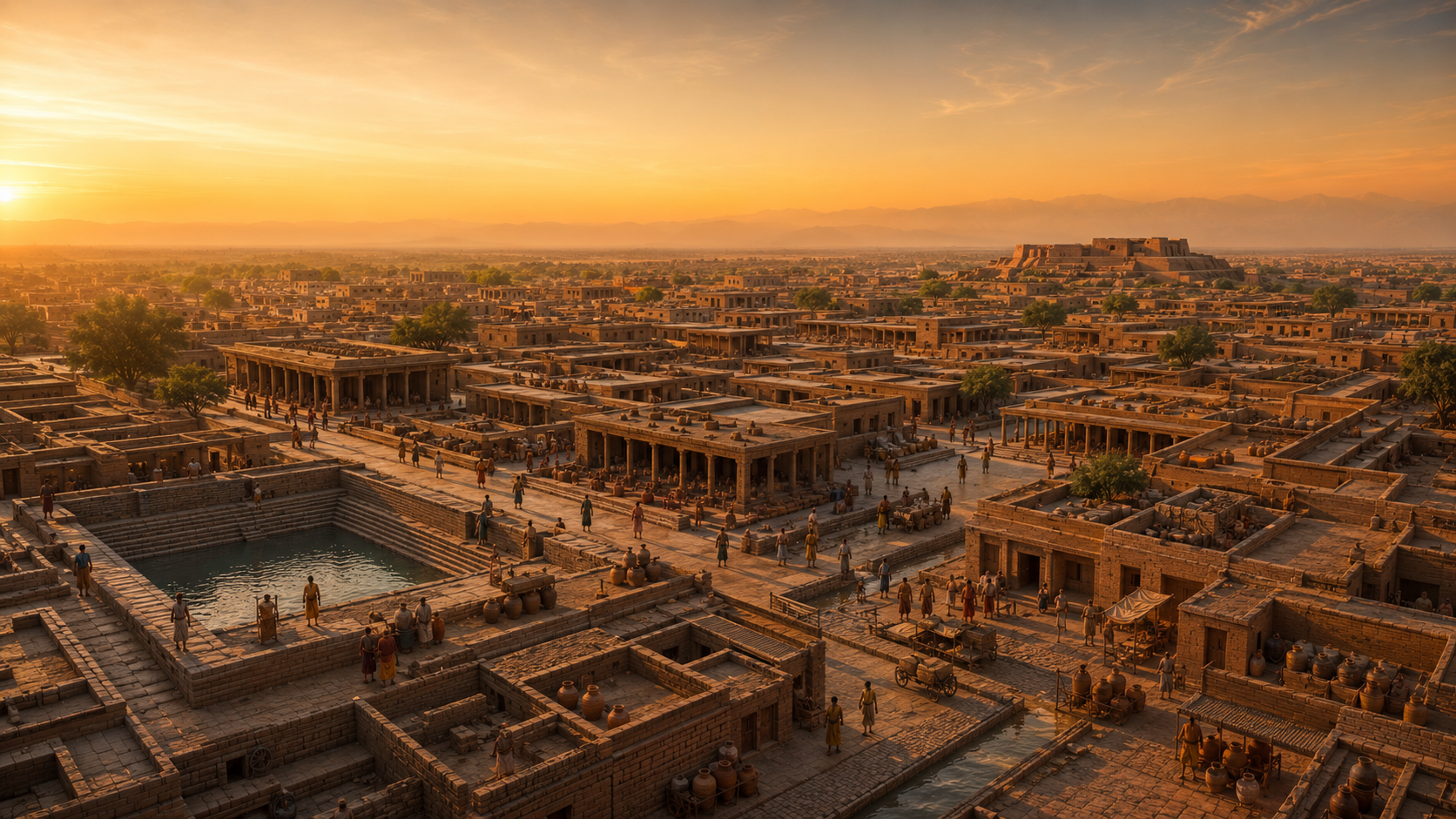
The core thesis. The claim that a superior “Aryan race” invaded India from the outside, conquered an indigenous “Dravidian race,” and implanted Vedic civilisation is not a finding of science. It is a construction of nineteenth-century European racial ideology — shaped by colonialism, disciplined by modern Indian scholarship, and progressively contradicted by archaeology, population genetics, and a close reading of the primary texts themselves. This essay presents that case using Indian and Indian-authored sources as its primary foundation.
Where the idea came from — the colonial manufacture of “Aryan”
The Aryan Invasion Theory (AIT) was not discovered by scientists examining Indian soil. It was assembled in European libraries between roughly 1780 and 1900, by scholars who were simultaneously celebrating European racial superiority and working for or within colonial administrations. Understanding this origin is the first and most important step in evaluating the theory — because the origin is not incidental to the claim; it is the claim’s deepest structural problem.
The linguistic seed
William Jones’s famous 1786 observation — that Sanskrit, Greek, Latin, Persian, and Gothic share structural similarities — was a genuine philological insight. It established what would become the Indo-European language family. But philology does not by itself establish racial descent, migratory conquest, or civilisational hierarchy. The conceptual leap from “related languages” to “a conquering master race” was made later, and was driven by forces external to linguistics.
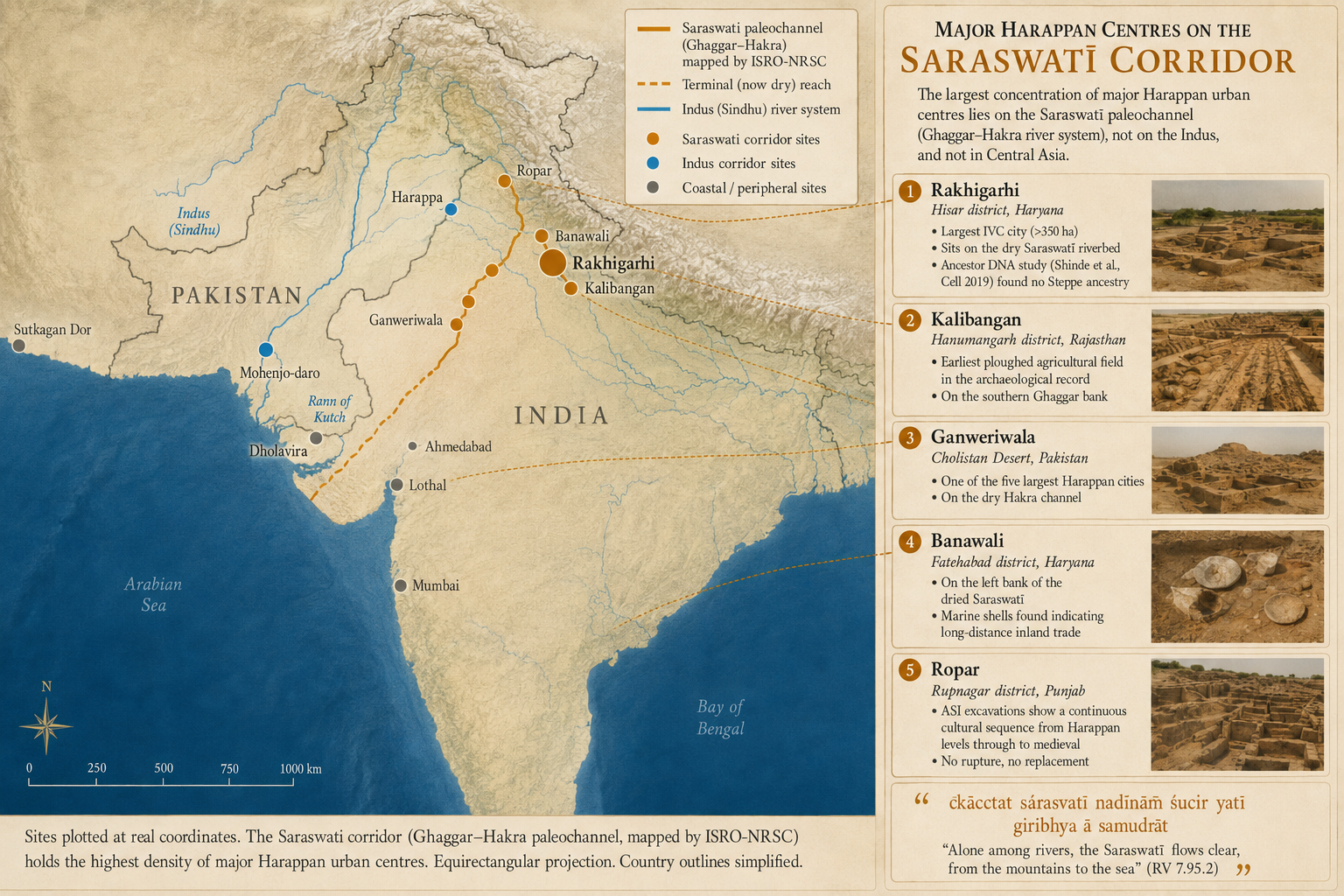
The key figure in racialising the linguistic observation was Friedrich Max Müller, a German Orientalist working in Oxford. Müller popularised the term “Aryan” as both a linguistic and racial category, arguing that the “Aryan race” was the progenitor of European civilisation — and that it had originally come from the Punjab. What makes this especially significant is that Müller himself later attempted to retract the racial meaning, writing explicitly in 1888 that “‘Aryan’ has no anthropological meaning.” Indian educational literature documenting the history of the theory notes this retraction — but the racial usage had already entered colonial administrative discourse and could not be recalled.
The theory of an Aryan race was just an assumption and it was not proved. So long as this assumption is not demonstrated, the Aryan theory must be treated as a theory and not as proven fact.
— B.R. Ambedkar, Who Were the Shudras? (Ambedkar Foundation edition)
The administrative racialisation
In India, the racial interpretation found its most systematic expression in the work of Herbert Risley, the British census commissioner who classified the entire Indian population into racial types — “Indo-Aryan,” “Dravidian,” “Aryo-Dravidian,” “Mongoloid,” and others — using head measurements and nose indices. Risley’s racial typologies were incorporated into the 1901 Census of India and shaped official British policy on caste, community, and governance. Indian anthropological scholarship reviewing colonial typologies has since highlighted the major conceptual drawbacks of Risley’s system: that it imposed European racial categories onto a population whose actual genetic and cultural structure was far more complex; that the measurements themselves were inconsistent; and that the categories served administrative convenience as much as any scientific programme.
The political function of the theory was not subtle. By positing that the highest-status groups in Indian society were “Aryans” who had come from outside — and by creating a permanent racial distinction between “Aryan north” and “Dravidian south” — the colonial framework achieved several things simultaneously: it denied the indigenous character of high Indian civilisation; it fractured Indian unity along racial lines; and it provided a narrative in which European administrators could style themselves as a second wave of Aryan civilisers, completing what the first had begun. Indian scholarship on colonial historiography has documented this function explicitly.
Ambedkar’s demolition
B.R. Ambedkar — among the most rigorous analytical minds India produced in the twentieth century — subjected the Aryan theory to a lengthy examination in Who Were the Shudras? (1946), a text now available in government-hosted editions through the Ambedkar Foundation. His conclusion was systematic and devastating: the theory rested on “an assumption and not on proof.” He pointed out that the equation “Indo-European language speaker = member of Aryan race” was never demonstrated; that no invasion was recorded in any Indian text; that Vedic literature describes the subcontinent as a known homeland, not as a conquered territory; and — most strikingly — that the very Vedic texts that the theory claimed to interpret contained verses showing that the distinction between Arya and Dāsa was not racial, because individuals could change from one category to the other. A biological race cannot be changed; a designation based on conduct or culture can.
Indian government-hosted source. The Ambedkar Foundation (Ministry of External Affairs) digital edition of Who Were the Shudras? is the most rigorously analytical Indian-authored critique of the racial Aryan theory.
What it establishes. No Sanskrit text records an invasion. No genetic proof existed when the theory was built. The racial reading of Arya/Dāsa is contradicted by Ṛgvedic verses in which status was not fixed.
What archaeology actually shows — the Sindhu-Saraswatī continuum
If an Aryan invasion had taken place of the kind described — a military conquest from outside that destroyed or replaced the Harappan civilisation — we would expect to find in the archaeological record a sharp discontinuity: a layer of burning, destruction, or foreign material culture suddenly superimposed on Harappan levels, followed by a completely new cultural tradition. Decades of excavation by the Archaeological Survey of India (ASI) and affiliated institutions have produced no such evidence. What they have produced is substantially more interesting.
Overlap, not rupture: three key sites
The ASI’s own excavation reports document transformation and continuity where the theory demands destruction and replacement. Three sites are particularly decisive.
Hulas (Uttar Pradesh). ASI records from Hulas document an overlap between Late Harappan ceramic levels and the Ochre Coloured Pottery (OCP) and early Painted Grey Ware (PGW) levels that follow. This overlap — a simultaneous presence of “Harappan” and “post-Harappan” material — is inconsistent with a scenario of violent external replacement, and consistent with a scenario of gradual cultural transformation by a continuing population.
Bhagwanpura (Haryana). Excavations at Bhagwanpura — conducted in the heartland of what Rigvedic geography describes as the Saraswatī region — revealed what the ASI described as an “interlocking” of Late Harappan and Painted Grey Ware levels. The Painted Grey Ware horizon is conventionally associated with the early Vedic period. Its presence in an interlocking stratigraphy with Late Harappan material at a site in the Saraswatī corridor is a profound datum: it places Harappan and Vedic culture in the same physical space, at the same time, with no invasion layer between them.
Ropar (Punjab). Excavations at Ropar documented a cultural sequence extending continuously from Harappan levels through to medieval levels — a span of roughly four thousand years. This is not the stratigraphy of a civilisation destroyed by invasion. It is the stratigraphy of a civilisation that continued.
The Harappan heritage is a cultural continuum and not a cultural hiatus.
— Abstract, Man and Environment (Indian journal of archaeology and anthropology)
The Saraswatī river — from text to satellite
One of the foundational objections to treating the Ṛgveda as an indigenous Indian composition was the claim that its most celebrated river — the Saraswatī, described as a mighty “mother of rivers” flowing from the mountains to the sea — did not correspond to any known Indian river and therefore proved that the Vedic poets were remembering a river from somewhere else (variously proposed as the Helmand in Afghanistan or a Central Asian river). This argument has now been substantially contradicted by Indian geoscientific research.
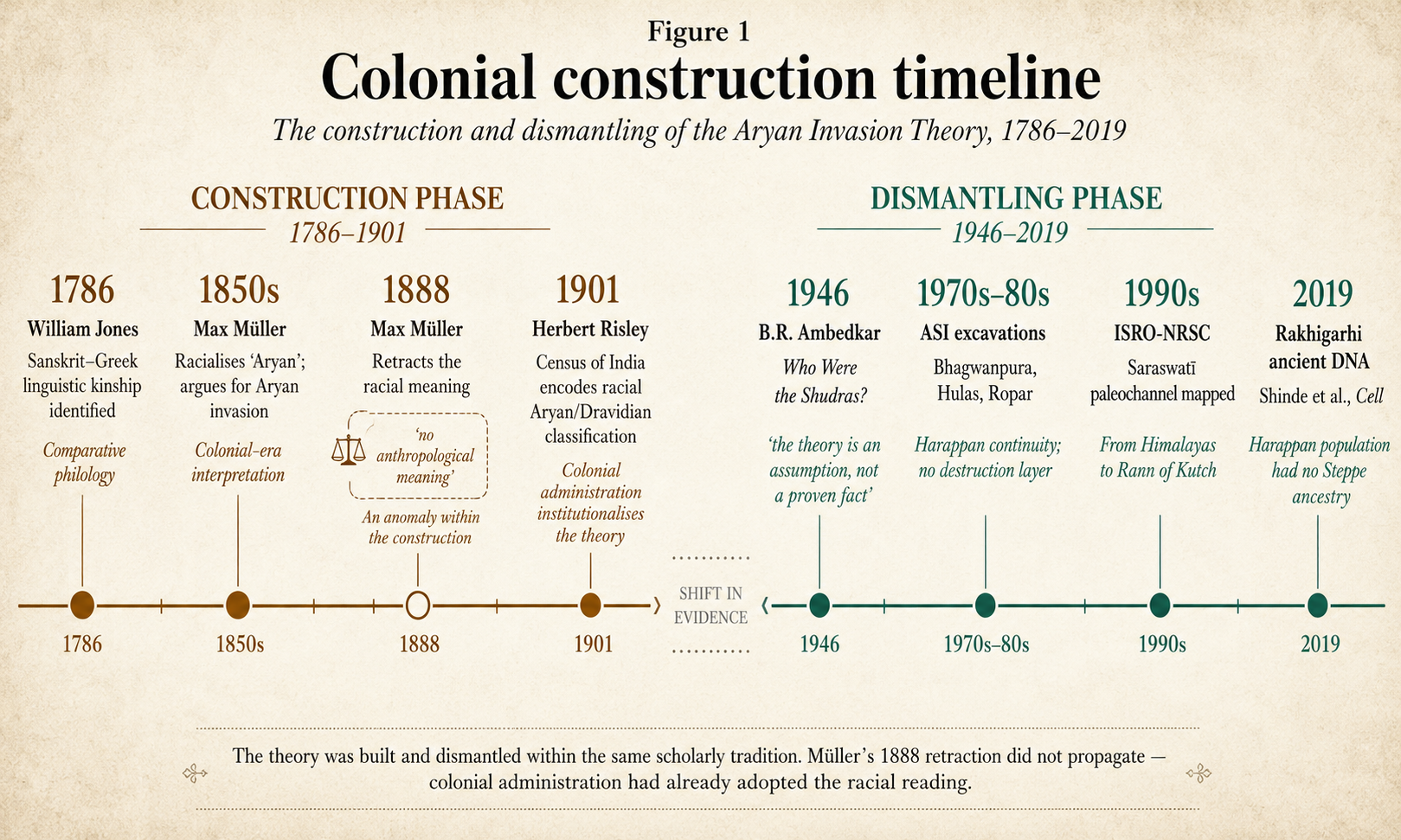
ISRO’s National Remote Sensing Centre (NRSC) produced an integrated paleochannel map tracing what they identified as the Saraswatī paleochannel from its Himalayan source through the Ghaggar-Hakra system toward the Rann of Kutch. Independent Indian-led geoscience work, including studies published in leading Indian science journals, found evidence for a perennial river system flowing through the Harappan heartland along the Ghaggar system during the period corresponding broadly to the Mature Harappan phase. The significance of this for the AIT debate is direct: the largest concentration of Harappan sites in the entire subcontinent is located along this Ghaggar-Hakra-Saraswatī corridor. The Vedic poets were not remembering a foreign river. They were describing a river that ran through the heartland of their own civilisation.
What this establishes — and what it does not
The archaeological evidence establishes civilisational continuity strongly and non-invasive transformation plausibly. It does not prove that every single feature of later Vedic tradition was already fully present in the Mature Harappan phase — the question of which Harappan cultural elements connect specifically to which Vedic elements remains a live research question. But that is a very different question from the one the AIT poses. The AIT’s central claim — that the Harappan civilisation was destroyed by foreign invaders — is flatly contradicted by the excavation record.
What the genetics shows — unity, not two races
The Aryan Invasion Theory, in its most tenacious modern form, rests on an implicit genetic claim: that there are two distinct biological populations in India — an “Aryan” north and a “Dravidian” south — whose difference reflects an ancient conquest. Genetic research on Indian populations, particularly Indian-authored and Indian-institution-led research, has comprehensively dismantled that claim while revealing a more complex and more interesting picture.
Shared ancestry across the subcontinent
Work on mitochondrial DNA (which traces maternal lineages) by Indian genetic researchers described what they called a “fundamental genomic unity of ethnic India.” Studies examining the genetic diversity of populations across the subcontinent — spanning both Indo-Aryan and Dravidian language families, covering north, south, east, and west — found that the degree of genetic divergence between Indian populations was relatively low given the scale of geographic and linguistic diversity. This is exactly the opposite of what the racial two-population model would predict.
Research by Analabha Basu and colleagues at the Indian Statistical Institute characterised India as a “genetic melting pot” — a description that emphasises shared ancestry and long-term mixture rather than two pure founding races. The NIBMG-linked work identifying five ancestral components in Indian populations found a complex, layered structure with no simple Aryan-Dravidian binary. Five components, not two, and those five components are mixed in varying proportions across virtually all Indian populations.
Limited external input — not conquest
The Y-chromosome study by Sengupta and colleagues — among the most important Indian-led population genetic analyses of South Asian ancestry — examined both indigenous and exogenous lineage expansions and explicitly concluded that Central Asian influence on the pre-existing South Asian gene pool was minor. This is a finding with direct bearing on the AIT: if a large-scale military invasion had brought a new ruling population, we would expect to see major, broad-based genetic replacement. The data show nothing of the kind.
Work by Thangaraj and colleagues demonstrated that deep-rooting maternal DNA lineages in India — particularly macrohaplogroup M — have their origin in situ, meaning that the deepest female ancestral lines of Indian populations arose within the subcontinent. Indian-led research on western India (Gujarat) found that maternal ancestry there was largely indigenous, with little evidence for major maternal replacement over the last five millennia. Women’s lineages, in other words, are overwhelmingly Indian in origin — and no conquest theory can explain the absence of mass genetic replacement in the maternal line.
The Rakhigarhi genome
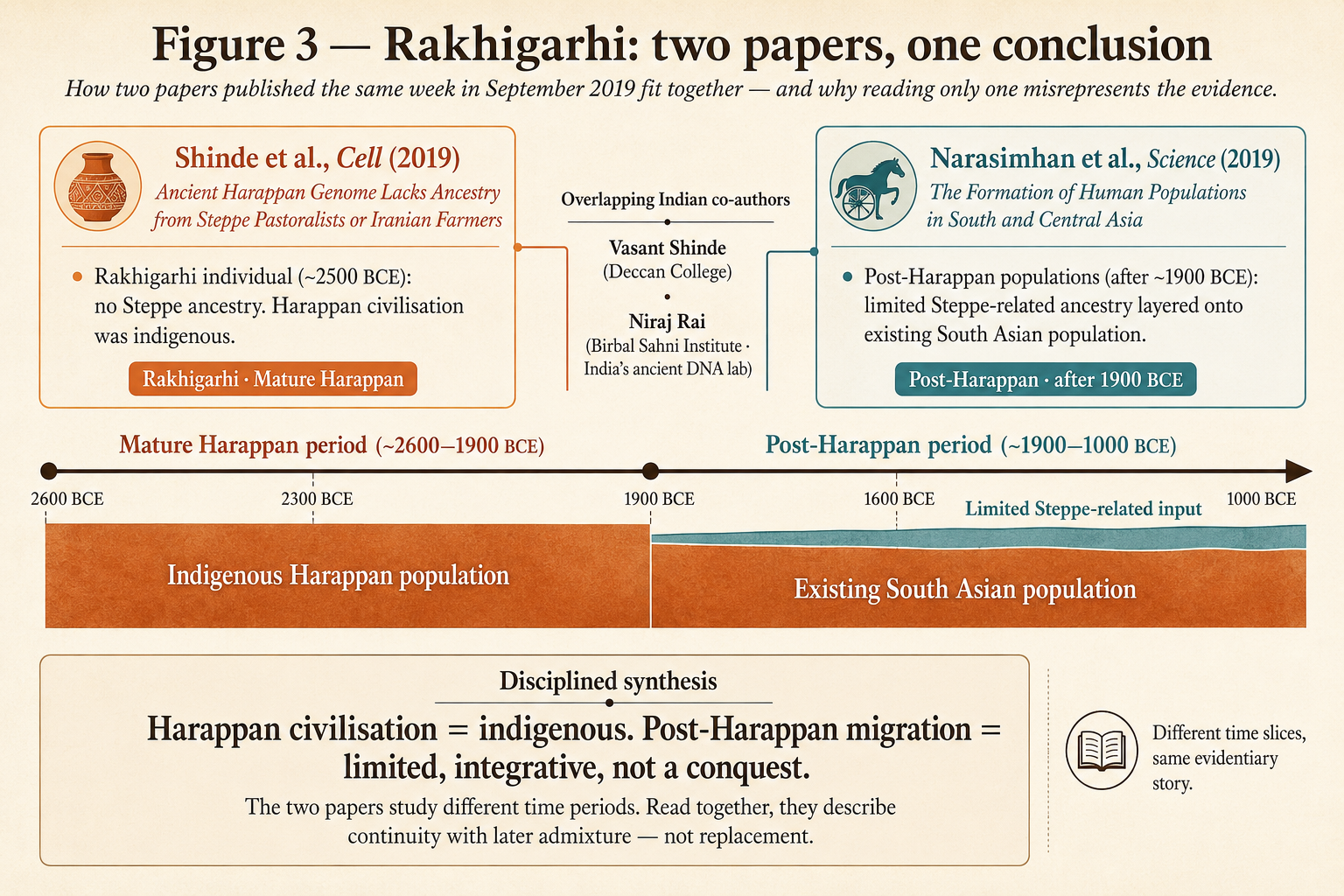
Perhaps the single most consequential recent data point from Indian soil was the publication of an ancient DNA genome from the Rakhigarhi burial site — one of the largest Harappan cities, located in Haryana. The genome, produced by an Indian-led team including researchers from the Deccan College Research Institute and international collaborators, showed an absence of Steppe pastoralist ancestry. The individual buried at Rakhigarhi roughly 4,500 years ago — a person from the heart of the Harappan civilisation at its peak — does not show the genetic signature that the Aryan invasion model requires.
The study of Indian populations reveals a fundamental genomic unity of ethnic India, with populations across the subcontinent sharing deep and overlapping ancestral lineages shaped by long residence and endogamy rather than racial conquest.
— Synthesis from Indian mitochondrial DNA and Y-chromosome literature (CCMB, Indian Statistical Institute, NIBMG)
What the genetics does and does not say
A fair reading of Indian genetic research supports the following: there is no genetic evidence for two pure races corresponding to “Aryan” and “Dravidian”; modern Indians draw deeply from long-resident South Asian ancestry including ancestry related to Harappan populations; external gene flow did occur, but Indian-authored studies characterise it as limited, layered, and integrated — not as a demographic conquest. The differences that do exist between north and south Indian populations reflect millennia of endogamy, local environmental selection, and regional differentiation — not a founding racial event. This is unity with structure, not racial bifurcation.
Evidence strength — genetic claims
Strong. There is no “Aryan race” and “Dravidian race” as distinct biological populations in India. Indian genetic studies find no such binary.
Strong. Deep Indian ancestry predominates across the subcontinent, including ancestry related to Harappan populations. The Rakhigarhi genome shows no Steppe ancestry.
Strong. External genetic input was minor and integrative — Sengupta et al.’s Y-chromosome study found Central Asian influence on the South Asian gene pool was limited.
Moderate. Regional differences exist but reflect endogamy and local differentiation, not racial founding events. Five ancestral components, not two, structure Indian genetic diversity.
Avoid: "North and south Indians are genetically identical." This overstates the case. Indian genomics shows unity and shared ancestry within a complex structure, not homogeneity.
What the texts say — Arya as a quality, not a race
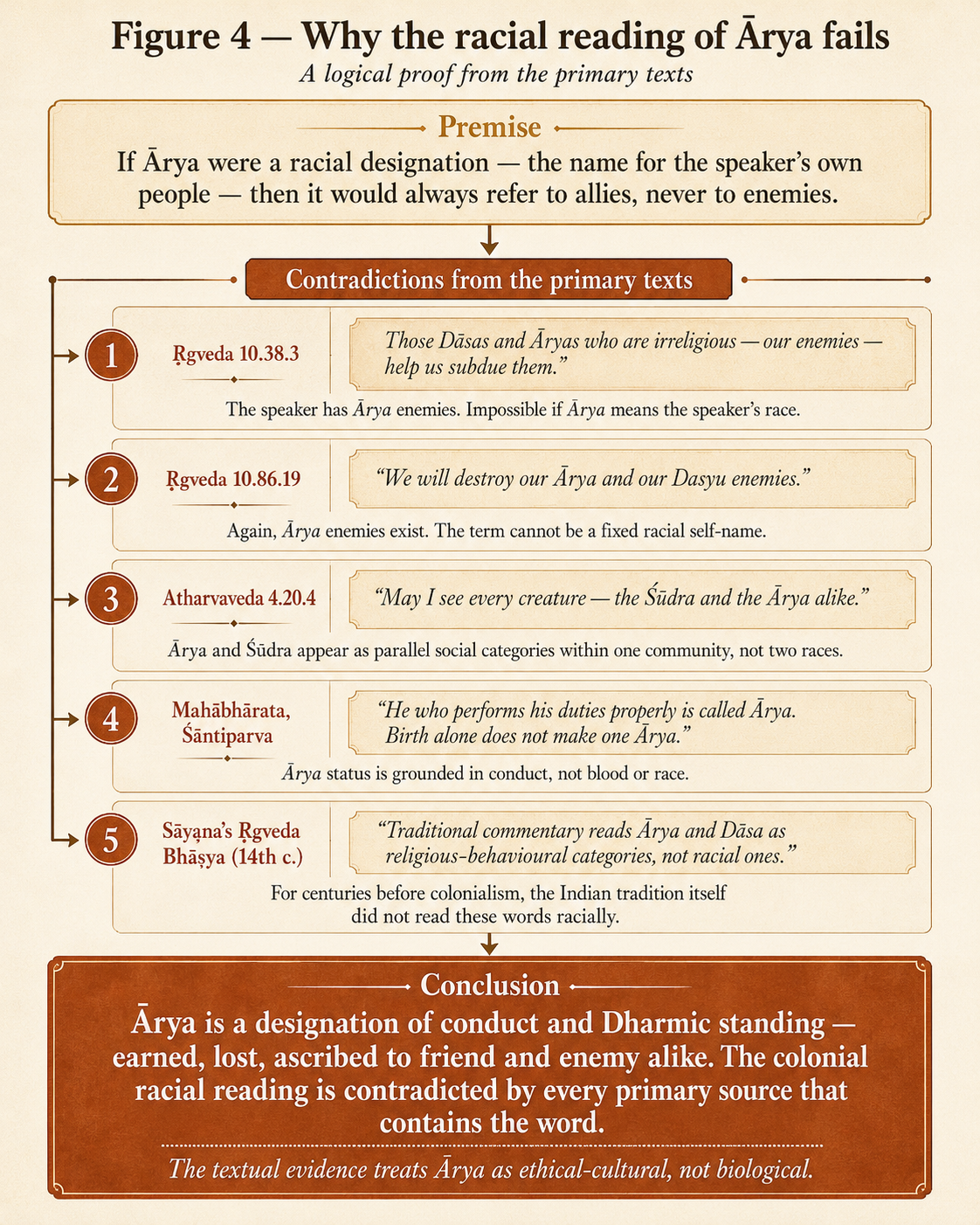
The Aryan Invasion Theory ultimately depends on a particular reading of the Ṛgveda and related Sanskrit texts — specifically, a reading in which the word ārya denotes a racial group, and in which the conflict between Āryas and Dāsas or Dasyus records an ethnic military conquest. Both elements of this reading are contradicted by the internal evidence of the texts themselves.
Ārya as a quality
In classical Sanskrit usage — and traceable through the oldest layers of the Ṛgveda — ārya means “noble,” “worthy,” “of good conduct.” It is a quality of character, not a designation of birth, race, or language. The Mahābhārata (Śāntiparva) states directly that Ārya status is not determined by birth: “Ārya is that person who performs his duties, not one who is merely born into a particular lineage.” This usage — in which a person becomes Ārya through conduct — is incompatible with a racial interpretation. If Ārya were a racial category, it could not be earned or lost.
Ambedkar, in his close reading of Ṛgvedic passages, pointed specifically to verses in which a Dāsa could become Ārya and vice versa — passages that make no sense if these terms denote biologically fixed races. His conclusion was that the opposition was cultural, ritual, or social in character, not racial. The same observation is supported by the traditional commentatorial tradition: Sāyaṇa and other traditional commentators on the relevant passages treat Ārya in terms of quality and disposition, not racial origin. The Atharvaveda (4.20.4) further treats Ārya and Śūdra as parallel social categories within a single community — not as racial opposites.
The subcontinent as home — not conquest territory
The Ṛgveda describes its geographical world in extraordinary detail — the Sapta Sindhava (seven rivers) of northwestern India, the great Saraswatī, the mountains to the north. It has no memory of a homeland elsewhere. There is no river in Afghanistan, no steppe in Central Asia, no memory of a migration that any honest reading of the text requires us to locate. The Avesta — the Iranian text closest linguistically to the Ṛgveda — does preserve a memory of movement, referring to Airyanem Vaējo as an ancient homeland from which Iranian peoples moved south. The Ṛgveda has no equivalent passage. The Indian text already speaks from within its home.
Ārya is not a racial designation in the Vedic literature. It is an epithet of honour, signifying nobility of character and observance of Dharma. The same person could be called Dāsa in one context and Ārya in another.
— Traditional interpretation, synthesised from Śāntiparva (Mahābhārata) and classical commentary
The land as Āryāvarta
The classical Sanskrit texts do not describe India as a conquered territory — they describe it as the birthplace and natural home of the Ārya way of life. The term Āryāvarta — “the abode of the Āryas” — appears in Dharmaśāstra literature as the designation for the sacred land of the subcontinent. The Manu Smṛti (2.22) defines Āryāvarta as the region between the Himālayas and the Vindhyas, from the eastern to the western sea. This is not the geography of a people who arrived from outside; this is the geography of a people who have named their entire homeland after themselves.
The Purāṇas — particularly the Viṣṇu Purāṇa (II.3) and the Bhāgavata Purāṇa (V.16) — describe India as Bhārata, the land of Bharata, named after the ancient king. They describe its rivers, mountains, and peoples in loving geographical detail. They place the origin of cosmic time, the origin of the human race, and the origin of sacred knowledge all within the subcontinent. These are not the texts of an immigrant population uncertain about their homeland. They are texts of a civilisation rooted for millennia in the land it describes.
Language and civilisational reach — the Vedic inheritance of the world
One of the most consequential insights that emerges from a reframing of the AIT is the recognition that the influence of Vedic-Indian civilisation on the world’s languages, philosophies, and religious traditions is far greater than colonial historiography — which positioned India as the recipient of outside influence — acknowledged. This section traces that influence carefully, distinguishing what is strongly evidenced from what is plausible conjecture.
Sanskrit and the Indo-European family — a revised reading
The fact of the Indo-European language family is not in dispute. Sanskrit, Greek, Latin, Avestan, Old Persian, Germanic, Celtic, Slavic, and Baltic languages share a common ancestral proto-language. The AIT used this family relationship to argue for an external origin of Sanskrit. But the family relationship is symmetric — it does not specify which branch is “closest to the origin.” Contemporary linguistic analysis has noted that Sanskrit preserves features of the proto-language in extraordinary archaic detail — more so than most other branches. Sanskrit’s retention of the dual number, the eight-case system, the complex verbal system of primary and secondary suffixes, and the Vedic accent system all suggest a highly conservative branch, one that remained close to the original form while other branches diverged.
Pāṇini’s Aṣṭādhyāyī — composed no later than the 4th century BCE, and possibly earlier — is the most precise grammatical analysis of any ancient language, so sophisticated that it anticipates features of twentieth-century generative grammar. The existence of such a work is only possible in a civilisation that had been engaged in rigorous formal analysis of language for centuries before Pāṇini. No comparable grammatical tradition exists for any hypothesised “homeland” of Proto-Indo-European speakers.
Pagan traditions as branched expressions of a common inheritance
The traditional religions of pre-Christian Europe — Norse, Celtic, Greek, Roman, Zoroastrian — share with Vedic Sanātana Dharma a cluster of structural features so deep that they cannot be coincidental: fire worship and the sacred fire altar; a cosmological triad of divine functions (sovereignty, force, fertility); the concept of a cosmic order or law (Ṛta in Sanskrit, Asha in Avestan, Ōrlog in Norse); annual ritual cycles tied to solar and lunar calendars; a pantheon structured around sky-father, thunder-god, and earth-mother archetypes; and a tradition of priestly specialists responsible for the preservation of sacred language. These shared features are most parsimoniously explained as divergent expressions of a common Indo-European sacred tradition whose most archaic and fully preserved form survives in Vedic Sanātana Dharma.
This is an important distinction from the stronger — and less defensible — claim that “all world religion comes from India.” The defensible claim is that the Indo-European sacred traditions, from the Vedas to Norse Eddas to Greek theology, share deep structural and linguistic ancestry, and that the Vedic tradition is their most ancient and complete surviving form. The pagan traditions of Europe are not copies of Hinduism; they are, in the language of philology, cognates — expressions of a shared inheritance in which the Vedic branch is the most archaic and least altered.
Sanskrit preserves features of Proto-Indo-European in an extraordinary degree of archaic faithfulness — the dual number, the eight cases, the accent system, the complex verbal morphology. No other branch of the family has preserved these together. The Vedic hymns may be the oldest surviving literature in any Indo-European language.
— Synthesis from comparative Indo-European linguistic scholarship
Where was Proto-Indo-European spoken? The Out-of-India hypothesis
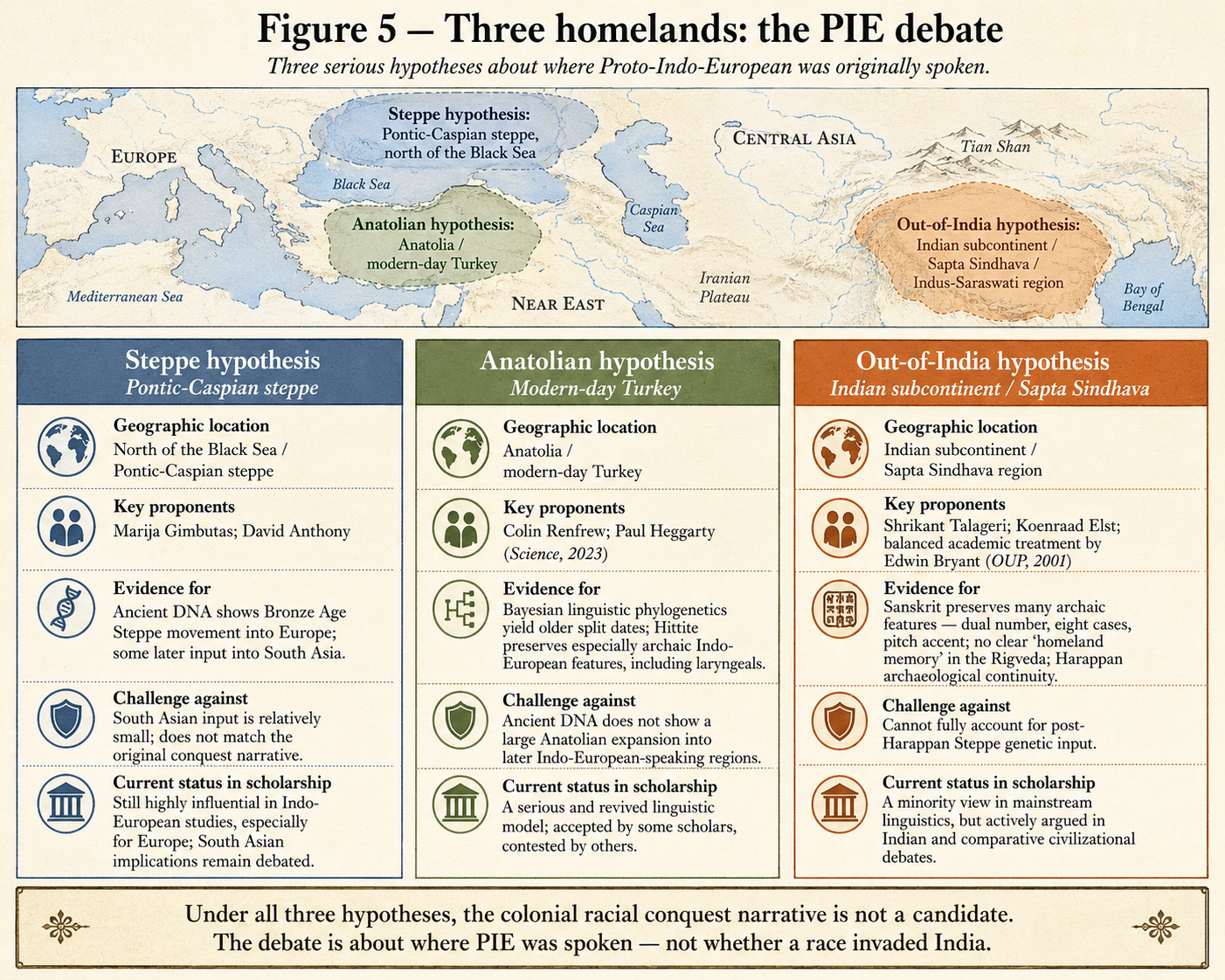
Three serious hypotheses about the original home of Proto-Indo-European are debated today: the Steppe hypothesis (Pontic-Caspian steppe, championed by Marija Gimbutas and David Anthony); the Anatolian hypothesis (modern-day Turkey, associated with Colin Renfrew and Paul Heggarty); and the Out-of-India hypothesis (Indian subcontinent / Sapta Sindhava, articulated in detail by Shrikant Talageri, Koenraad Elst, and balanced academic treatment by Edwin Bryant in The Quest for the Origins of Vedic Culture, Oxford University Press, 2001). Each hypothesis has strengths and weaknesses, and the literature continues to debate them on linguistic and archaeological grounds. The decisive point for our purposes is this: under all three hypotheses, the colonial racial conquest narrative is not a candidate. The debate is about where PIE was spoken — not whether a race invaded India.
The Vedic contribution to the world’s mathematics and science
The astronomical precision of the Vedic calendar system, the mathematical sophistication of the Śulbasūtras (which contain geometric theorems including what is known in the West as the Pythagorean theorem, predating Pythagoras by centuries), the decimal place-value numeral system that the world now uses — all originate in India, and their transmission to the Arab world and then to Europe is well-documented. The Vedic astronomical tradition — the Jyotiṣa Vedāṅga — represents a continuous engagement with precise celestial observation stretching back to the earliest recoverable strata of Vedic literature.
These contributions are not peripheral to Vedic civilisation — they are its products, the natural expression of a civilisational tradition that treated the cosmos as a precisely ordered Dharmic whole, in which knowledge of astronomical cycles was inseparable from ritual, philosophical, and scientific understanding.
Domains of transmission — at a glance
Decimal numerals. Brāhmī numeral system and Vedic mathematical tradition; transmitted via the Arab world to mediaeval Europe and now universal.
Geometry. Baudhāyana Śulbasūtra contains the geometric theorem known in the West as Pythagorean — the Indian formulation predates the Greek by centuries.
Language analysis. Pāṇini’s Aṣṭādhyāyī is the most precise ancient grammar; it influenced Western linguistics from Jones onward and anticipates twentieth-century generative grammar.
Sacred cosmology. Ṛta (cosmic order), fire worship, and the sky-father pantheon have direct cognates in Avestan Asha, Greek Logos, Roman Ius, and Norse Ōrlog.
Medicine. Āyurveda (Caraka Saṃhitā, Suśruta Saṃhitā) was transmitted into Unani medicine and shaped the early Arab medical tradition.
What we can conclude — and what we should not overclaim
The Aryan Invasion Theory, as a racial conquest narrative, has no credible support in any domain that has been properly examined by Indian scholarship. It was built on European racial ideology. It was institutionalised through colonial administration. It was contradicted by Indian thinkers from Ambedkar onward. And it has been progressively undermined by Indian-led archaeology, geoscience, and population genetics over the past four decades.
What the evidence establishes — strongly, defensibly, and across multiple independent disciplines — can be summarised in four propositions.
1. Civilisational continuity. The Sindhu-Saraswatī civilisation did not vanish. ASI excavation records from Hulas, Bhagwanpura, and Ropar document overlap, interlocking strata, and continuous sequences from Harappan to later periods. The civilisation transformed, regionalised, and adapted. It was not destroyed from outside.
2. One ancestry, not two races. Indian population genetics finds no genetic binary corresponding to “Aryan north” and “Dravidian south.” Modern Indians draw deeply from long-resident South Asian ancestry that includes Harappan-related lineages. The differences between populations reflect endogamy and local differentiation — not a racial founding conquest.
3. Ārya is a quality, not a race. The primary texts themselves — the Ṛgveda, the Mahābhārata, the Dharmaśāstra literature — use Ārya as a designation of conduct and nobility, not biological descent. India was named Āryāvarta not because it was conquered by Āryans but because it is the land in which the Ārya way of life — Sanātana Dharma — has its deepest home.
4. Vedic civilisation is the world’s oldest living tradition. Sanskrit is among the most archaic surviving Indo-European languages. The pagan traditions of the ancient world are cognates of the Vedic tradition — divergent branches of a shared inheritance whose most complete form survives in India. The world’s mathematics, astronomical tradition, and grammatical science received foundational contributions from Indian civilisation. These are not assertions of superiority; they are historical observations supported by independent evidence.
Summary — what this essay claims, and at what strength
Strong. The old racial Aryan Invasion model is colonial in origin and weak in evidence. Ambedkar, ASI, ISRO, and Indian geneticists all support this conclusion.
Strong. There was no violent civilisational replacement. Harappan culture transformed into later Indian cultures — the archaeological record shows continuity, not rupture.
Strong. Genetics does not support separate Aryan and Dravidian races. Indian genomics finds shared ancestry and no binary racial structure.
Moderate. The Ghaggar-Hakra was the Vedic Saraswatī. ISRO paleochannel mapping and Harappan site distribution are consistent with this — the exact correlation with textual chronology remains a research question.
Moderate. Pagan traditions are cognate branches of the Vedic inheritance. Deep structural and linguistic parallels make this plausible — but these traditions are cognates, not copies.
Avoid: "All world civilisation originated exclusively in India." This overstates the case and makes the argument easy to dismiss. The stronger — and true — claim is civilisational continuity and deep influence.
Avoid: "There was absolutely no movement into India at any period." Indian genetic work acknowledges some external gene flow — the point is that it was minor and integrative, not a conquest replacement.
The case in one paragraph
India is not a civilisation that received its culture from outside. It is a civilisation that has been continuously generating, transmitting, and transforming its own tradition for longer than any other on earth. The Sindhu-Saraswatī cities, the Vedic hymns, the Darśanas, the Purāṇas, and the living traditions of Sanātana Dharma are not separate episodes — they are stations in a single long journey. All Indians — north and south, Sanskrit-speaking and Dravidian-speaking, high-caste and low-caste — are heirs to this civilisation. The Aryan Invasion Theory divided them by race. The evidence unites them by ancestry, text, and continuity.
Āryāvarta was not named by conquerors. It was named by those who were already home.
Primary sources cited
Contents
Have questions about this article?
Ask about this →