Philosohy, Bhagavadgita
Bhagavad Gita: How to Act Without Fear
A source-grounded Vedika guide to duty, detachment, Karma Yoga, self-mastery, devotion, and surrender in the Bhagavad Gita for modern work, family, grief, leadership, and moral decision-making.
Vedika Research · 25 min read · 1 primary source cited · May 2026
Why this question matters today
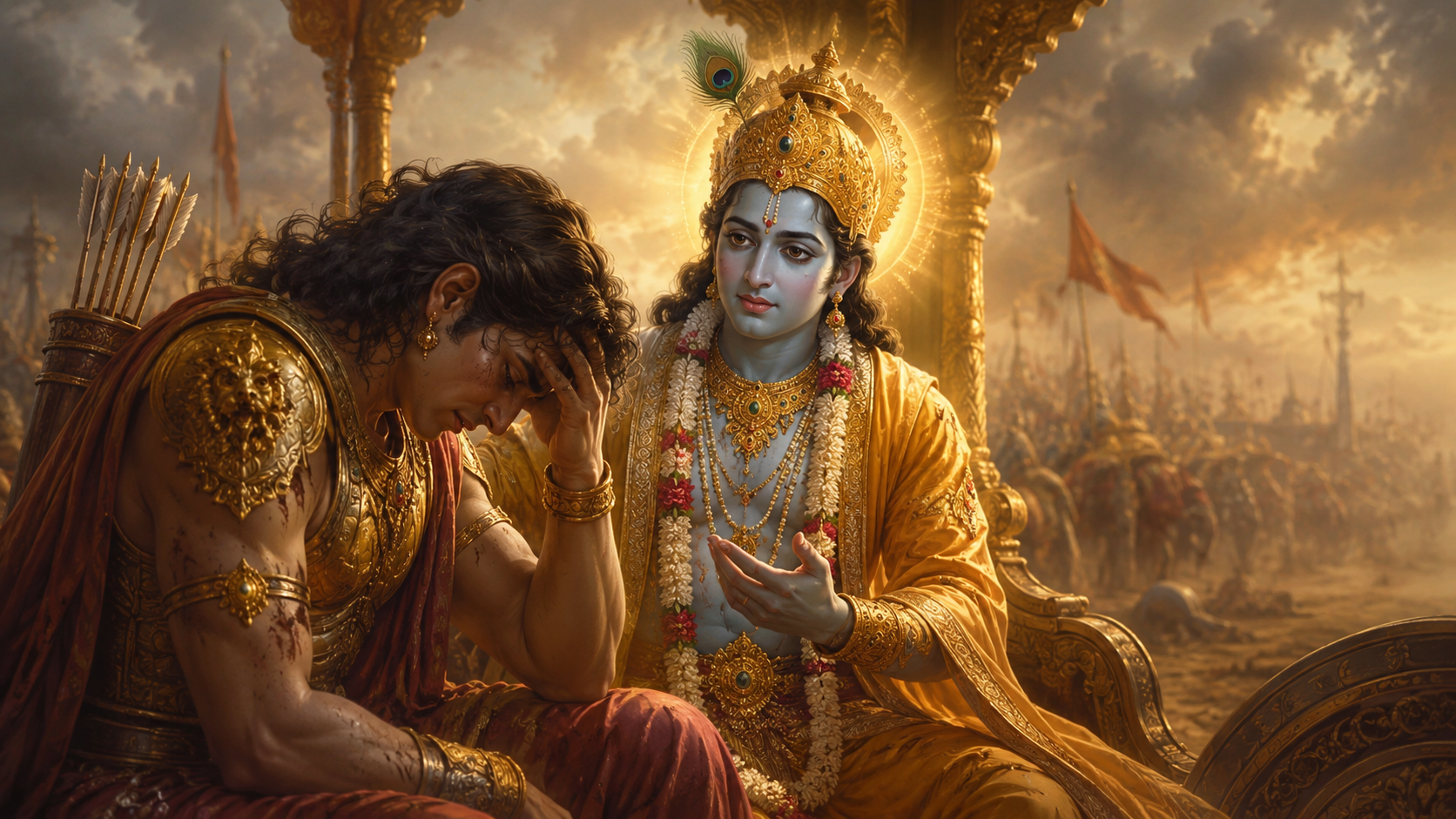
Modern people rarely stand between two armies, but they do stand between competing obligations: career and conscience, family loyalty and truth, grief and responsibility, ambition and dharma, fear and leadership. The traditional introduction published by the Divine Life Society explicitly presents the Gita as a guide for restless minds, daily conduct, and release from sorrow, grief, delusion, anxiety, and fear. The introduction on Gita Supersite similarly frames Krishna’s teaching as help for rising above personal limitation and doing what is good both for oneself and for society.
This matters because the Gita does not wait for inner calm before it begins teaching. It addresses a person in breakdown. It begins where most modern readers actually live: in pressure, conflict, nervous agitation, ethical ambiguity, and emotional flooding. And Krishna makes it clear that inaction is not a real escape, because no one can remain actionless even for a moment; prakriti pushes all into action.
Vedika’s opportunity here is to present the Gita not as a decorative wisdom text or a slogan-generator, but as a serious doctrine of how to act when one’s mind is unreliable. That is the heart of the text.
Arjuna’s crisis and why the Gita begins with collapse
Scriptural setting
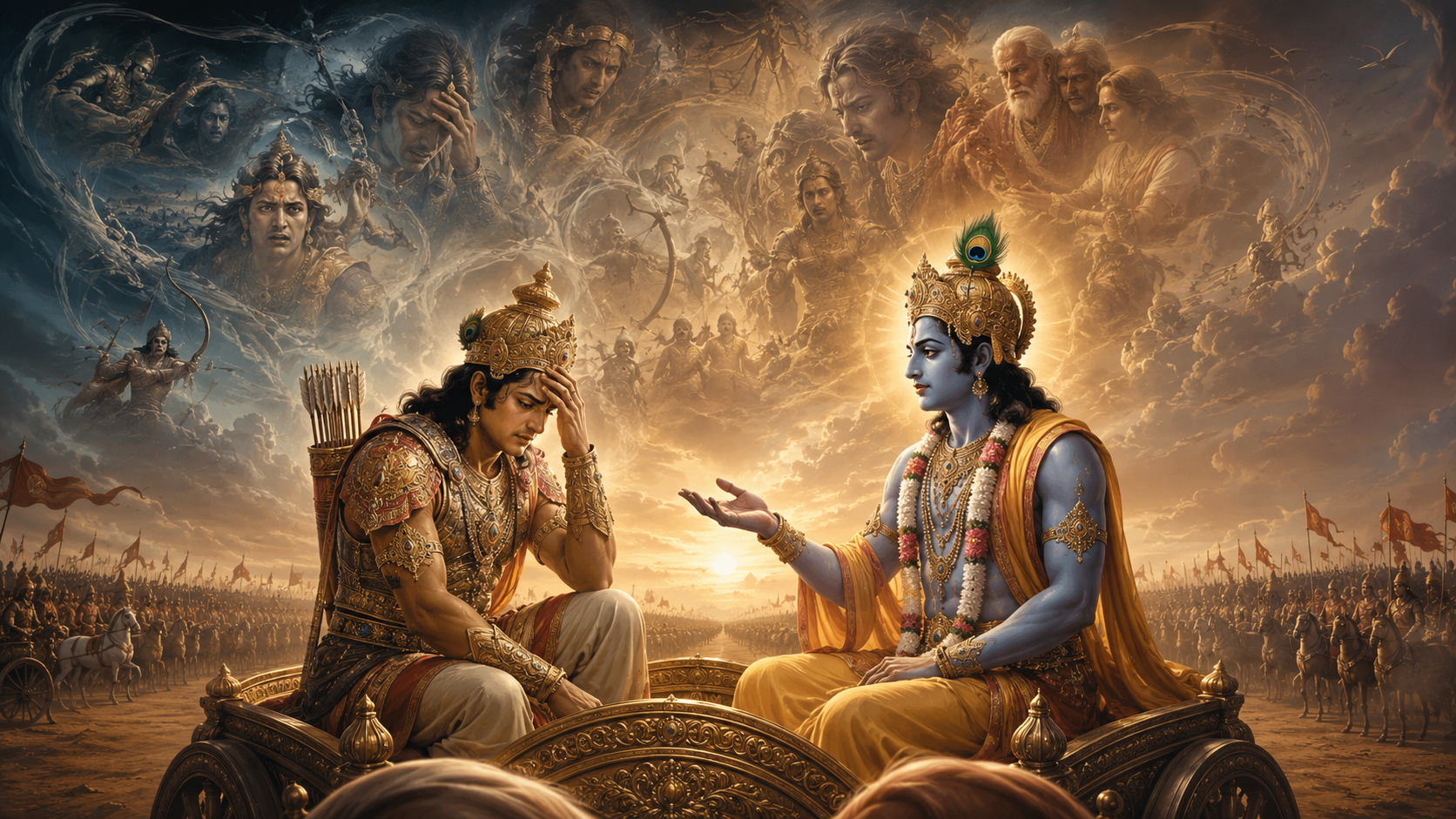
The Gita takes place in the Bhishma Parva of the Mahabharata. It stands just before battle after attempts at peace have failed, including the denial of even a modest compromise to the Pandavas. Arjuna had already chosen Krishna’s presence over Krishna’s army, and then asked Him to place the chariot between the two sides so he could inspect the field. There, in the presence of elders, teachers, relatives, and kin, his internal crisis breaks open.
The location matters too. The battlefield is not merely external. The text stages outer duty and inner disturbance at the same moment. This is why the Gita feels permanently contemporary: it does not separate the battlefield of life from the battlefield of consciousness. That connection is already implicit in the narrative frame.
Arjuna’s real crisis
Arjuna’s problem is not simple cowardice. The text itself portrays him as battle-ready until the emotional shock of recognition overtakes him. In chapter 1 he describes bodily symptoms: his limbs fail, his mouth dries up, his body trembles, his skin burns, the Gandiva slips from his hand, and his mind reels. These are not philosophical statements. They are the signs of inner collapse under moral-emotional strain.
The crisis deepens in 2.7, where Arjuna gives the real diagnosis: dharma-sammūḍha-cetāḥ—his consciousness is bewildered regarding dharma. He is not saying, “I do not know what battle is.” He is saying, “I no longer trust my own moral and spiritual judgment in this moment.” That is why he becomes a disciple and asks Krishna to teach him decisively.
Traditional Indian commentary reinforces this reading. Ramanuja’s commentary on Arjuna’s collapse describes him as overwhelmed by compassion, attachment to teachers and relatives, and uncertainty about the rightness of the battle. The problem is therefore dharmic paralysis: role-duty remains, but the inner instruments have become cloudy.
Why the Gita begins with emotional collapse
The first chapter is named Arjunaviṣādayoga on Gita Supersite’s chapter list: “The Yoga of the Despondency of Arjuna.” That naming is itself a teaching. In the Gita’s structure, despair is not the end of the path; it can become the beginning of yoga when it is offered to right guidance instead of being obeyed blindly.
The Divine Life Society’s introduction describes the Gita as the drama of elevating human beings from dejection, sorrow, weakness, and delusion into strength, peace, blessedness, and a broader vision of life. That is why the text begins not with abstraction but with breakdown. The Gita is medicine, not merely theory.
This is one of the text’s deepest insights for modern readers: philosophy becomes transformative only when it enters the moment of trembling. The Gita is not a discourse delivered in retirement from life. It is teaching delivered in the middle of necessity.
Krishna’s answer in layers
Krishna’s response is not one slogan. It is a layered path. The Gita moves from correction, to ontology, to ethics, to action, to discipline, to devotion, to surrender. Read that way, it becomes a practical map for modern life.
The verse pathway
Arjuna’s collapse — 1.28–1.30 सीदन्ति मम गात्राणि ... गाण्डीवं स्रंसते हस्तात् sīdanti mama gātrāṇi ... gāṇḍīvaṁ sraṁsate hastāt Paraphrase: “My limbs fail … my bow slips from my hand.” The Gita begins by acknowledging that the body, mind, and emotions can all fail together. Spiritual teaching here does not deny distress; it works through it.
The decisive confession — 2.7 कार्पण्यदोषोपहतस्वभावः ... धर्मसंमूढचेताः kārpaṇya-doṣopahata-svabhāvaḥ ... dharma-sammūḍha-cetāḥ Paraphrase: “My nature is overpowered; my mind is confused regarding dharma.” This is the true hinge of the Gita. Fear becomes fruitful only when it turns into inquiry and discipleship.
Krishna’s first intervention — 2.2–2.3 Krishna does not soothe Arjuna into passivity. He directly names the collapse as unworthy weakness, calls for the abandonment of “small-hearted faintness,” and commands him to rise. The first medicine is not sentiment. It is awakening from mental self-abandonment.
Wisdom begins with identity — 2.11 and 2.20 अशोच्यानन्वशोचस्त्वं aśocyān anvśocas tvaṁ न जायते म्रियते वा कदाचित् na jāyate mriyate vā kadācit Paraphrase: the wise do not grieve in the ordinary way because the Self is unborn, undying, and not slain when the body is slain. Krishna’s first deep correction is metaphysical: grief becomes absolute when the body is treated as the whole of the person. Knowledge of Atman does not abolish tenderness, but it abolishes metaphysical panic.
Endurance in change — 2.14 मात्रास्पर्शास्तु कौन्तेय ... तांस्तितिक्षस्व भारत mātrā-sparśās tu kaunteya ... tāṁs titikṣasva bhārata Pleasure and pain, heat and cold, rise and pass through contact. Krishna does not say they are unreal at the level of experience; he says they are changing and should not be allowed to rule judgment. This is the Gita’s discipline of forbearance.
Duty is role-specific — 2.31–2.33 स्वधर्ममपि चावेक्ष्य svadharmam api cāvekṣya Arjuna is told to view the situation through svadharma—his own rightful duty—not merely through the lens of emotion. Importantly, Krishna does not reduce the teaching to bare role-duty; but neither does he permit feeling alone to cancel dharma. If Arjuna refuses a righteous conflict, he does not become pure; he abandons responsibility.
Action without fruit-clinging — 2.47, 2.48, 2.50 कर्मण्येवाधिकारस्ते karmaṇy eva adhikāras te समत्वं योग उच्यते samatvaṁ yoga ucyate योगः कर्मसु कौशलम् yogaḥ karmasu kauśalam This cluster is the backbone of Karma Yoga. One has a claim over action, not over guaranteed outcomes. Yoga is equanimity amid success and failure. Yoga is also “skill in action,” which traditional commentators explain not as mere efficiency but as the art of acting without bondage.
The steady person — 2.55–2.72 Chapter 2 culminates in the portrait of the sthitaprajña: one who is inwardly satisfied, not shaken by sorrow, not addicted to pleasure, free from attachment, fear, and anger, with senses drawn back like a tortoise, and finally established in a peace compared to the unmoving ocean receiving many rivers. This is not emotional numbness. It is inner order.
Action is unavoidable, so purify it — 3.5, 3.19, 3.30 न हि कश्चित्क्षणमपि ... अकर्मकृत् na hi kaścit kṣaṇam api ... akarma-kṛt असक्तः सततं कार्यं कर्म समाचर asaktaḥ satataṁ kāryaṁ karma samācara मयि सर्वाणि कर्माणि संन्यस्य ... युध्यस्व विगतज्वरः mayi sarvāṇi karmāṇi saṁnyasya ... yudhyasva vigata-jvaraḥ No one can avoid action. Therefore the real question is not whether to act, but how. Act without attachment; surrender action into the Divine; and act vigata-jvaraḥ—free from inner fever, grief, and anxious burning. This is one of the most powerful formulations of fearless action in the whole Gita.
Know the inner enemies and retrain the instruments — 3.34, 3.37–3.43, 6.5–6, 6.26 रागद्वेषौ व्यवस्थितौ rāga-dveṣau vyavasthitau काम एष क्रोध एष kāma eṣa krodha eṣa उद्धरेदात्मनात्मानं uddhared ātmanātmānam यतो यतो निश्चरति मनः yato yato niścarati manaḥ Attachment and aversion sit near every sense-object. Desire and anger cloud knowledge. The senses, mind, and buddhi become the field of delusion. Therefore the self must raise itself; the disciplined self becomes friend, the undisciplined self becomes enemy. And when the mind wanders, it must be brought back again and again. The Gita’s psychology is exacting and unsentimental.
Knowledge, worship, and surrender complete the path — 4.7–4.8, 4.18, 4.38, 5.10, 9.22, 12.13–12.20, 18.46, 18.66 Krishna declares that He manifests when dharma declines and adharma rises. He teaches the paradox of “seeing inaction in action,” meaning acting without egoic bondage. He says there is no purifier like knowledge. He compares untainted action to a lotus leaf untouched by water. He promises to carry the welfare of the one who thinks of Him exclusively. He describes the beloved devotee as non-hating, compassionate, egoless, steady, and free of agitation. He says one’s own work can itself become worship. And finally he gives the culminating instruction: take refuge in Me alone; do not grieve. Fearless action thus culminates in śaraṇāgati, not in stoic self-sufficiency.
What Krishna teaches in conceptual form
Dharma: In the Gita, dharma is not mere social convention. It is right order, right obligation, and the law of what ought to be done in alignment with truth. At Arjuna’s level, it includes the righteous performance of his role; at Krishna’s level, it includes the restoration of cosmic and moral order when it declines.
Karma: Karma is action, and also action with consequence. The Gita refuses the fantasy of non-action: life itself is movement under prakriti. Therefore bondage does not arise from action alone, but from egoism, attachment, and fruit-hunger within action.
Karma Yoga: Karma Yoga is the discipline of action performed with steadiness, detachment, offering, and inward clarity. It is action as yoking, not action as compulsion. That is why yoga can be called both equanimity and skill in action.
Nishkama Karma: Nishkama Karma does not mean desireless passivity or lack of care. It means acting wholeheartedly without making one’s ego depend on a particular fruit. Ramanuja’s commentary on 2.47 explicitly says that actions done without an eye on fruits become worship of the Lord and a means to release.
Svadharma: Svadharma is one’s own rightful duty—rooted in role, nature, obligation, and circumstance. The Gita repeatedly warns against abandoning one’s own dharma for another’s, even if another’s appears outwardly more attractive.
Sthitaprajna: The sthitaprajña is the person of firm wisdom: not desire-driven, not shattered by sorrow, not intoxicated by pleasure, not ruled by the senses, inwardly satisfied, and established in peace. This is the Gita’s portrait of composure.
Atman: Atman is the unborn, undying Self. Krishna’s moral psychology depends on this doctrine. Without it, grief swells into absolute despair; with it, duty can be performed without metaphysical terror.
Buddhi: Buddhi is discriminative intelligence. It can be steady, scattered, sattvic, rajasic, or tamasic. Fearless action requires buddhi that can distinguish dharma from adharma, action from inaction, and the Self from the mind’s turbulence.
Manas: Manas is the mind that wavers, broods, projects, follows the senses, and wanders. The Gita treats it as trainable, but never casually. The mind must be brought back deliberately and repeatedly.
Indriyas: The senses are not demonized, but they are recognized as powerful channels of disturbance. Unruled senses drag the mind; ruled senses support steadiness.
Raga and Dvesha: Attraction and aversion are built into ordinary sense-life. The Gita names them as immediate enemies of discernment because they bend perception and push a person off dharma.
Bhakti: Bhakti in the Gita is not sentimental excess. It is steady loving orientation to Bhagavan expressed through mind, buddhi, conduct, compassion, humility, and constancy. The qualities of the devotee in chapter 12 are among the text’s finest descriptions of mature inner character.
Sharanagati: Surrender is the culmination of the Gita. The Gaudiya Vaishnava explanation preserved in the ISKCON VedaBase notes the classic sixfold form of surrender: accepting the favorable, rejecting the unfavorable, faith that Krishna will protect, embracing Him as guardian, full self-surrender, and humility. That makes clear that surrender is not passivity; it is active refuge.
Moksha: Moksha is freedom from binding ignorance, delusion, and karmic entanglement. The Gita presents it not as a negation of life, but as the fruit of purified action, knowledge, devotion, and surrender.
A distinctly Indic synthesis
One of the strongest findings from the Indian commentarial tradition is that the Gita is not reducible to a single instruction. Adi Shankaracharya emphasizes that unattached action prepares the person for purification and the Highest. Ramanujacharya emphasizes that fruitless action becomes worship and that one’s own work can be offered to the indwelling Lord. Abhinavagupta stresses relinquishment of egoic doership in action. Sri Aurobindo, in a modern Indian idiom, states that the Gita’s solution is to perform all works as a sacrifice to the Divine and replace desire with the consciously felt will of the Eternal. These are not contradictory strands; they converge on a single doctrine: action must be purified, illumined, and offered.
The Vedika Vigata-Jvara Mandala

Sanskrit-inspired name: Vedika Vigata-Jvara Maṇḍala Modern name: The Fearless Action Wheel
The phrase vigata-jvaraḥ in 3.30 is the seed of this framework. Krishna does not merely say, “Act.” He says, “Act free from fever.” In the Gita, jvara is not only bodily heat; it is mental fever—panic, grief, agitation, possessiveness, shame, overthinking, emotional combustion. The Vedika framework therefore begins not with external productivity but with diagnosing inner fever.
Visual model: A six-spoked mandala with a still center. The center is Ātma-smṛti—remembrance of deeper identity beyond agitation. Around it move six stages that lead a person from turbulence to offered action. The outer ring is Lokasaṅgraha—action that sustains the wider order of life. This keeps the framework distinctly Gita-rooted: the goal is not self-optimization, but dharmic participation.
The six stages
Jvara-Darśana — See the inner fever English meaning: Notice the disturbance without obeying it. Explanation: Before dharma can be followed, the person must name the agitation: fear, grief, attachment, anger, ego-hurt, avoidance, or result-anxiety. Arjuna first becomes teachable when he stops pretending composure and reveals the real state of his mind. Daily-life question: What exactly is burning inside me right now? Example: “I say I am being ‘practical,’ but actually I am afraid of disapproval.” Gita anchor: 1.28–1.30; 2.7. Visual metaphor: A battlefield outside, a storm-map inside.
Tattva-Viveka — Separate truth from turbulence English meaning: Distinguish what is real, changing, and merely reactive. Explanation: The mind feels many things; not all feelings reveal dharma. Krishna first reorders Arjuna’s perception by teaching the distinction between the eternal Self and changing sensations, and between wisdom and grief. Daily-life question: What in this moment is passing sensation, and what is enduring truth? Example: “My fear of short-term discomfort is real as a feeling, but it does not decide what is right.” Gita anchor: 2.11, 2.14, 2.20. Visual metaphor: Mist clearing from a mirror.
Svadharma-Nirdhāra — Identify the duty that is actually yours English meaning: Name the responsibility belonging to your role and situation. Explanation: Not every possible good act is your act. The Gita teaches discernment through role, obligation, nature, and circumstance. Fearlessness becomes possible when duty is particularized. Daily-life question: What action belongs to me here as parent, leader, seeker, citizen, friend, or worker? Example: “As a manager, my duty is not to be liked in this moment, but to speak truthfully and justly.” Gita anchor: 2.31–2.33; 18.46. Visual metaphor: A compass finding north while many arrows pull sideways.
Phala-Tyāga-Saṅkalpa — Set intention without possession English meaning: Commit fully, without claiming ownership of results. Explanation: This is the heart of Nishkama Karma. The person does not lower effort; he or she lowers grasping. Intention becomes pure when action is chosen for its rightness, not for egoic harvest. Daily-life question: Can I do this completely without demanding a guaranteed result, applause, or control? Example: “I will make the necessary apology sincerely, even if the relationship does not repair immediately.” Gita anchor: 2.47, 2.48, 2.50; 3.19. Visual metaphor: A planter sowing a seed carefully, while sun, rain, and fruit remain outside total control.
Yukta-Kriyā — Perform disciplined, timely, skillful action English meaning: Act with steadiness, competence, and inward alignment. Explanation: Once action is clear, over-brooding becomes another form of tamas. The Gita’s ideal is not hesitant virtue but joined action: senses gathered, mind directed, skill applied, fever reduced. Daily-life question: What is the next concrete action, and what is the best way to do it well? Example: “Book the meeting, gather facts, speak without blame, follow through.” Gita anchor: 3.30; 5.10; 6.26. Visual metaphor: The archer drawing the bow with a still wrist and clear eye.
Īśvara-Arpaṇa-Prasāda-Buddhi — Offer the action, receive the result as prasāda English meaning: Surrender the act to the Divine and accept the return without collapse. Explanation: The Gita does not end with technique. It ends with refuge. The action is offered; the result is received as instruction, consequence, grace, correction, or delay—but not as the owner of one’s identity. Daily-life question: Can I offer this before acting, and accept its result without self-destruction? Example: “I did the right thing truthfully. The outcome was painful. I will learn from it, but I will not become broken by it.” Gita anchor: 9.22; 18.46; 18.66. Visual metaphor: Hands releasing an offering into flame, then opening to receive ash as blessing.
Daily use of the framework
In morning practice, the framework can be used in less than five minutes. Name the day’s most unavoidable responsibility, identify the inner fever around it, clarify what is truly yours to do, set an unattached intention, take the first concrete step, and dedicate the work inwardly before beginning. The Gita’s point is not to eliminate all emotion before action, but to refuse emotional turbulence the right to govern action.
Before a difficult conversation, decision, or duty, the framework can be run as six quick questions: What is burning in me? What is true? What is my duty? What fruit am I clutching? What action is next? Can I offer and release? This turns chapter-study into lived sadhana.
At night, the final step matters most. The day should close not with self-accusation but with prasāda-buddhi: “What came today through this action, and what is it teaching me?” This prevents both pride in success and despair in failure.
Primary sources cited
Contents
Have questions about this article?
Ask about this →