SAGE & COMPILER
वेदव्यास
Veda Vyasa
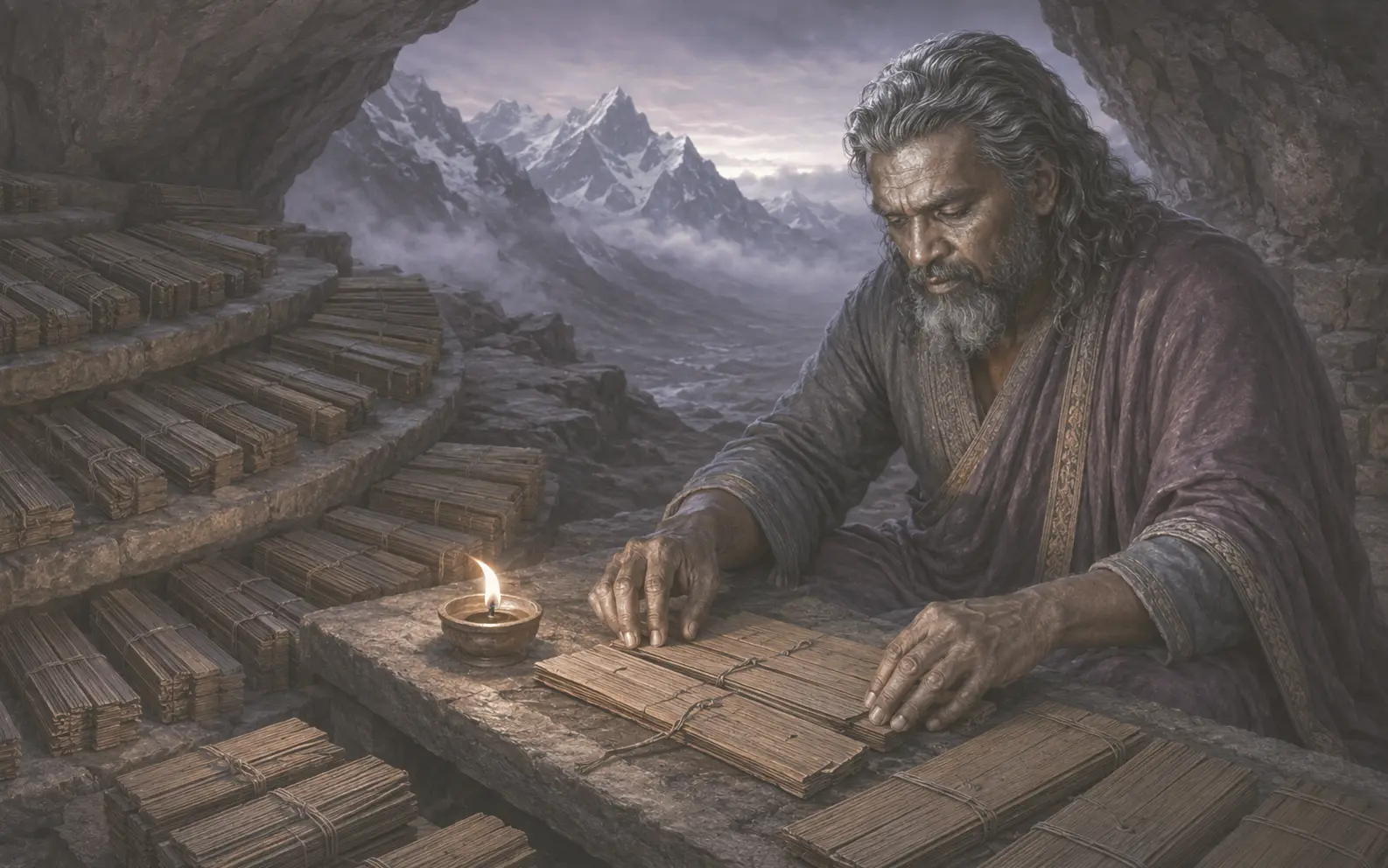
The towering figure traditionally connected with the Mahabharata, Vedas and Puranas.
- Era
- Traditional chronology
- Known for
- Sage & compiler · Dharma
WHY VEDA VYASA MATTERS
The organiser of sacred memory
Veda Vyasa is less a single biographical subject than a civilizational memory of compilation, narration and transmission. Tradition links him with the Mahabharata, the organization of the Vedas, the Brahma Sutras and Puranic teaching; Vedika presents that grandeur with evidence labels intact.
LIFE & HISTORICAL RECORD
The organiser of sacred memory
The name Vyasa means arranger or compiler. Krishna Dvaipayana Vyasa is traditionally revered as the arranger of the Vedas and the composer or narrator of the Mahabharata.
His importance is structural: he stands where revelation, epic history, genealogy, philosophy and devotion are gathered into transmissible form. The tradition uses his figure to explain how vast memory becomes teachable.
Epic character, authorial presence and traditional compiler
In the Mahabharata, Vyasa is not only linked to authorship; he appears inside the story as ancestor, seer and interpreter. This gives him a rare double role as both narrator and participant.
What the record leaves open
Modern historical method cannot verify every traditional attribution. The Mahabharata itself is a layered epic, and the Puranic and Vedantic attributions around Vyasa belong to a long history of sacred authorship.
CORE TEACHINGS
Three threads to carry with you
Vyasa’s deepest teaching comes through the Mahabharata’s refusal to make dharma simplistic. Family, oath, loyalty, rule, violence and grief collide until moral life can no longer be reduced to a neat instruction.
The Bhagavad Gita, embedded in the Mahabharata, gives this crisis a contemplative centre: action, knowledge and devotion must be integrated when withdrawal is no longer possible.
Dharma is subtle
The epic repeatedly shows that right action may be difficult to discern.
Transmission matters
Wisdom survives when it is organized, taught and remembered responsibly.
Many paths can meet
The Gita joins action, knowledge, devotion and disciplined insight.
WORKS & PRACTICES
Mahabharata, Vedantic memory and Puranic horizons
The Mahabharata is the primary anchor for Vyasa’s public importance. Tradition also attributes the Brahma Sutras and Puranic compilation to Vyasa, though these attributions need historical qualification. A practical reading path begins with the Mahabharata’s frame, the Bhagavad Gita and selected dharma debates, then follows how later Vedanta and Puranic traditions invoke Vyasa’s authority.
Mahabharata
The great epic traditionally connected with Vyasa’s narration and authorship.
Bhagavad Gita
A central teaching text embedded within the epic crisis.
Brahma Sutras
Traditionally attributed to Badarayana Vyasa; historical identity is debated.
RELEVANCE TODAY
The discipline of not oversimplifying
Vyasa is crucial for Vedika because modern spirituality often wants quick clarity, while the Mahabharata trains a deeper capacity: staying awake inside complexity. His archive asks readers to organize memory without controlling it, to seek dharma without pretending it is always obvious, and to let conflicting duties deepen attention rather than end inquiry.
SOURCES & FURTHER READING
Follow the record
The Mahabharata
Epic text associated with Vyasa’s narration, authorship and presence within the story.
Open primary text ↗Bhagavad Gita
Central teaching text embedded in the Mahabharata’s Bhishma Parva.
Open primary text ↗Vyasa overview
Reference overview for Vyasa as epic figure, compiler and traditional author.
Open scholarly reference ↗CONTINUE THE JOURNEY