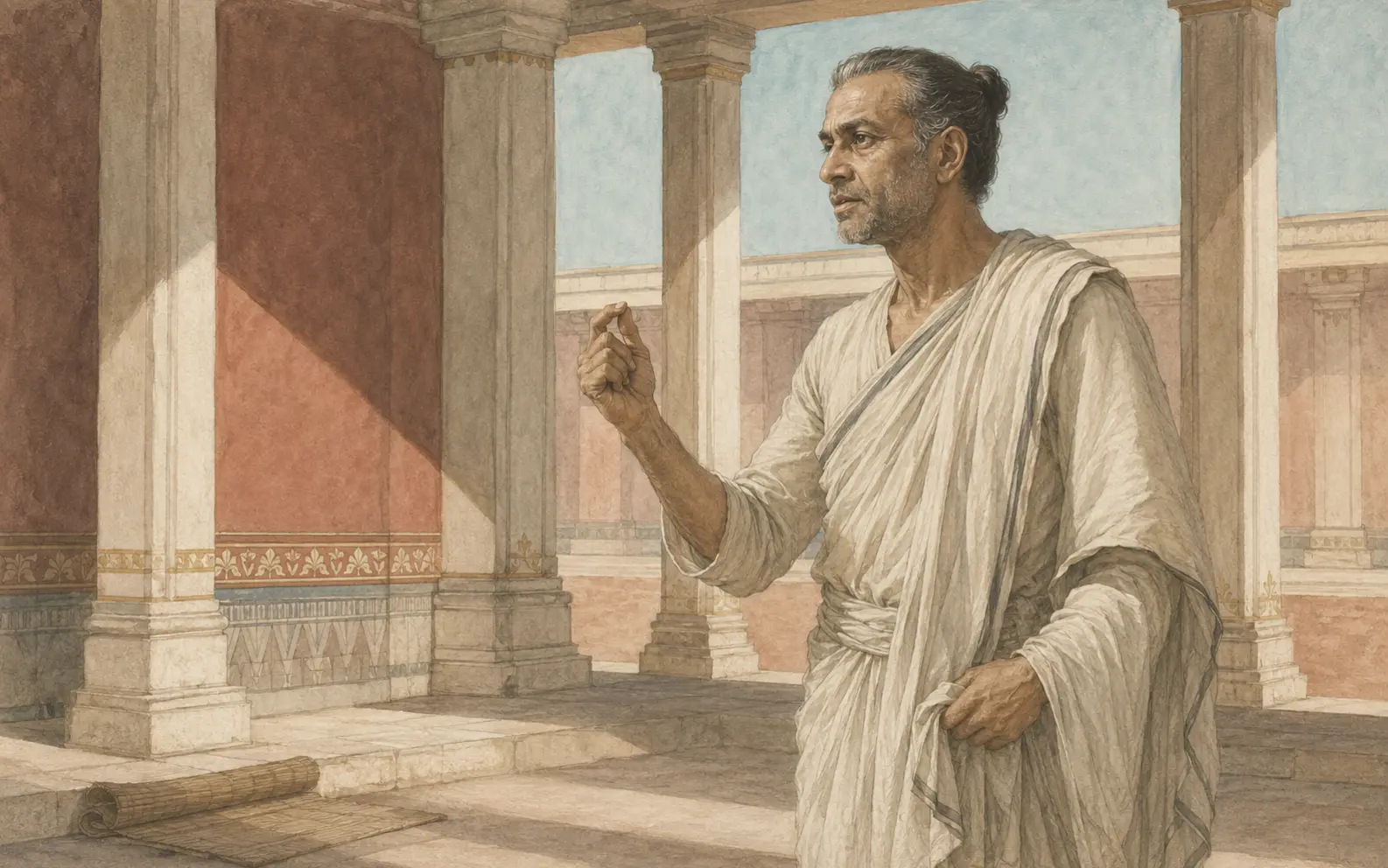
UPANISHADIC SAGE
याज्ञवल्क्य
Yajnavalkya
A central teacher of the knowledge of the Self in the Brihadaranyaka Upanishad.
- Era
- c. 8th–7th century BCE
- Known for
- Upanishadic sage · Self
WHY YAJNAVALKYA MATTERS
The teacher who keeps turning inquiry inward
Yajnavalkya is one of the clearest philosophical voices in the early Upanishads. His dialogues with Maitreyi, Gargi and King Janaka preserve a demanding inquiry into the Self, the imperishable and the freedom that comes from knowing what cannot be possessed.
LIFE & HISTORICAL RECORD
The teacher who keeps turning inquiry inward
The Brihadaranyaka Upanishad gives Yajnavalkya several major teaching scenes: debates in Janaka’s assembly, the dialogue with Maitreyi, and instructions on the Self that cannot be grasped as an object.
He matters because the text does not present him only as a saintly figure. He is sharp, sometimes abrupt and intellectually formidable. The philosophical force of the dialogues is stronger than any neat heroic biography.
A textual personality more than a recoverable biography
The early sources place Yajnavalkya in an Upanishadic world of debate, household life, renunciation and royal patronage. They do not provide a modern chronology that can be verified independently.
What the record leaves open
His wives Maitreyi and Katyayani, his exchanges with Gargi and his relationship with Janaka belong to the textual world that preserves him. Vedika treats those passages as primary evidence for teaching scenes.
CORE TEACHINGS
Three threads to carry with you
In the Maitreyi dialogue, Yajnavalkya teaches that wealth cannot grant immortality. What is loved is ultimately loved for the sake of the Self. The teaching shifts the seeker from accumulation to recognition.
In debates with Gargi and others, he points toward the imperishable, the ground by which all experience is held. His method is rigorous: negate what is not final, then refuse to turn the Self into an object among objects.
Neti, neti
The Self is approached by denying every limited objectification: not this, not this.
Love and the Self
The Maitreyi dialogue asks what makes anything finally dear.
Freedom through knowledge
Liberation is tied to seeing the real nature of the knower, not owning more.
WORKS & PRACTICES
Dialogues in the Brihadaranyaka Upanishad
Yajnavalkya’s surviving authority rests especially on Brihadaranyaka Upanishad chapters 2-4. These include the Maitreyi dialogue, the debates at Janaka’s court and teachings on the imperishable. Practice here means disciplined listening: track the question being answered, the level of reality being discussed and the way language reaches its limit.
Brihadaranyaka 2.4 and 4.5
Dialogues with Maitreyi on wealth, immortality and the Self.
Brihadaranyaka 3.6 and 3.8
Dialogues with Gargi on what the world is woven upon.
Brihadaranyaka 4
Teachings around Janaka, consciousness and liberation.
RELEVANCE TODAY
A medicine for endless accumulation
Yajnavalkya’s teaching challenges the reflex to solve inner lack by adding more outer possession. The question is not whether wealth or relationship matters, but whether either can answer the longing for the deathless. For Vedika, he becomes a guide to inquiry that is both intimate and exact: what is the Self for whose sake everything else becomes meaningful?
SOURCES & FURTHER READING
Follow the record
Brihadaranyaka Upanishad
Primary Upanishadic text containing Yajnavalkya’s dialogues with Maitreyi, Gargi and Janaka.
Open primary text ↗Brihadaranyaka Upanishad translation
Chapter-by-chapter translation and commentary reference.
Open primary text ↗Yajnavalkya overview
Reference overview for the Upanishadic and later traditional figure.
Open scholarly reference ↗CONTINUE THE JOURNEY