GAUDIYA VAISHNAVA SAINT & TEACHER
चैतन्य महाप्रभु
Chaitanya Mahaprabhu
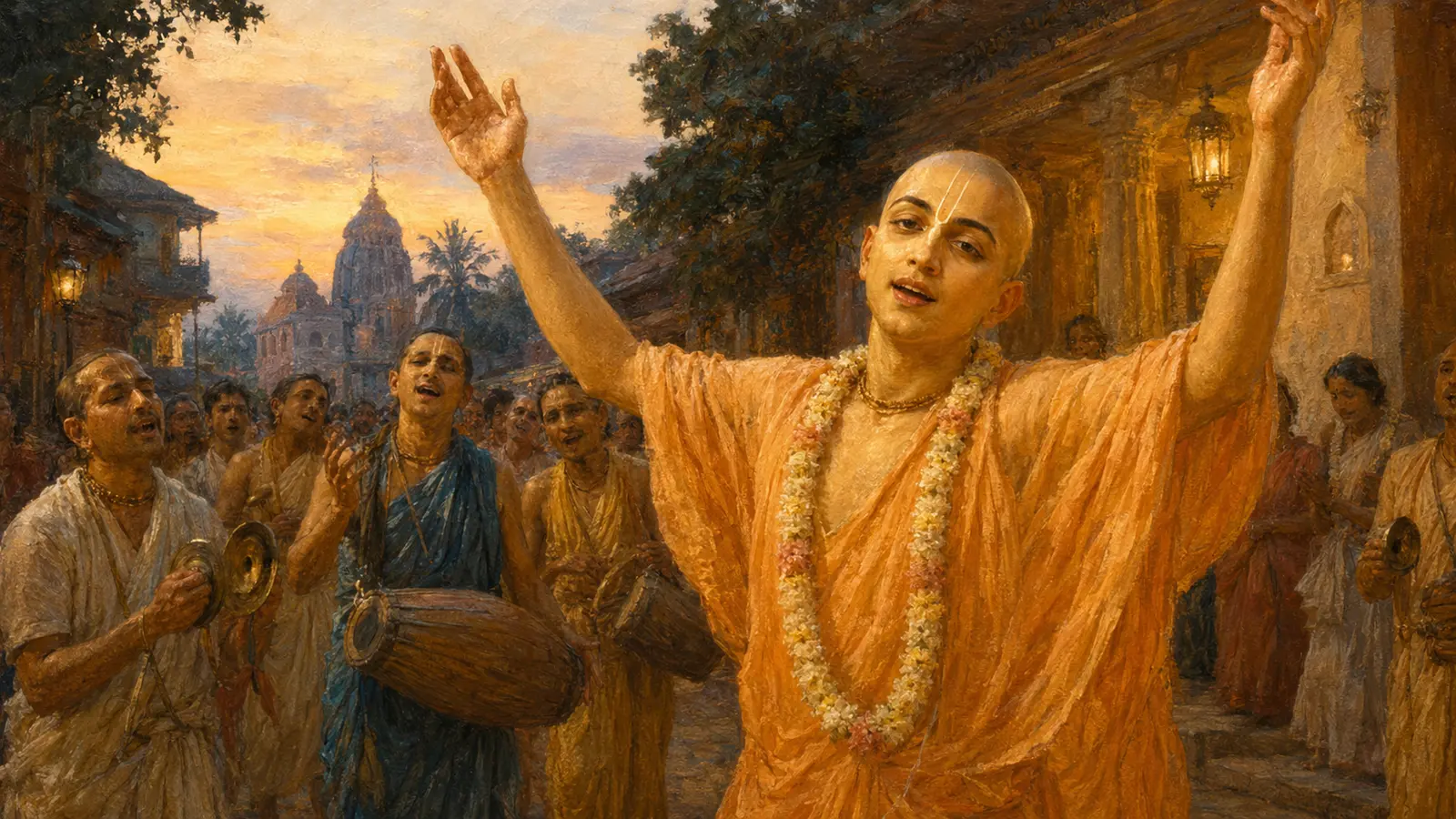
The Bengali saint who made congregational Krishna-nama and ecstatic devotion central to a living Gaudiya tradition.
- Era
- 1486–1533/34
- Known for
- Gaudiya Vaishnava saint & teacher · Devotion
WHY CHAITANYA MAHAPRABHU MATTERS
When devotion becomes a shared voice
Chaitanya Mahaprabhu transformed the devotional landscape of Bengal and Odisha through Krishna bhakti expressed in singing, remembrance and ecstatic participation. His own surviving verses are few; his life and theology are known chiefly through reverent Gaudiya biographies and the movement shaped by his companions and later theologians.
LIFE & HISTORICAL RECORD
When devotion becomes a shared voice
Born Vishvambhara Mishra at Navadvipa, Chaitanya is remembered first as a gifted scholar and then as the centre of an intense Krishna devotional movement. Congregational nama-sankirtana gave that devotion a public and participatory form.
Gaudiya Vaishnavas worship him as Krishna in the devotional mood of Radha. Vedika identifies this clearly as the tradition’s theological understanding, not as a claim that historical method can independently establish.
From Navadvipa to Puri
Lineage biographies describe a decisive devotional transformation after pilgrimage to Gaya, followed by kirtan in Navadvipa, acceptance of sannyasa, journeys through India and a long final period at Jagannath Puri.
What the record leaves open
The principal narratives—the Chaitanya Bhagavata and Chaitanya Charitamrita—are hagiographies written within the community. They preserve names, places, teachings and sacred memory, while interpreting the life through devotion from the outset.
CORE TEACHINGS
Three threads to carry with you
Chaitanya placed the chanting of Krishna’s names at the centre of practice. Sankirtana is not simply musical performance: it is attention, community and surrender enacted through the voice and body.
The eight verses known as the Shikshashtakam emphasise cleansing of consciousness, humility, perseverance and love without bargaining. The systematic formula achintya-bhedabheda was developed by later Gaudiya theologians; it should not be carelessly presented as a treatise written by Chaitanya.
Nama-sankirtana
Congregational chanting makes remembrance of Krishna collective, embodied and accessible.
Shikshashtakam
Eight attributed Sanskrit verses are the compact textual core of Chaitanya’s own teaching.
Practice cue
Repeat a divine name attentively, listening as carefully as you speak.
WORKS & PRACTICES
Few verses, a large living tradition
Unlike many acharyas, Chaitanya did not leave a large authored philosophical corpus. The Shikshashtakam is traditionally accepted as his, while associates and later Goswamis articulated the movement’s theology and practice. Kirtan, mantra remembrance, Bhagavata devotion and the cultivation of relationship with Krishna continue across several Gaudiya institutions. Their diversity should not be collapsed into the history of any one modern organisation.
Sri Sri Chaitanya-charitamrita
English edition of Krishnadasa Kaviraja’s central Gaudiya hagiography, used with explicit awareness of its lineage perspective.
BAPS: Chaitanya Mahaprabhu
A second Hindu lineage overview used for the broad life, Krishna bhakti, kirtan and the attributed Shikshashtakam.
RELEVANCE TODAY
Why he matters now
Chaitanya matters because he makes spiritual life participatory without making it shallow. Voice, rhythm, emotion and community can become disciplines of attention rather than escapes from thought. For Vedika, he completes the archive with a distinctive form of bhakti: collective yet intimate, emotionally expansive yet grounded in humility and remembrance.
SOURCES & FURTHER READING
Follow the record
Sri Sri Chaitanya-charitamrita
English edition of Krishnadasa Kaviraja’s central Gaudiya hagiography, used with explicit awareness of its lineage perspective.
Open primary text ↗BAPS: Chaitanya Mahaprabhu
A second Hindu lineage overview used for the broad life, Krishna bhakti, kirtan and the attributed Shikshashtakam.
Open lineage source ↗CONTINUE THE JOURNEY