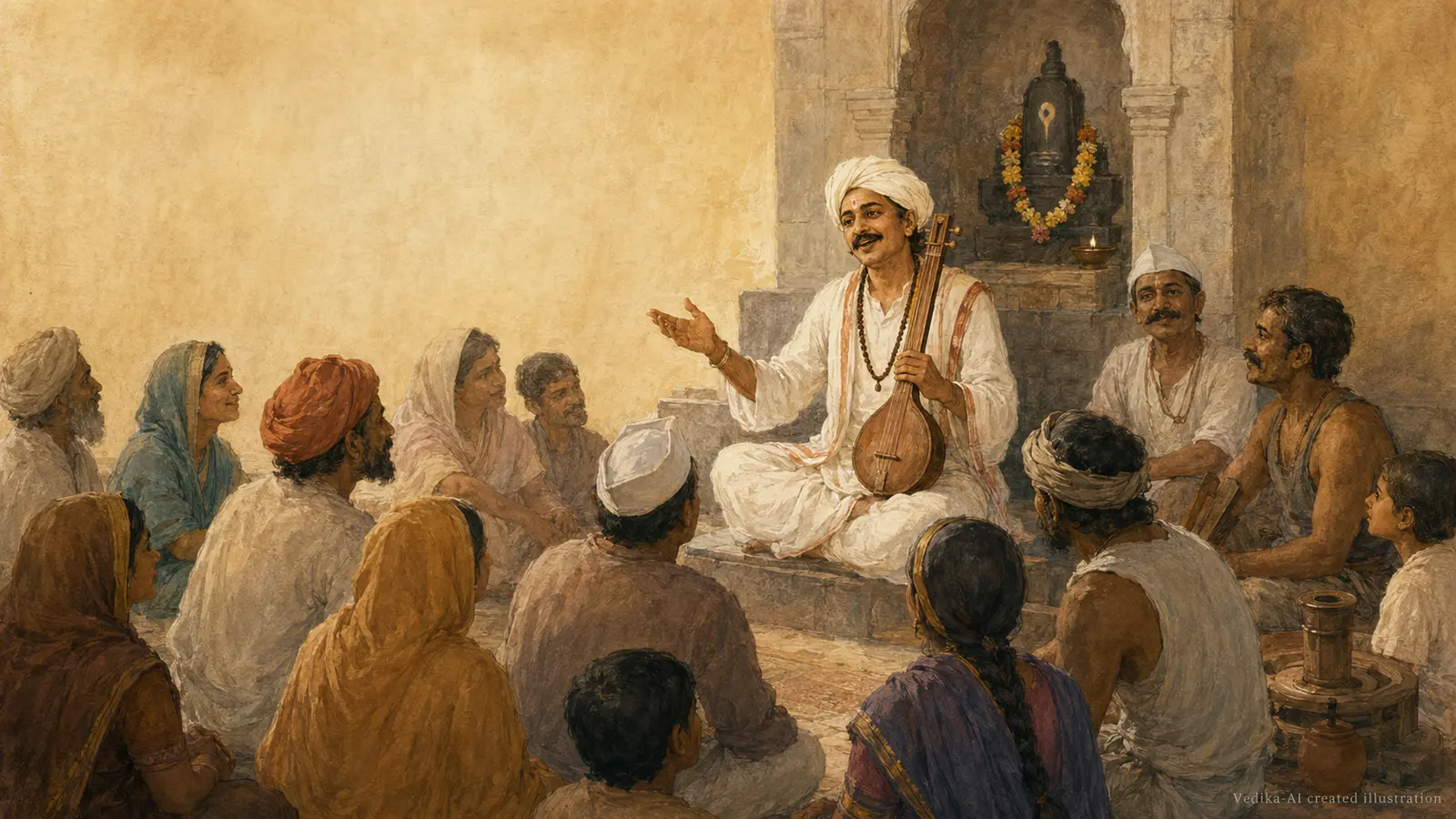
MARATHI SANT & POET
नामदेव
Namdev
The poet-saint whose songs to Vithoba travelled across languages and became part of both Varkari and Sikh scripture.
- Era
- c. 1270–1350 · dates debated
- Known for
- Marathi sant & poet · Devotion
WHY NAMDEV MATTERS
A devotional voice that crossed regions
Namdev stands at an important crossing of regional and pan-Indian bhakti. Marathi abhangs remember an intimate relationship with Vithoba, while hymns under his name in the Guru Granth Sahib gave his voice a durable place in Sikh scripture and North Indian devotional history.
LIFE & HISTORICAL RECORD
A devotional voice that crossed regions
Namdev’s remembered world begins in Maharashtra and Pandharpur, but his songs and life narratives travel north. Different linguistic corpora do not always preserve the same voice or historical layer.
That complexity is part of his significance. Bhakti moved through pilgrimage, performance and communities long before modern categories tried to contain traditions inside one language or religious boundary.
Vithoba, artisan memory and journeys north
Tradition places Namdev in a tailor or calico-printer community and describes his childhood intimacy with Vithoba. He is associated with Jnaneshwar and remembered as travelling across India.
What the record leaves open
Hagiographic collections narrate miracles in which the deity eats offerings, temples turn and social exclusion is overturned. Historical details vary, while the existence of early devotional reception in more than one region is secure.
CORE TEACHINGS
Three threads to carry with you
Namdev’s poetry contests the idea that God is confined to one ritual location or controlled by social rank. The divine name accompanies the devotee through work, travel and exclusion.
His inclusion in the Guru Granth Sahib gives particular weight to teachings about the one Divine and the inadequacy of empty external performance.
Vithoba intimacy
Marathi tradition remembers a direct, personal relationship with the deity of Pandharpur.
Cross-tradition reception
Hymns under Namdev’s name form part of the Guru Granth Sahib as well as Varkari memory.
Practice cue
Carry remembrance into one routine task instead of waiting for a specially religious setting.
WORKS & PRACTICES
Abhang, shabad and questions of attribution
Marathi songs and Hindi or sant-bhasha hymns circulate under Namdev’s name, including compositions canonised in Sikh scripture. Scholars debate how these corpora relate to one historical poet and later Namdev traditions. Practice is sung and mobile: nama-smarana, pilgrimage, kirtan and truthful work. The transmission itself demonstrates how devotion can be adopted without erasing the distinct identity of receiving communities.
Sri Guru Granth Sahib: Bhagat Namdev
Sikh scriptural resource used as a primary witness to hymns canonically transmitted under Namdev’s name.
Encyclopaedia Britannica: Namdev
Reference overview used for Namdev’s Marathi setting, Vithoba devotion and wider North Indian reception.
RELEVANCE TODAY
Why he matters now
Namdev matters for conversations about shared sacred inheritance. His presence across Varkari and Sikh traditions should invite careful mutual respect, not appropriation into a single flattened story. He also speaks to dignity in work. Spiritual authority can arise from artisan communities and vernacular song, not only institutions that control formal learning.
SOURCES & FURTHER READING
Follow the record
Sri Guru Granth Sahib: Bhagat Namdev
Sikh scriptural resource used as a primary witness to hymns canonically transmitted under Namdev’s name.
Open primary text ↗Encyclopaedia Britannica: Namdev
Reference overview used for Namdev’s Marathi setting, Vithoba devotion and wider North Indian reception.
Open scholarly reference ↗CONTINUE THE JOURNEY