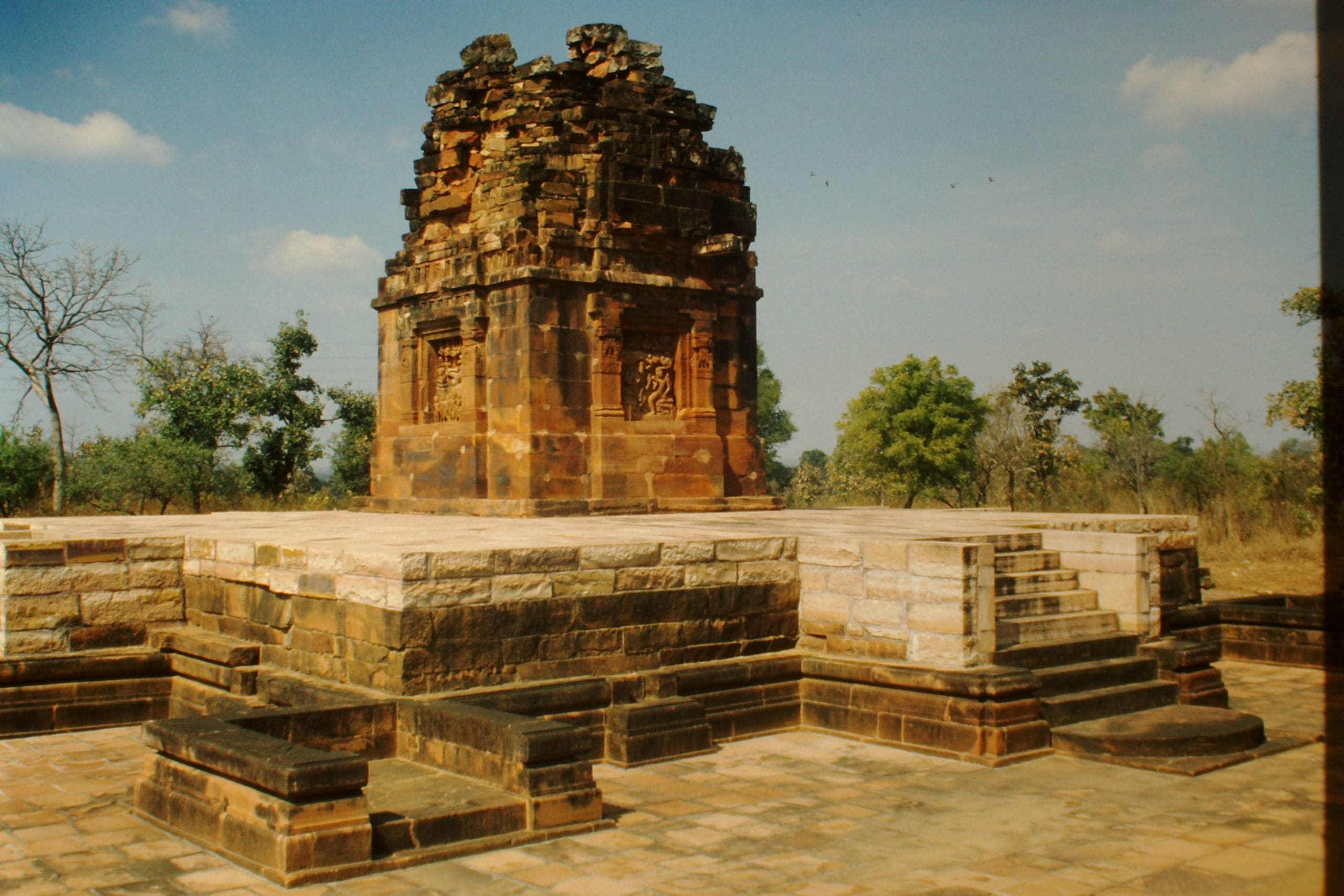
01 · Why Deogarh
The Rāmāyaṇa in pieces
Deogarh matters to the Rāmāyaṇa not because of where it is, but because of what was carved on it. Its terrace carried scenes from the epic, and the record of those scenes, from 1875 to the museum label, shows how scenes get named, renamed and moved.
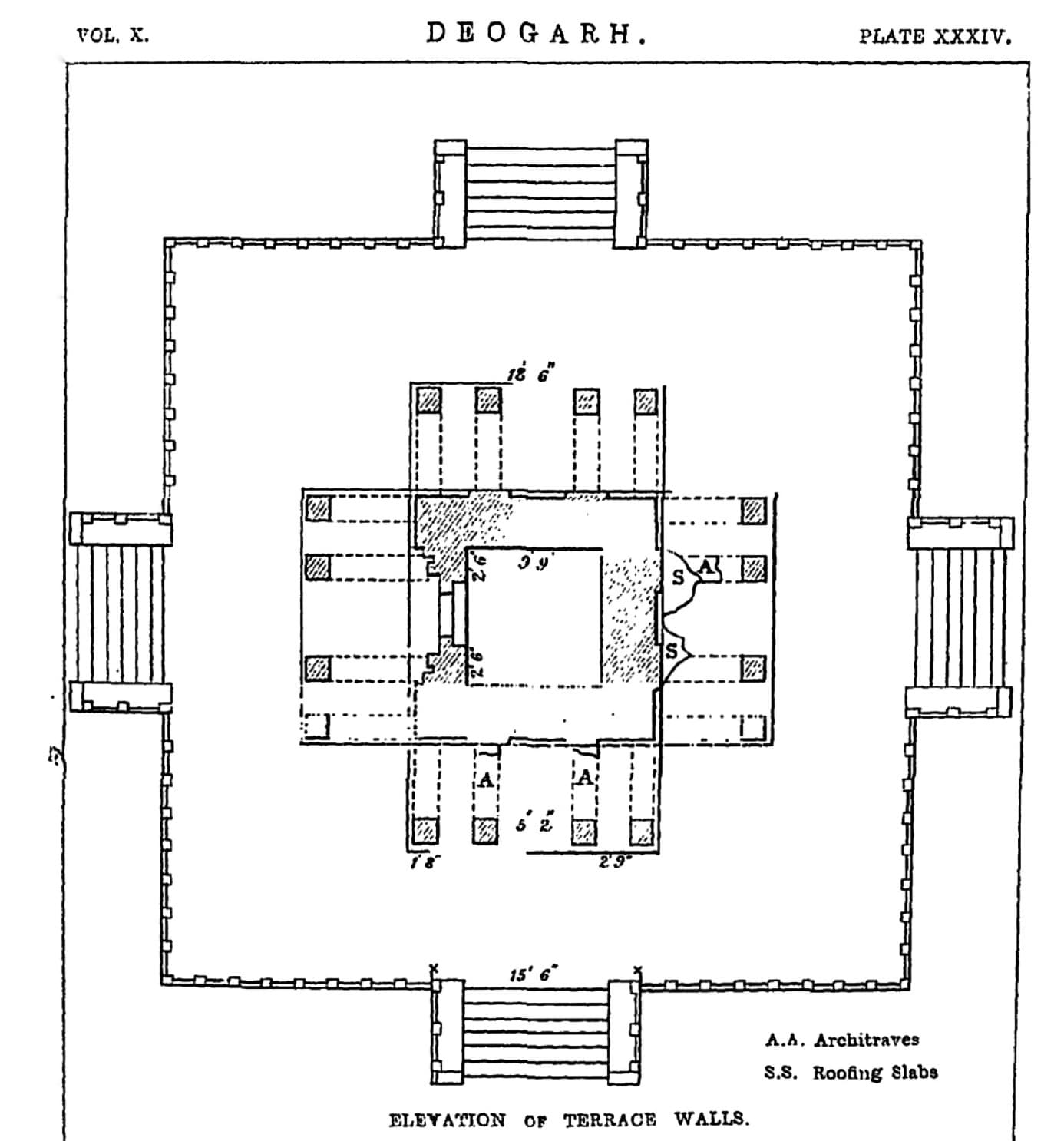
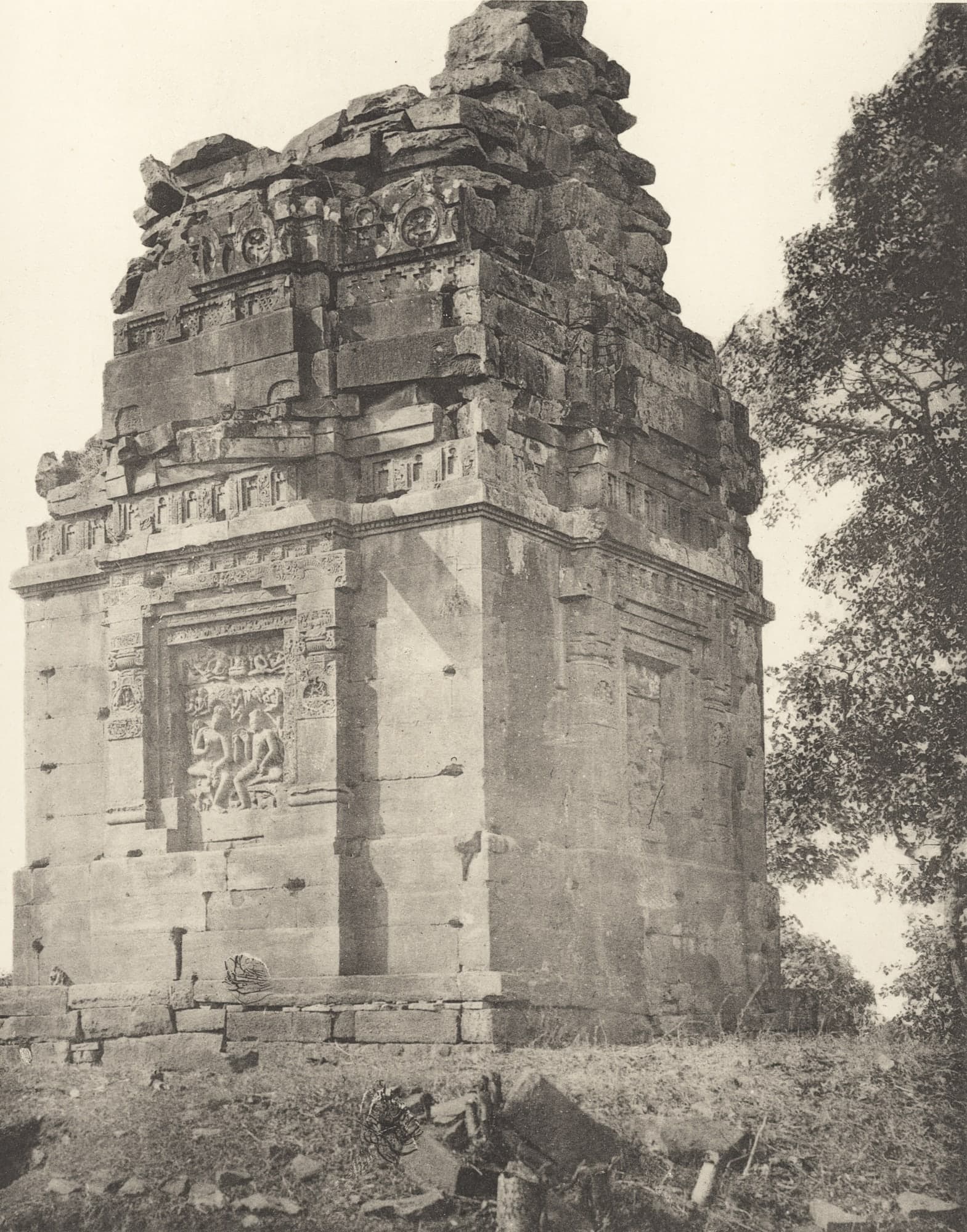
The temple is a small square shrine in the middle of a broad raised terrace, with a staircase at the centre of each side S3S1. It was dedicated to Viṣṇu, though its original cult image does not survive S3S2S1. Modern scholars usually place it around 500 CE or in the first half of the sixth century S1S4S10.
Whether the Rāmāyaṇa panels are as old as the temple is debated: Sahni thought they might be somewhat later S2S1. Vālmīki’s text names no place connected with Deogarh. The temple’s link to the epic is through its sculpture, not its geography S6S1.
- Established
Directly documented by primary evidence or Indian archaeological record; not in serious dispute.
- Strong inference
Well supported by epigraphy, chronology or architectural analysis, but reconstructed rather than explicitly recorded.
- Debated
Scholarly opinion differs, or the surviving evidence does not settle the question.
- Later tradition
Preserved in literary or regional tradition later than the monument itself; not contemporary testimony.
- Unknown
No surviving primary record establishes this, and it is left open rather than inferred.
- Investigative claim
A modern hypothesis or observation, recorded and examined here without being treated as established fact.
02 · Architecture
A Viṣṇu temple on a carved terrace
The narrative panels belonged to the terrace walls, not to the shrine. Cunningham estimated that the walls once held about 80 sculptured panels, twenty to a side S3.
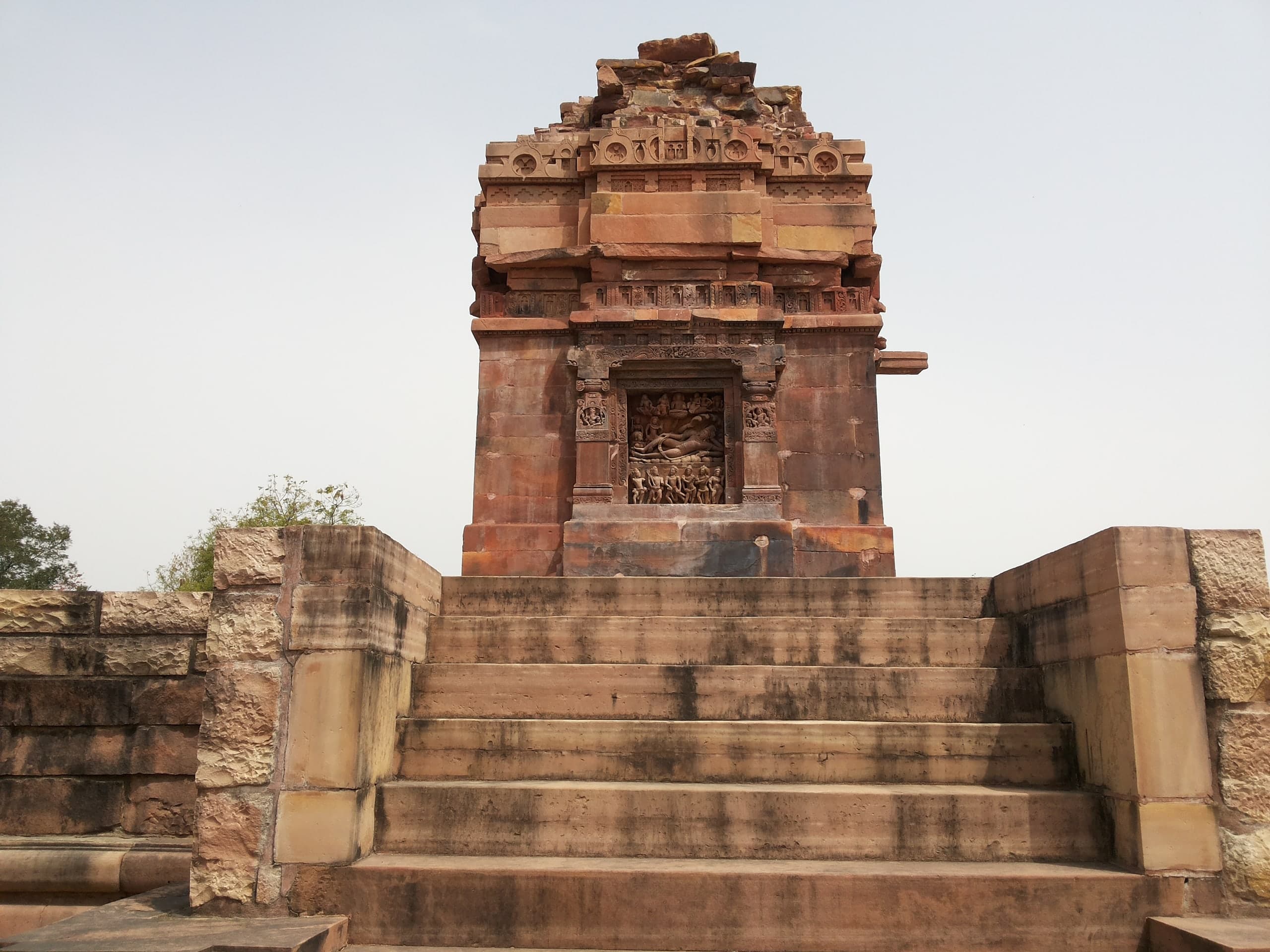
Small shrines stood at the four corners of the terrace, making the complex an early five-shrine (pañcāyatana) layout S1S2S8. The three sides of the shrine without the door carry large relief niches, which are still in place S1S4S8.
The name “Daśāvatāra temple” is modern. P. C. Mukherji gave it in 1899, from the ten incarnations of Viṣṇu he believed had been carved on it. Cunningham called it simply “the Gupta temple”, and locally it was known as Sāgar Maṛh, after the rock-cut well in front S1S3S9S8. Sahni thought the name untenable, since apart from Rāma he found no incarnations of Viṣṇu. Vats later found Kṛṣṇa, Balarāma, Narasiṃha and Vāmana reliefs as well, but still preferred “the Gupta temple” S2S1.
Four panels left in place
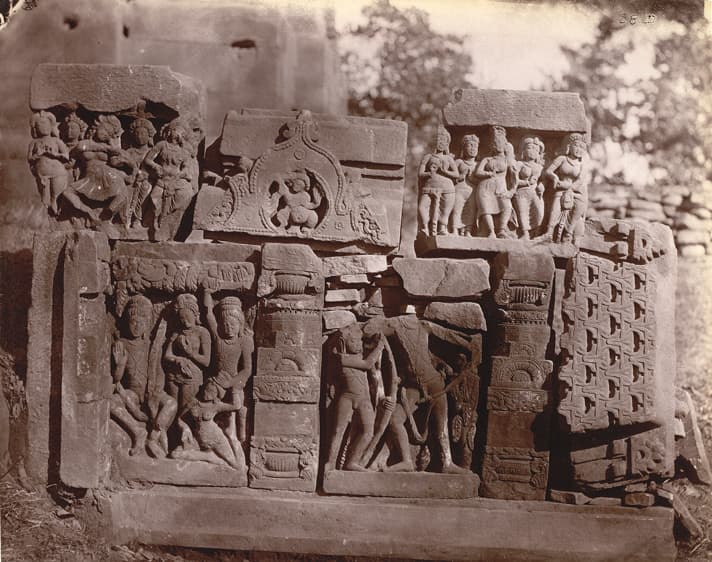
By the 1870s only four of the terrace panels were still in place: two on the south face and two on the west S3. In 1917–18 Daya Ram Sahni excavated the buried terrace and exposed the plinth and the remains of the corner shrines S2S1. Most of the plinth’s sculpture is lost; Sahni called the missing Rāmāyaṇa panels “irretrievably lost” S2S1S4.
03 · The anchor panel
One scene read alike since 1875: Śūrpaṇakhā
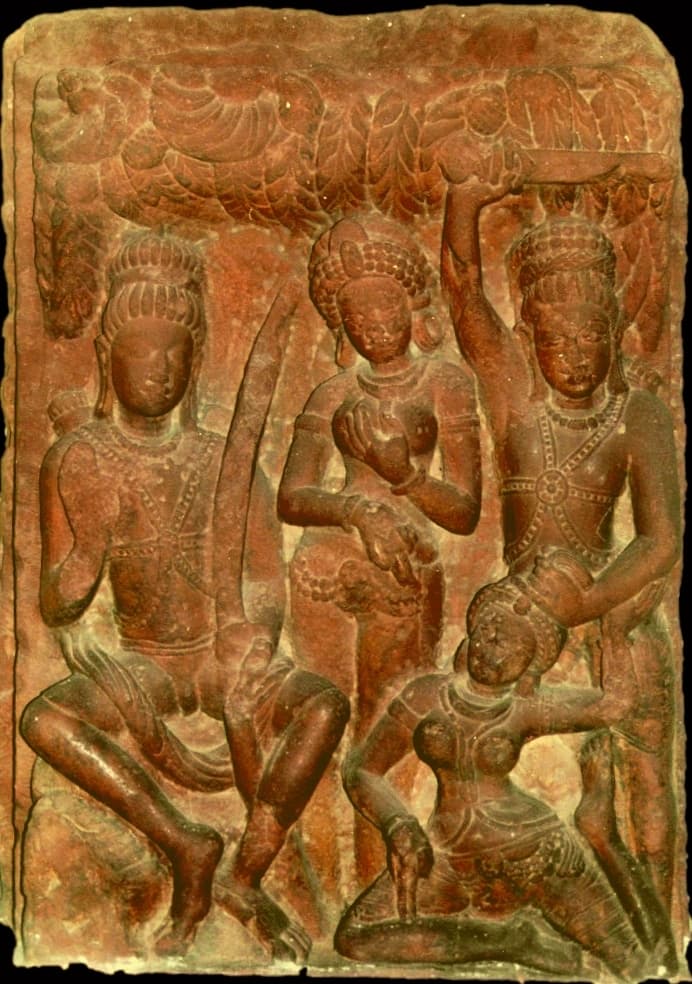
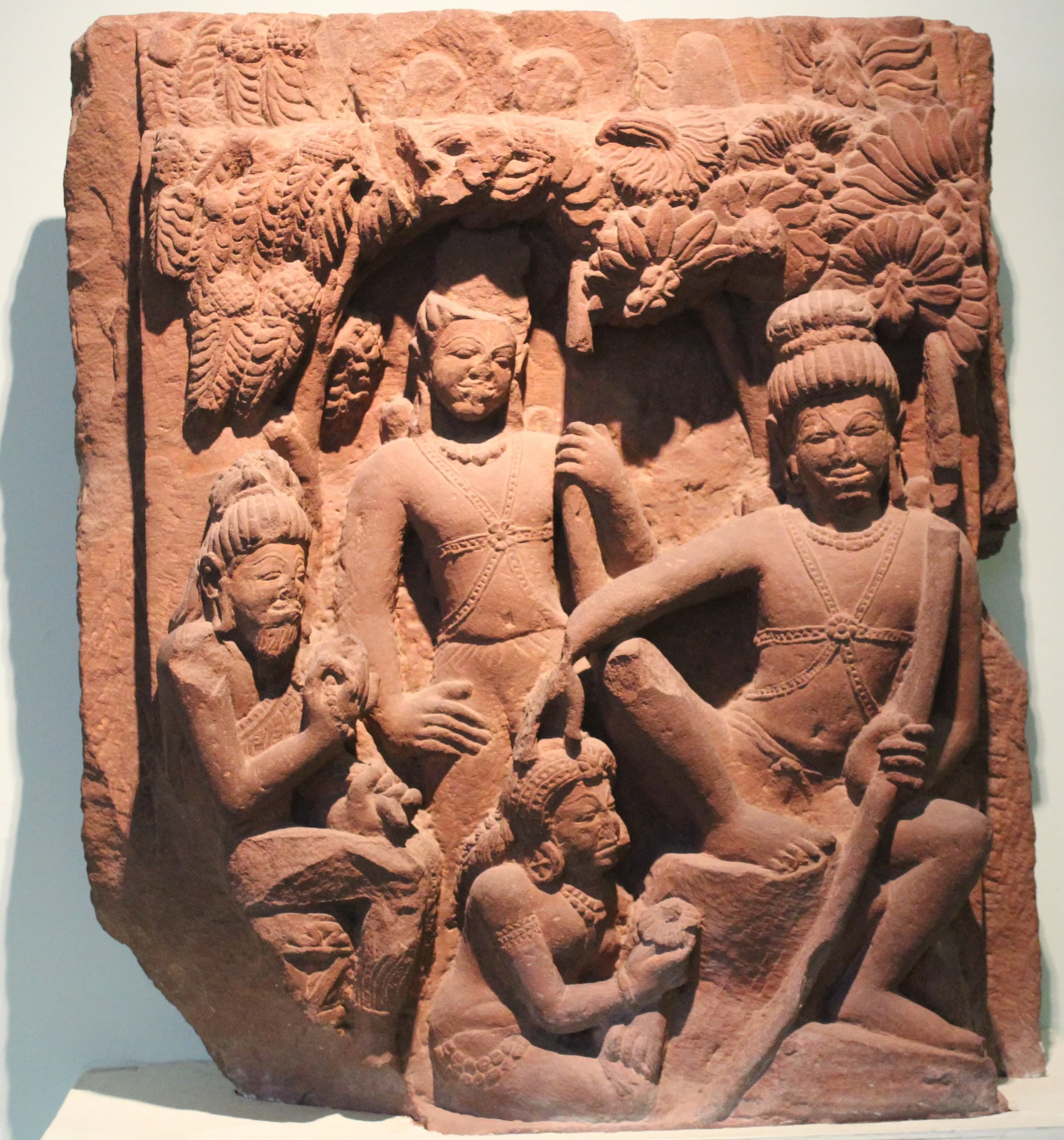
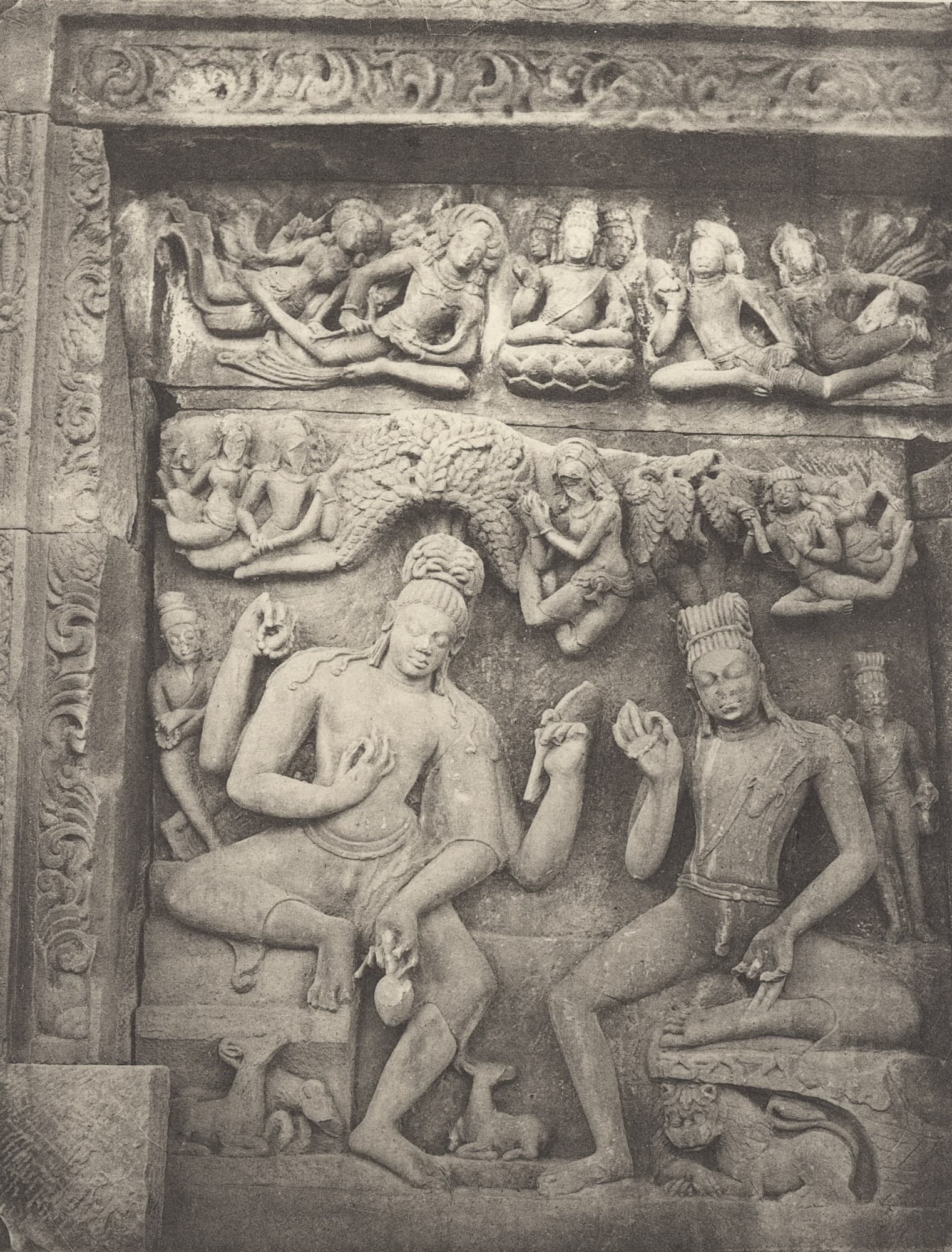
The corner panel on the south face shows Lakṣmaṇa about to cut off Śūrpaṇakhā’s nose in the presence of Rāma and Sītā. J. D. Beglar proposed this reading in 1875, the earliest on record; Cunningham accepted it, and Sahni and Vats repeat it S3S2S1.
It is the only Rāmāyaṇa panel at Deogarh whose identification has stayed the same from 1875 to the present museum label, and the only one whose movements can be followed to the present day S3S2S1S7.
1875
In place on the south face
The panel is at the corner of the south face of the terrace, one of four still in place; Beglar identifies the scene S3.
1880
Published by Cunningham
Cunningham describes a “king”, a “queen”, and a man grasping a kneeling woman’s hair with his sword raised, and accepts Beglar’s reading S3.
by 1918
Built into a modern wall
The panel has been built into an enclosure wall put up by the Public Works Department. Sahni rescues it and says the wall is probably why it survived S2S1. When and why it was moved is not recorded.
1928–1951
The site godown
Vats builds a sculpture godown east of the temple in 1928; by 1951 most surviving panels are kept there S1.
Today
National Museum, New Delhi
The panel is in the National Museum, New Delhi, Acc. No. 51.178, labelled as from Deogarh S7S1. When it reached Delhi is not recorded in the sources read.
The panel, as described
04 · Readings, not certainties
The panel audit
Vats catalogued ten Rāmāyaṇa panels in 1952. Each reading below is his, or an earlier scholar’s, at the confidence that scholar gave it. One panel can be traced today with certainty, and a second very likely.
Sahni’s 1918 excavation recovered only one Rāmāyaṇa panel, which he read as Rāma and Lakṣmaṇa visiting the hermitage of Śabarī S2. Vats’s catalogue has no Śabarī scene S1. Four more fragments were found in the jungle by Y. R. Gupte; Sahni read one as probably the installation of Sugrīva and one as Rāma, Lakṣmaṇa and Sītā standing side by side, and thought two others uncertain S2. Whether any of these are among Vats’s panels has not been established.
By 1951 most of the surviving panels were in a sculpture godown that Vats had built at the site in 1928; he marks none of the ten Rāmāyaṇa panels as still in place on the terrace S1.
| Panel | Reading, who makes it, and where it is now | Status |
|---|---|---|
| R.1 · Ahalyā | Rāma releasing Ahalyā from her curse, with Lakṣmaṇa and Viśvāmitra: “very likely”, says Vats S1S5. Very likely now in the National Museum, New Delhi, which attributes it to Deogarh; that rests on copies of the museum’s caption and a match with Vats’s plate, and no accession number has been seen S11S1. | Strong inference |
| R.2 · Into exile | Two men and a woman walking side by side: Rāma, Sītā and Lakṣmaṇa going into exile, “evidently”, says Vats S1. Where it is now is not known. | Strong inference |
| R.3 · Atri’s hermitage | A seated sage, a woman placing her hands on another woman’s head, and two peacocks “may, perhaps” show Anasūyā blessing Sītā at Atri’s hermitage, says Vats S1S5. Where it is now is not known. | Investigative claim |
| R.4 · Śūrpaṇakhā | Lakṣmaṇa about to cut off Śūrpaṇakhā’s nose, Rāma and Sītā present: Beglar, Cunningham, Sahni and Vats agree S3S2S1. Now in the National Museum, New Delhi, Acc. No. 51.178 S7. | Established · read alike since 1875 |
| R.5 · The archers | A man drawing a bow beside a boy stringing one, recorded on the south face in the 1870s S3. “Perhaps Rāma and Lakṣmaṇa”, said Sahni; it “might possibly” be the killing of the rākṣasas in the Daṇḍaka forest, said Vats S2S1. Where it is now is not known. | Investigative claim |
| R.6 · Rāvaṇa and Sītā | Possibly Rāvaṇa seizing Sītā; Vats himself calls this “a mere surmise” S1. Not an identified scene. Where it is now is not known. | Unknown |
| R.7 · Sugrīva’s garland | Lakṣmaṇa garlanding Sugrīva in Rāma’s presence, so that Rāma can tell him from Vālin in the duel: Vats’s reading, tied to the garland in the text (4.12.35–36) S1S6. Where it is now is not known. | Strong inference |
| R.8 · Sugrīva roused | Sugrīva lying drunk, with Rumā, Hanumān and, “presumably”, Aṅgada urging him to rise: Vats’s reading S1S6. Where it is now is not known. | Strong inference |
| R.9 · The aśoka grove | Possibly Rāvaṇa threatening Sītā in the aśoka grove; Vats calls this “merely tentative” S1. Not an identified scene. Where it is now is not known. | Unknown |
| R.10 · The herb mountain | A monkey in flight holding up a mountain, “possibly” Hanumān carrying the herb peak, says Vats S1. The text has two such journeys, so the fragment cannot be tied to one S6. Where it is now is not known. | Investigative claim |
| Sahni, 1918 · Śabarī | Rāma and Lakṣmaṇa at Śabarī’s hermitage: Sahni’s reading of the one Rāmāyaṇa panel he excavated S2. Whether this is the panel Vats later read as Ahalyā is not known S2S1. | Unknown |
05 · The epic
What the panels show of the epic
Every episode that Vats identifies with any confidence appears in the critical edition of Vālmīki’s Rāmāyaṇa: Ahalyā, the departure into exile, Atri and Anasūyā, Śūrpaṇakhā, Sugrīva’s garland, Sugrīva’s drunkenness, and the herb mountain S6. That shows the episodes are in the text, not which telling the sculptors knew.
The Ahalyā panel, as Vats describes it
The critical text
- The two princes clasp Ahalyā’s feet, and she receives them as guests (1.48.17–18) S6.
- If Vats’s identification holds, the panel does not follow the critical text’s gesture. Which telling the sculptors followed is not claimed here.
06 · Chronology
How old are the panels?
No foundation inscription dates the temple. Its date rests on the style of its architecture and sculpture S3S1.
Modern scholars usually place the temple around 500 CE or in the first half of the sixth century S1S4S10. Vats preferred “the early part of the sixth century” S1; Lubotsky says the temple was completed in “the first half of the sixth century”, citing Williams S4S10. Cunningham, whose 1880 report is the earliest detailed description found in this research, dated it later, between 600 and 700 CE S3; that date is superseded.
A pillar found in the compound has a two-line inscription in Gupta script naming “the illustrious Bhāgavata Govinda”, a votary of “the Lord of Keśavapura” S1. The inscription is undated, and that the pillar belonged to this temple is an inference.
Are the panels as old as the temple?
Scholars disagree. Sahni thought the Rāmāyaṇa panels stylistically somewhat later, possibly added when the plinth was renewed. Vats treats them as part of the original Gupta programme S2S1. The panels are usually treated as part of the original plinth, but their date is not settled.
07 · On the shrine
What survives in place
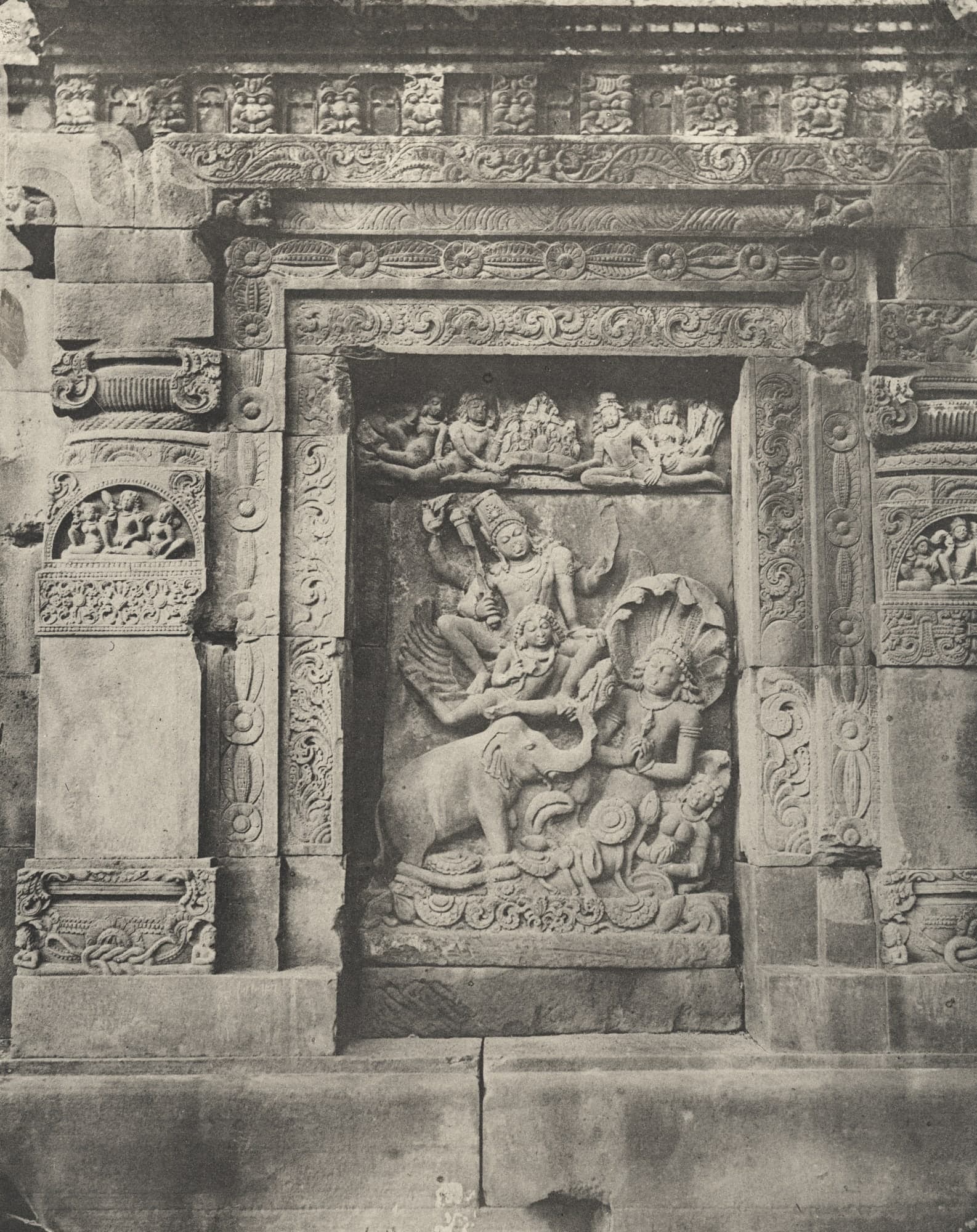
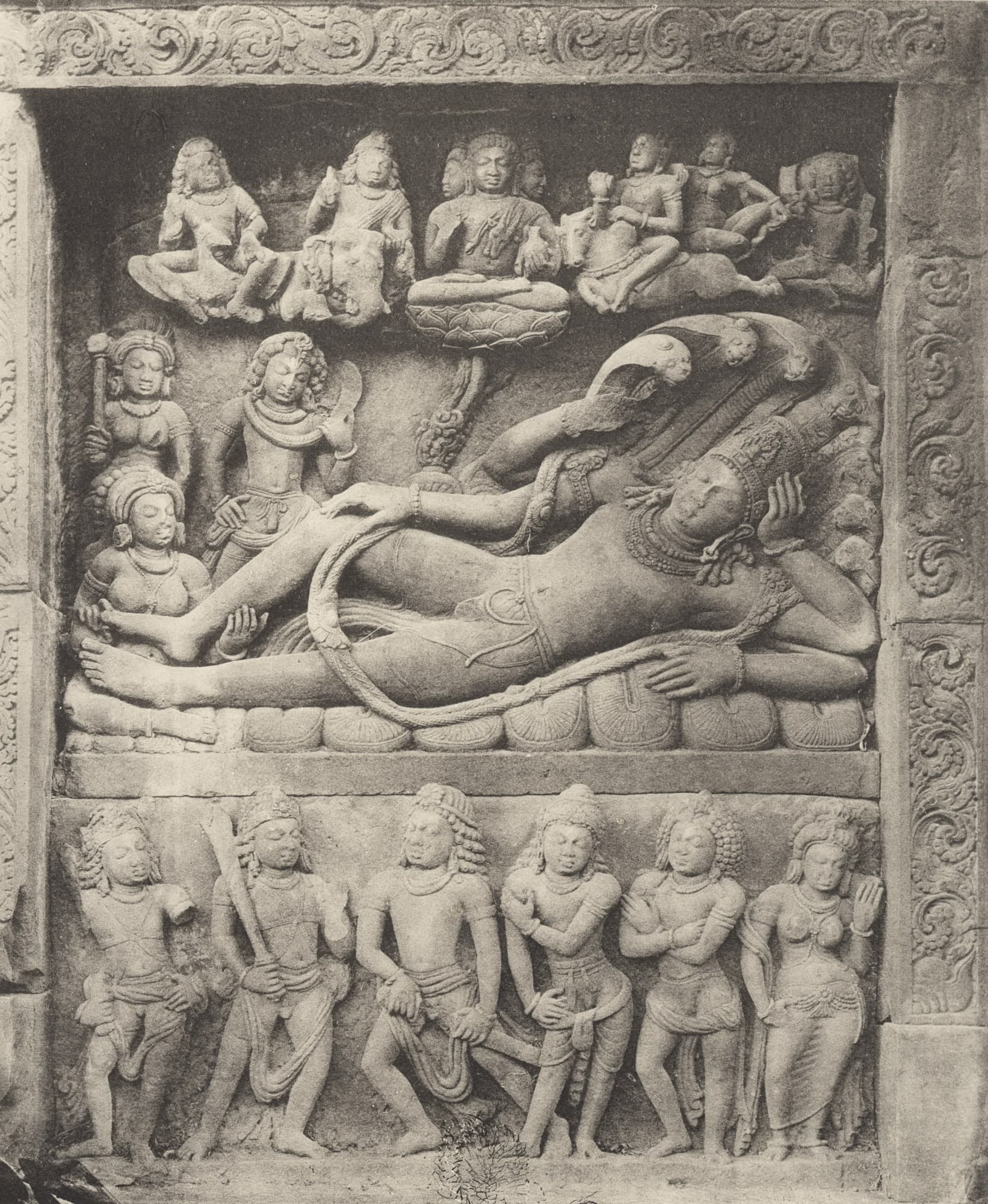
While the terrace panels were scattered, the shrine kept its doorway and three great relief niches: Gajendramokṣa (Viṣṇu rescuing the elephant king), Nara-Nārāyaṇa, and Viṣṇu reclining on the serpent Ananta S1S4S8.
Lubotsky argues that a chapter of the Viṣṇudharmottara Purāṇa, a text he dates to about the seventh century, describes this temple. He notes, though, that the text’s list of deities for the platform panels does not include the Rāma and Kṛṣṇa scenes S4. The identification is his argument, not a consensus.
Today the temple is presented as a protected archaeological monument. Its site board tells visitors that the plinth was “originally adorned with panels showing scenes from Ramayana and Krishna-lila” S8. Whether any worship takes place at the shrine today was not researched, and this page does not cover it.
08 · Evidence
What we know, and what remains open
The temple, its panels and the epic each have their own evidence.
| Statement | Basis | Status |
|---|---|---|
| The temple was dedicated to Viṣṇu | Cunningham, Sahni and Vats; the original cult image does not survive S3S2S1. | Strong inference |
| It dates to about 500 CE or the first half of the sixth century | Stylistic dating; there is no foundation inscription S1S4S10. | Strong inference |
| The Rāmāyaṇa panels are as old as the temple | Sahni thought them somewhat later; Vats treats them as original S2S1. | Debated |
| The Śūrpaṇakhā panel is National Museum Acc. No. 51.178 | The museum label, and the identification stable since 1875 S7S3S1. | Established |
| The Ahalyā panel is in the National Museum | Copies of the museum caption and a match with Vats’s plate; no accession number seen S11S1. | Strong inference |
| Where the other eight catalogued panels are now | Not confirmed. In 1951 Vats marks none of them as in place; most surviving panels were then in the site godown S1. | Unknown |
| The original order of the scenes is lost | The original place of most fragments is unknown S4S1. | Established |
| The name “Daśāvatāra” is modern (Mukherji, 1899) | Mukherji gave the name in 1899; Sahni rejected it, and Vats preferred “the Gupta temple” S1S2S9. | Established |
| Vālmīki names no place connected with Deogarh | No such reference appears in the critical edition S6. | Established |
| Deogarh’s panels are older than Nachna Kuthara’s | Both are assigned to the same broad horizon S5; Nachna’s date was not verified in this research. | Unknown |
Open questions
These are gaps in the surviving record rather than settled conclusions. Each remains open until primary documentation or published scholarship closes it.
- Where eight of the ten Rāmāyaṇa panels in Vats’s catalogue are today.
- Whether the panel Sahni read in 1918 as Śabarī’s hermitage is the panel Vats read as Ahalyā.
- An accession record for the Ahalyā panel in the National Museum.
- Whether the Rāmāyaṇa panels belong to the original temple or to a later renewal.
- The original position of most panels on the terrace, and so the order of the scenes.
- When and why the south-face panels were moved into the Public Works Department wall.
- The date of the Nachna Kuthara panels, and so how the two sites compare.
- The museum label for the Śūrpaṇakhā panel disagrees with other records on its century and its size.
- Whether any worship takes place at the shrine today.
09 · Sources
Source library
Every citation on this page links here.
- S1ASI1952
The Gupta Temple at Deogarh (Memoirs of the Archaeological Survey of India, no. 70)
The panel catalogue (R.1–R.10), with Vats’s own confidence wording; where the panels were in 1951; the inscribed pillar; his date.
Open indexed source ↗ - S2ASI1918
Annual Progress Report of the Superintendent, Hindu and Buddhist Monuments, Northern Circle, for the year ending 31st March 1918
The 1917–18 excavation of the terrace; the panels recovered and rescued; Sahni’s readings and his view that the Rāmāyaṇa panels look somewhat later than the temple.
Open indexed source ↗ - S3ASI1880
Report of Tours in Bundelkhand and Malwa, 1874–75 and 1876–77 (Archaeological Survey of India Reports, vol. X)
The earliest detailed description found: the terrace, the estimate of about 80 panels, the four still in place, Beglar’s reading of the Śūrpaṇakhā panel, and Cunningham’s date.
Open indexed source ↗ - S4International scholarship1996
The Iconography of the Viṣṇu Temple at Deogarh and the Viṣṇudharmottarapurāṇa
The modern date, the three reliefs in place, the unknown original position of the Rāma fragments, and his reading of the Viṣṇudharmottara Purāṇa.
Open indexed source ↗ - S5Indian scholarship2018
Visualising the Rāmāyaṇa: Power, Redemption and Emotion in Early Narrative Sculptures (c. Fifth to Sixth Centuries CE)
Deogarh with Nachna Kuthara among fifth- to sixth-century Rāmāyaṇa narrative sculpture (abstract only read).
Open indexed source ↗ - S6Primary text1960–75
Vālmīki Rāmāyaṇa, Critical Edition, Kāṇḍas 1–6
Where each episode named on the panels appears in the text, and where text and panel differ.
Open indexed source ↗ - S7Archival recordphotographed 2017
Object label: “Lakshmana disfiguring Surpanakha”, Acc. No. 51.178
The museum’s accession number and Deogarh attribution for the Śūrpaṇakhā panel. Only the label text is used.
Open indexed source ↗ - S8ASIby 2015
“Dasavatar Temple” interpretation board at the temple
What the site itself tells visitors.
Open indexed source ↗ - S9Archival record1899
Report on the Antiquities in the District of Lalitpur, N.-W. Provinces, India
Origin of the name “Daśāvatāra temple” (known here through Vats and Sahni).
Open indexed source ↗ - S10International scholarship1982
The Art of Gupta India: Empire and Province
The standard discussion of the temple’s date, known here only through Lubotsky’s citation.
Open indexed source ↗ - S11Archival recordundated
“Selections from the National Museum, Delhi” (museum captions, as transcribed)
A secondary copy of the museum’s caption attributing the Ahalyā panel to Deogarh. Weak on its own.
Open indexed source ↗ - S12Archival record2007
L’âge d’or de l’Inde classique. L’empire des Gupta (Paris), p. 288
A catalogue entry for the Śūrpaṇakhā panel, quoted on Commons; the catalogue itself was not seen.
Open indexed source ↗