01 · Why Janakpur
A Rāmāyaṇa landscape, made on the ground
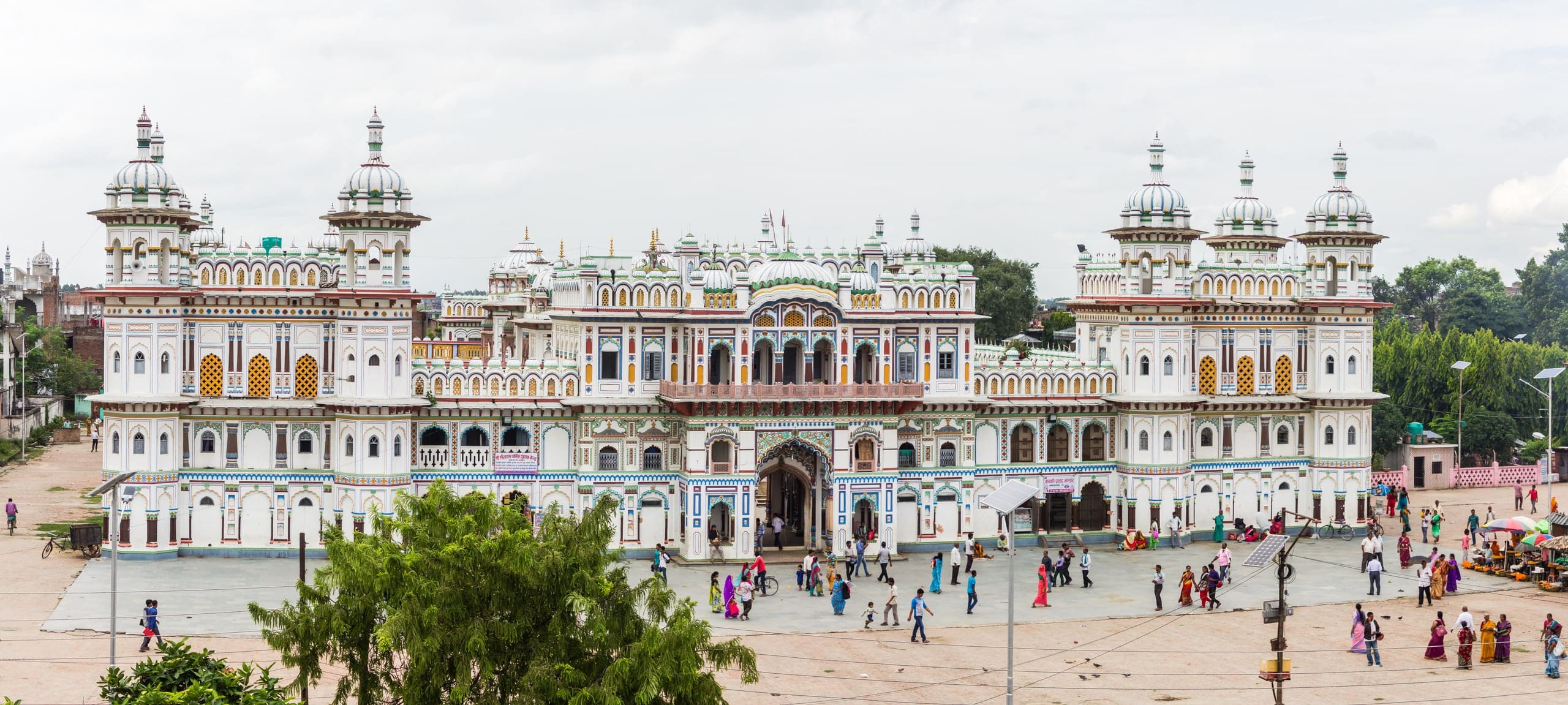
Janakpur shows a sacred geography being made. The epic sets Sītā’s birth and wedding in Mithilā but names no site S1. From about 1700, ascetics, on land granted by kings, gave that Mithilā a place on the map, and a scholar later recorded both their stories and their land documents S4.
This page keeps the layers apart: what Vālmīki says, what critical scholarship says about the book that tells it, how Janakpurdham was founded as a pilgrimage field, and what is and is not known about the present temple.
Nepal placed the temple on UNESCO’s Tentative List in 2008 under the name “Ram Janaki Temple” S5. It is not a World Heritage Site S6.
- Established
Directly documented by primary evidence or Indian archaeological record; not in serious dispute.
- Strong inference
Well supported by epigraphy, chronology or architectural analysis, but reconstructed rather than explicitly recorded.
- Debated
Scholarly opinion differs, or the surviving evidence does not settle the question.
- Later tradition
Preserved in literary or regional tradition later than the monument itself; not contemporary testimony.
- Unknown
No surviving primary record establishes this, and it is left open rather than inferred.
- Investigative claim
A modern hypothesis or observation, recorded and examined here without being treated as established fact.
02 · The epic
What Vālmīki says
In the critical edition, Janaka himself tells how Sītā was found: a girl rose from the furrow while he was ploughing a field. The passage is set in Mithilā, the city of the Videhas, and names no field, village or site S1.
Vālmīki Rāmāyaṇa · Critical Edition 1.65.14–15
Risen from the plough
lāṅgalād utthitā … nāmnā sīteti viśrutā … ayonijā
Vedika rendering: risen from the plough, she is known by the name Sītā … not born from a womb.
Short phrases from the Baroda critical edition, quoted from the GRETIL e-text. In the vulgate numbering the passage is 1.66.13–14. The translation is a concise Vedika rendering.
What the epic says
- Janaka tells that a girl rose from the furrow as he ploughed a field; she was named Sītā and was “not born from a womb” S1.
- Janaka had promised her to the man who could string Śiva’s bow. At his court in Mithilā, Rāma breaks it “in the middle” S1.
- Janaka fixes the wedding for the day of the asterism Uttara Phalgunī, and gives Sītā to Rāma: “This is Sītā, my daughter, your partner in dharma” S1.
A later layer
In J. L. Brockington’s view, the Bālakāṇḍa, the book that holds the furrow birth and the wedding, is a late addition to the epic, and the account of Rāma’s marriage a further expansion within it S3. He finds that earlier parts of the epic speak of Sītā as Janaka’s daughter in the ordinary way, and concludes that the furrow story is probably a later development S3. He notes a contrary view by R. Antoine (1975) S3.
03 · Founding tradition
The city that “reappeared”
Burghart found no chronicle of Janakpur’s founding. When the anthropologist Richard Burghart worked there in 1973–75, the only accounts of its founding were stories told by ascetics, pandits and bards about the forebears of the monastery abbots S4.
In the ascetics’ tradition, ancient Janakpur was destroyed in the Dvāpara age and vanished under jungle. In the Kali age it “reappeared” to two ascetics, Caturbhuj Giri and Sūr Kiśor S4. The tellers do not agree on which of them came first S4.
In the story, Sūr Kiśor’s small image of the maiden Sītā emerged from the ground beneath a margosa tree and so revealed the site of Janaka’s palace, where the Jānakī monastery stands S4. Burghart notes that the image’s emergence recalls Sītā’s own emergence from the furrow S4.
Burghart reads these stories as devotion rather than chronicle. In his words, they tell “not so much … about the history of a place but rather … about a place which releases man from history” S4.
04 · Chronology
Ascetics, kings and land, c. 1700–1816
The land documents of the Janakpur monasteries, known here through Burghart’s study, date the founding more closely than the stories do S4.
The original grants to the first monasteries do not survive S4. Burghart argues that the hill kings’ grants to Janakpur’s ascetics went with their wars for the rich eastern Tarai, and that large royal grants stopped once Nepal’s border was fixed after 1816 S4S7. He finds the evidence for such a link weaker for the Sen kings and more convincing for the Shāhs, and holds that the ascetics themselves came for devotion, not for land S4.
c. 1700
Two monasteries
Land documents indicate that Caturbhuj Giri and Sūr Kiśor founded the Rām Candra and Jānakī monasteries at or shortly after the turn of the eighteenth century S4. The exact year is not known.
1727
Land in the goddess’s name
An 1811 confirmation of land rights records that King Māṇik Sen of Makwanpur granted land in the name of the goddess Jānakī S4.
1740
The name on a grant
The earliest surviving land grant to name the “Janakpur mauja” S4. Burghart asks whether the name was already in local use or was given after the “reappearance”.
1781
A grant for Hanumān
One of the Shāh kings’ largest grants goes to Pritam Dās of the Hanumān Nagar monastery S4.
1792
“Worship especially the Bow”
Appointing an abbot of the Jānakī monastery, King Raṇa Bahādur Shāh closes his order: “Worship especially the Bow of Śiva at Dhanusā” S4.
c. 1800
A pilgrimage field
Burghart describes Janakpurdham at this time as a field of monasteries, ponds, fields and forest with a twice-weekly bazaar, not yet a town S4.
1805
A pilgrims’ guide
The Śrī Mahārāja Caritra, finished in 1805, is the earliest description of Janakpurdham as a Vaiṣṇava pilgrimage centre that Burghart found. It tells pilgrims to begin at King Janaka’s palace, the present Jānakī monastery S4.
1807
A copper plate
A large grant to the abbot of the Rām Candra monastery fulfils a vow made in 1806 by the general Amar Siṃha Thāpā. The copper plate is kept in the monastery S4.
1814–16
War and a border
East India Company troops occupy Janakpurdham in December 1814. After the 1816 Sagauli settlement it stays in Nepal, about seven miles from Company territory S4.
05 · Architecture
The temple: what is known and what is attributed
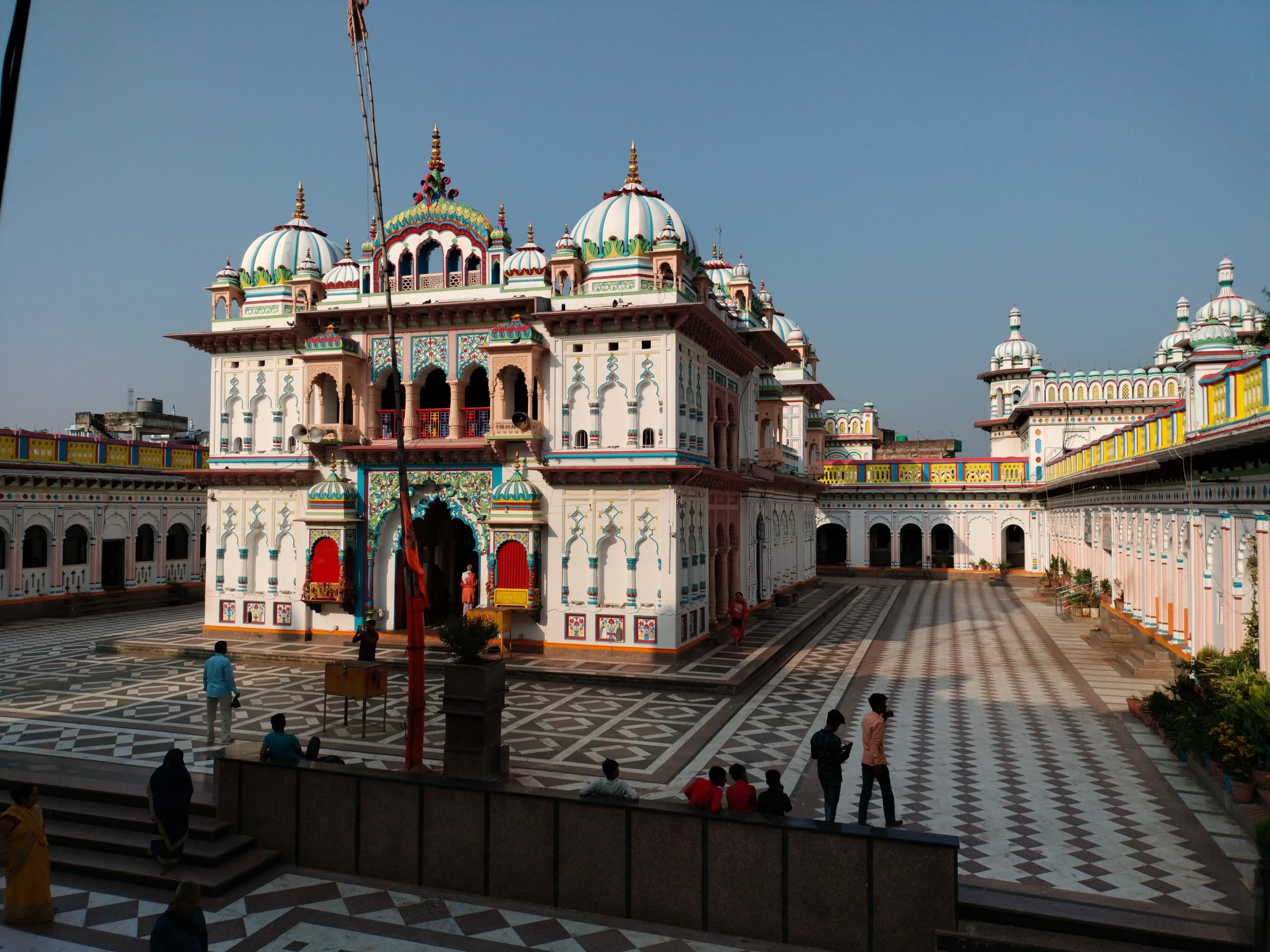
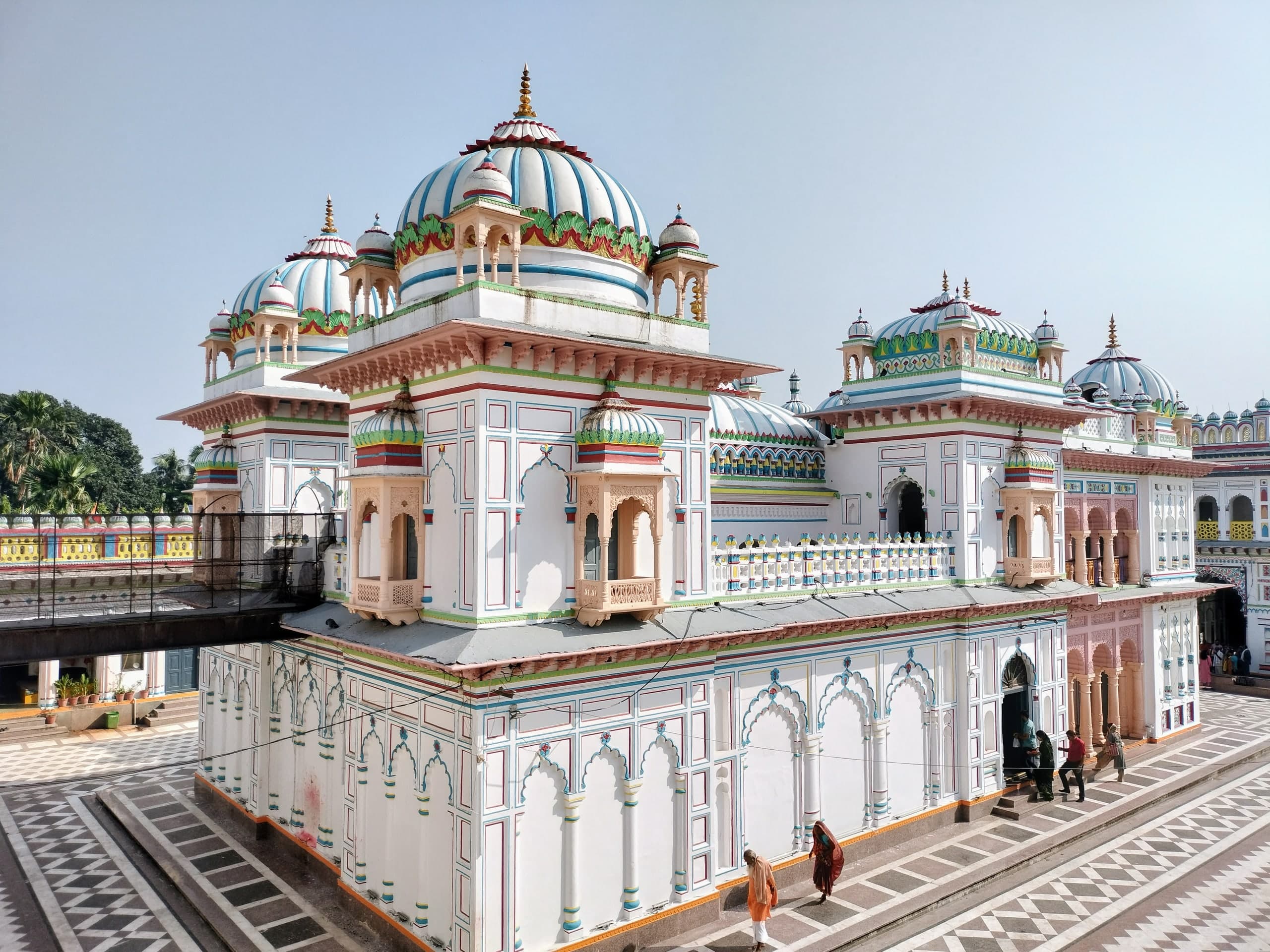
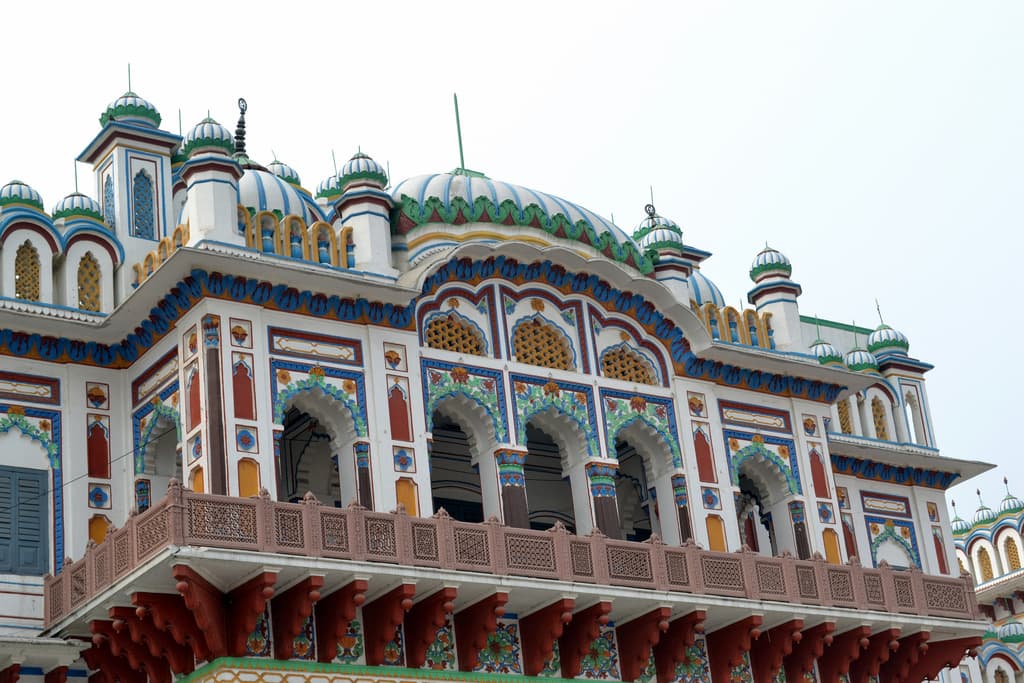
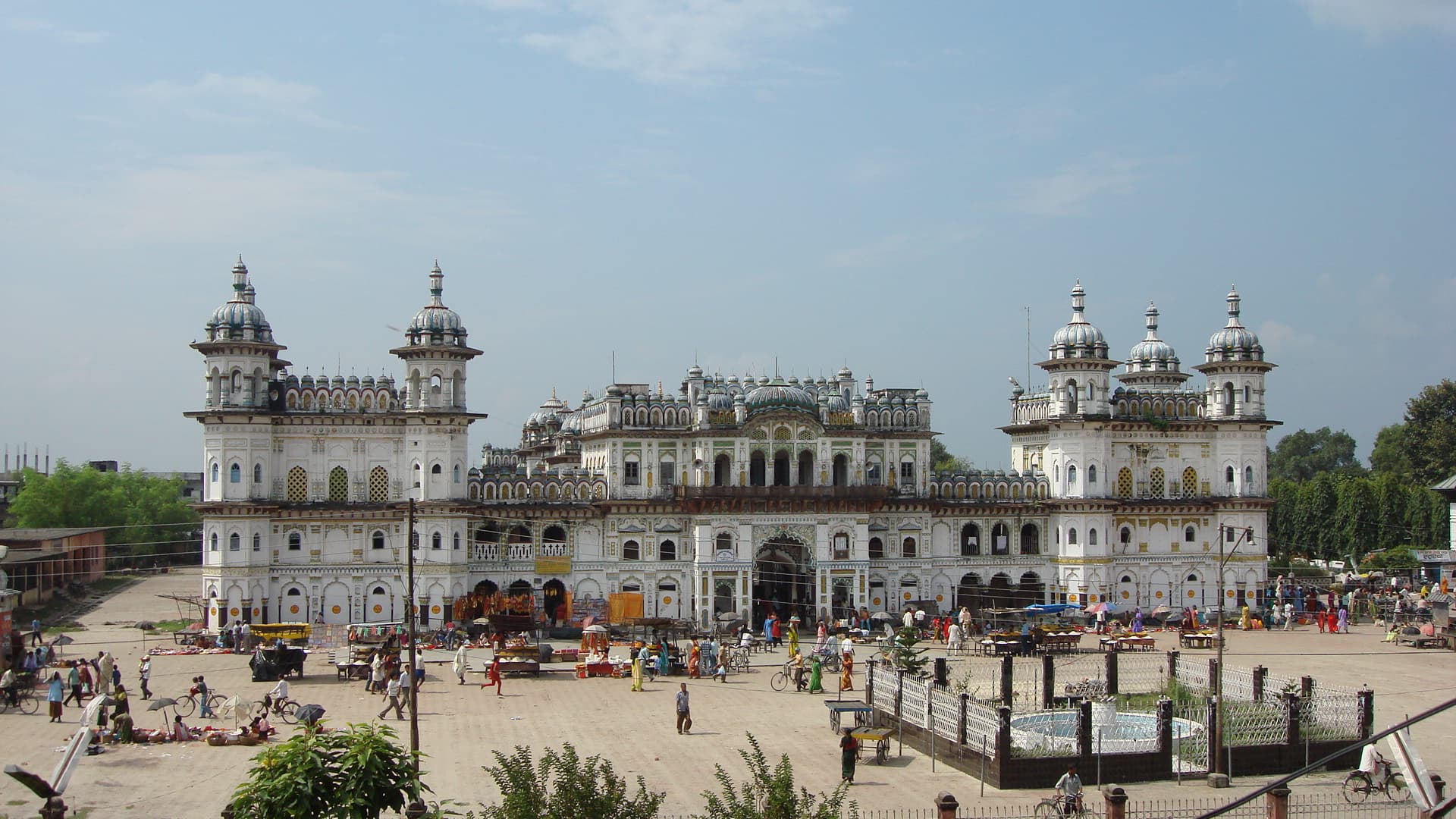
Nepal’s Tentative List entry describes the temple’s architecture as “of a much later period”, in a blend of classical and neo-classical design with elements of fortification S5. That is the State Party’s description, not an architectural study.
The present building is credited, in tourism and press accounts, to Queen Vṛṣabhānu Kumārī of Tikamgarh, in the Bundela state of Orchha S8S9. No inscription or scholarly source for this was found.
Its date is debated. Published accounts give 1910 S8S9 and 1874 S10; Nepal’s tourism board itself gives both S9S10. Burghart’s 1978 study does not date the building S4.
| Question | What the evidence says | Status |
|---|---|---|
| Who built the present temple? | Tourism and press accounts credit Queen Vṛṣabhānu Kumārī of Tikamgarh S8S9. No inscription or scholarly source for this was found. | Investigative claim |
| When was it built? | Published dates disagree: 1910 S8S9 and 1874 S10, both from Nepal’s tourism board. | Debated |
| How does Nepal’s submission describe the building? | “Of a much later period”, blending classical and neo-classical design with elements of fortification S5. | Established · the submission says this |
| How old are the remains at the site? | Burghart, writing in the 1970s without excavation, saw no visible ruins older than the mid-nineteenth century and called claims of “extensive ruins” baseless S4. Nepal’s 2008 Tentative List text speaks of vestiges of the “11th and 12th century” S5. The two are not reconciled here. | Debated |
| Is it a World Heritage Site? | No. Nepal’s Department of Archaeology placed it on the Tentative List on 30 January 2008 as the “Ram Janaki Temple”, under criteria (ii), (iii) and (vi) S5. Nepal’s four inscribed properties are Kathmandu Valley, Lumbini, Chitwan and Sagarmatha S6. | Established · Tentative List only |
06 · Sacred geography
Ponds and the parikramā
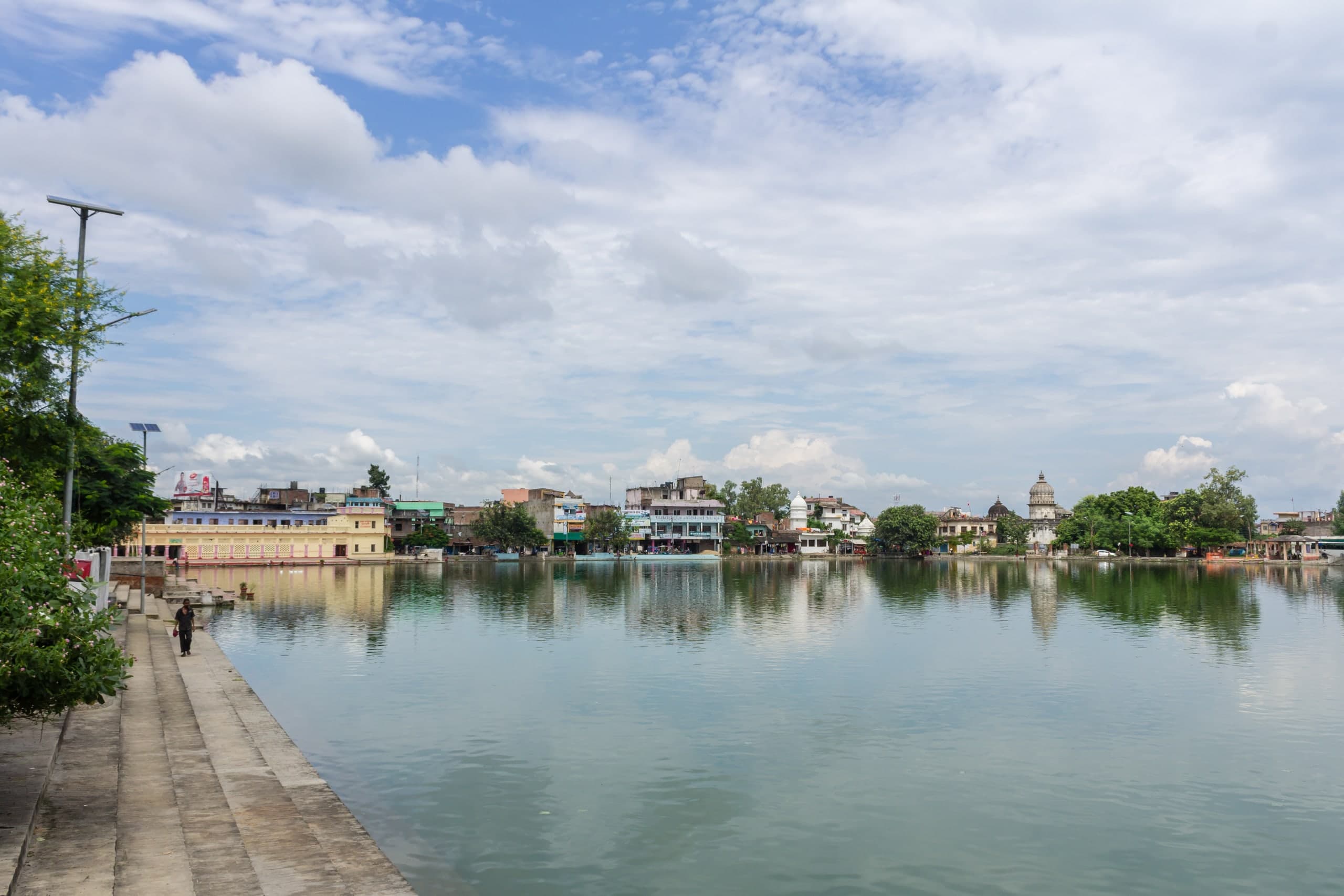
By 1805 Janakpur’s ponds already carried names from the Mithilā story. These identifications belong to later tradition S4.
The Śrī Mahārāja Caritra names Dhanusā Sar, where the bow lay; Gaṅgā Sāgar, where Mithi, first of the Janaka kings, was born; Ratna Sāgar; the Daśaratha and Lakṣmaṇa Kuṇḍs; and Argajā Kuṇḍ, where Sītā was anointed before her wedding S4.
The ascetics’ founding stories add more: Ratna Sāgar as King Janaka’s treasury, found by Raghunāth Dās, and Sītā Kuṇḍ as the pond where the child Sītā bathed, found by Rām Dās S4. The old trees on some banks suggest to Burghart that a few ponds may be older than 1700, but he leaves the question open S4.
The four gates
The ascetics took four Śiva temples about ten miles out, at Kalyāṇeśvar, Jaleśvar, Kṣīreśvar and Mithileśvar, as the gates of ancient Janakpur, and by the early nineteenth century a five-day circumambulation linked them S4. Burghart reads this as older Śaiva remains absorbed into the Vaiṣṇava cult as “ruins of ancient Janakpur” S4.
07 · Contested places
Contested places: Dhanusā and Sitamarhi
Two places carry episodes that Vālmīki sets only in Mithilā: the broken bow and the furrow.
At Dhanusā, about twelve miles north-east of Janakpur, a long seam of rock is worshipped as a surviving piece of Śiva’s bow S4. The epic says only that Rāma broke the bow in the middle S1. The abbot of the Jānakī monastery was traditionally the overseer of the Dhanusā shrine S4.
Nepal’s Tentative List text, which UNESCO says is the State Party’s sole responsibility, states that “according to Vedic literature” the temple stands at Sītā’s birthplace S5. The Vālmīki Rāmāyaṇa names no site S1.
Burghart records a different placement in the tradition that founded Janakpurdham S4. In it, Sitamarhi, now in Bihar, was where Janaka found Sītā in the furrow, and the 1805 guide lists it as a pilgrimage site 32 miles south-west of Janakpur S4. The same tradition placed Janaka’s palace and the wedding at Janakpur S4.
Whether Sitamarhi is older than Janakpurdham as an ascetic centre is not known S4. The border that now runs between them was fixed only after 1816 S4.
08 · Living tradition
Living Janakpur
Janakpur’s founding stories are also devotional ones.
Sūr Kiśor is remembered as worshipping Sītā as a young maiden, taking the part of her father’s brother, and carrying her small image wherever he went S4.
Nepal’s tourism board describes Vivāha Pañcamī, on the fifth day of the bright half of Mārgaśīrṣa, as the festival of Rāma and Sītā’s wedding, with re-enactments at the Vivāha Maṇḍapa beside the temple S9.
09 · Evidence
What we know, and what remains open
The epic, the founding tradition, the land documents and the present building each have their own evidence.
| Statement | Basis | Status |
|---|---|---|
| In Vālmīki, Sītā rises from a furrow Janaka is ploughing, in Mithilā | Critical Edition 1.65.14–15 S1. | Established · in the text |
| Vālmīki names no modern site as the place | No modern place is identified in the critical edition S1. | Established · absent from the text |
| The Bālakāṇḍa is a later addition to the epic | Brockington’s reading of the critical text S3. | Strong inference |
| Janakpur “reappeared” to two ascetics in the Kali age | The ascetics’ own tradition, as Burghart records it S4. | Later tradition |
| The Rām Candra and Jānakī monasteries were founded c. 1700 | Inferred from later land documents; the original grants do not survive S4. | Strong inference |
| A king granted land in the goddess Jānakī’s name in 1727 | Recorded in an 1811 confirmation of land rights S4. Later royal grants (1740, 1781, 1807) went to other monasteries S4. | Established |
| Sītā was born at Janakpur, or at Sitamarhi | Nepal’s Tentative List text places her birth at the temple S5; Janakpur’s own early Vaiṣṇava tradition put the furrow at Sitamarhi S4. The epic names no site S1, and this page chooses neither. | Debated |
| A piece of Śiva’s bow survives at Dhanusā | A tradition; the epic says nothing about where any piece fell S1S4. | Later tradition |
| The present temple was built by the Queen of Tikamgarh | Tourism and press accounts only S8S9. | Investigative claim |
| The present temple dates from 1874, or from 1910 | Nepal’s tourism board publishes both dates S9S10. | Debated |
| The site has remains older than the mid-nineteenth century | Burghart saw none in the 1970s, without excavation S4; the Tentative List text speaks of 11th- and 12th-century vestiges S5. | Debated |
| Vivāha Pañcamī’s Mārgaśīrṣa date comes from later tradition | The critical text dates the wedding by an asterism and names no month S1; where the month comes from was not traced. | Strong inference |
Open questions
These are gaps in the surviving record rather than settled conclusions. Each remains open until primary documentation or published scholarship closes it.
- Who built the present temple, and when. No foundation inscription has been traced.
- Whether people lived at Janakpur, or already linked it with Janaka’s city, before about 1700.
- The year of the first monastery grants, whose originals do not survive.
- How old the remains at the site are. No excavation is reported in the sources used here.
- Whether Sitamarhi is older than Janakpurdham as an ascetic centre.
- Where the Mārgaśīrṣa date of Vivāha Pañcamī comes from.
10 · Sources
Source library
Every citation on this page links here.
- S1Primary text1960–75
Vālmīki Rāmāyaṇa, Critical Edition — Bālakāṇḍa
What the epic says about Sītā’s emergence from the furrow, the bow and the wedding in Mithilā.
Open indexed source ↗ - S2Primary textonline edition
Vālmīki Rāmāyaṇa, vulgate — Bāla Kāṇḍa, sarga 66
The vulgate numbering of the furrow passage (vulgate 1.66.13–14 = CE 1.65.14–15).
Open indexed source ↗ - S3International scholarship1984
Righteous Rāma: The Evolution of an Epic
The Bālakāṇḍa as a later layer of the epic, and the furrow birth as a later development.
Open indexed source ↗ - S4International scholarship1978
The Disappearance and Reappearance of Janakpur
The ascetics’ founding stories, the land grants of the Sen and Shāh kings, the 1805 pilgrimage guide, the ponds, Dhanusā and Sitamarhi. Based on fieldwork in 1973–75.
Open indexed source ↗ - S5UNESCO2008
Ram Janaki Temple (Tentative List, ref. 5261)
Tentative List status, date and criteria, and the State Party’s own description of the temple. UNESCO notes that the content is the State Party’s sole responsibility.
Open indexed source ↗ - S6UNESCOread 2026
States Parties: Nepal
Nepal’s inscribed World Heritage properties and its Tentative List.
Open indexed source ↗ - S7International scholarship2020
Review of Richard Burghart, The History of Janakpurdham (2016)
Burghart’s posthumous book on Janakpur’s ascetics, their land grants and the hill kings.
Open indexed source ↗ - S8Modern reporting2019
Once upon a time in Janakpur
Evidence only that a 1910 date and an attribution to a queen of Tikamgarh are published in the press.
Open indexed source ↗ - S9Modern reportingundated
Janakpur and Vivah Panchami: A Timeless Journey into Nepal’s Sacred Heritage
Evidence only that Nepal’s tourism board gives the 1910 date and the attribution to the queen, and describes Vivāha Pañcamī.
Open indexed source ↗ - S10Modern reportingundated
Janaki Mandir, Janakpur, Dhanusha
Evidence only of a second published date, 1874, from the same tourism board.
Open indexed source ↗