01 · Why Pattadakal
The Rāmāyaṇa, carved by name
Pattadakal is not a place in the Rāmāyaṇa. Its link to the epic is the stories its builders chose to carve S12S5, and many of Pāpanātha’s carvings, with some on Virūpākṣa’s pillars, are labelled with the names of the figures they show S1S4.
Two temples here carry the epic. Virūpākṣa, built as the temple of Lokeśvara in the reign of Vikramāditya II, sets Rāmāyaṇa scenes in the niches of its south wall and in bands around its hall pillars S1S8S4. Pāpanātha, whose date is disputed, tells a long Rāmāyaṇa sequence along its south wall, many of its figures named in short inscriptions S5S1.
The royal temple also names, in inscriptions on its own gateway, the master builder who made it, the queen who paid for it, and hails her husband as the king “who three times conquered Kāñcī” S1. Pattadakal was inscribed on the World Heritage List in 1987 S6.
- Established
Directly documented by primary evidence or Indian archaeological record; not in serious dispute.
- Strong inference
Well supported by epigraphy, chronology or architectural analysis, but reconstructed rather than explicitly recorded.
- Debated
Scholarly opinion differs, or the surviving evidence does not settle the question.
- Later tradition
Preserved in literary or regional tradition later than the monument itself; not contemporary testimony.
- Unknown
No surviving primary record establishes this, and it is left open rather than inferred.
- Investigative claim
A modern hypothesis or observation, recorded and examined here without being treated as established fact.
02 · Patronage
The queen’s temple
The temple now called Virūpākṣa was the temple of Lokeśvara. Inscriptions on its own fabric name it so, and call it the temple of Lokamahādevī S1S2.
A pillar inscription of Kīrtivarman II, dated by Fleet to 25 June 754 CE from a total solar eclipse, names three royal Śiva temples at the site: Vijayeśvara, built by Vijayāditya; Lokeśvara, built by his son Vikramāditya II’s chief queen, Lokamahādevī; and Trailokyeśvara, built by her younger sister Trailokyamahādevī S2. Each god’s name seems to echo its patron’s: Lokeśvara for Lokamahādevī, as Vijayeśvara for Vijayāditya and Trailokyeśvara for Trailokyamahādevī S2S8.
The gateway inscription identifies her king as Vikramāditya “who three times conquered Kāñcī”, the Pallava capital S1. The temple was built in his reign, roughly 733–745; UNESCO gives c. 740, and no inscription gives a foundation year S6S8S4.
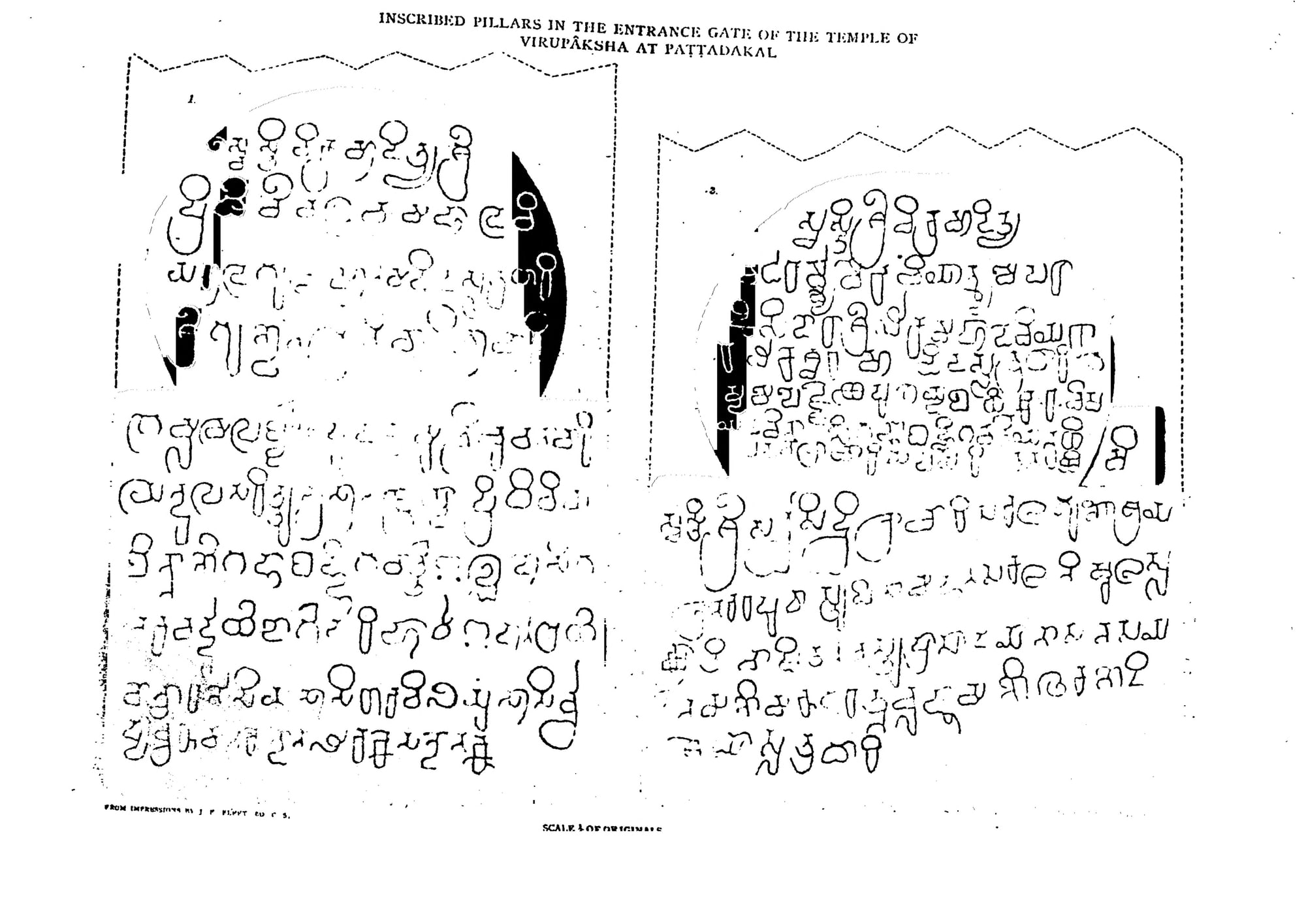
Fleet No. C · east gateway, south pilaster
The temple of Lokeśvara of Lokamahādevī
Lokeśvara · Lokamahādevī · Śrī-Sarvasiddhi-ācārya
“Hail! Let it be known that these are the names of the Ācārya who averted the excommunication of the skilful people of this district, after that they had given the mime-perjerepu to the Sūtradhārī who made this temple of Lokeśvara of Lokamahādevī, (the queen) of Vikramāditya, the worshipful one, who three times conquered Kāñcī: — Hail! Śrī-Sarvasiddhi-ācārya; the asylum of all virtuous qualities; the Pitāmaha of many cities and houses; … the (most eminent) Sūtradhārī of the southern country.”
Fleet’s English translation (The Indian Antiquary, 1881), with his spellings brought to this page’s diacritics; “…” marks titles left out here. The names above the translation are taken from it; Fleet’s transcription is not reproduced. Fleet found this inscription almost entirely hidden behind a later rubble wall.
A victory monument? An inference
The inscriptions give the king the epithet “who three times conquered Kāñcī” S1. Fleet, UNESCO and Cummings all read the temple as a monument to those victories S1S6S8. That is an inference: as Cummings notes, the records “do not go so far as to say that she had the temple built for him” S8. The year of the victory is uncertain too. ICOMOS gives 731, earlier than the reign dates most scholars use, and Cousens thought the third conquest may have come late in the reign S7S8S4.
03 · Epigraphy
The builder named on the gate
An inscription on the north pilaster of the east gateway names Guṇḍa as the sūtradhārī, the master builder, who made the temple of Vikramāditya’s queen. It records the honours he received: a paṭṭa, a patent or fillet of honour, and the title Tribhuvanācārya S1S8.
Fleet judged from the letterforms that the engraving was contemporary with the building S1. The companion inscription lists the titles of Śrī-Sarvasiddhi-ācārya: “pitāmaha” (creator) of many cities and houses, and the most eminent sūtradhārī of the southern country S1S4S8. Whether these are further titles of Guṇḍa or name a second master is read differently (see below). Fleet took Sarvasiddhi-ācārya to be the name of a celebrated guild of architects or builders S1.
At Kāñcīpuram itself, a Kannada inscription in the Rājasiṃheśvara temple records that Vikramāditya-Satyāśraya captured Kāñcī, saw the temple’s riches and gave them back to the god S3. It is undated, and two Vikramādityas took Kāñcī; Hultzsch assigned it to Vikramāditya II “with great probability” S3S4S8.
Fleet No. XCIX · east gateway, north pilaster
Guṇḍa, the sūtradhārī
Śrī-Guṇḍa · sūtradhārī · Tribhuvanācārya
“Hail! There is no excommunication from caste of the skilful people of the world who have attained the favour (of the god), having given the paṭṭa called mime-perjerepu (and) the name of Tribhuvanācārya to Śrī-Guṇḍa, whose (observance of the) established rules of conduct was unimpeded, the Sūtradhārī who made the temple of the queen of Vikramāditya, the favourite of the world; …”
Fleet’s English translation (The Indian Antiquary, 1881), with his spellings brought to this page’s diacritics. Fleet read “anivārit-ācāri” as an epithet; the ASI guide and later writers take it as part of the builder’s name, Guṇḍan Anivāritācāri. Fleet warned that his reading of the passage on caste was “not altogether certain”. This inscription is the other one reproduced in the facsimile above.
| Question | What the evidence says | Status |
|---|---|---|
| Guṇḍa made the temple | The north gateway inscription names him as the sūtradhārī who made the queen’s temple S1. | Established · in the inscription |
| One master builder or two? | Fleet and Cousens treat Sarvasiddhi-ācārya as a title or guild of the one builder. The ASI guide names Guṇḍa and Sarvasiddhi Ācārya as two architects, citing an inscription near the Nandi pavilion for the temple’s southern part S1S4S5. | Debated |
| Were the builders brought from Kāñcī? | ICOMOS says two inscriptions “offer proof” of it. The inscription itself calls the builder only the most eminent sūtradhārī of the southern country, and Cousens offered the import of Kāñcī architects as a “surmise” S1S4S7. | Debated |
| The Kāñcīpuram inscription is Vikramāditya II’s | Hultzsch’s attribution, “with great probability”; the inscription is undated S3. | Strong inference |
04 · Narrative
Rāma on the king’s temple
Three niches on the south wall of Lokeśvara’s hall carry Rāmāyaṇa subjects; Cummings numbers them murtis 11–13 S8S4.
As Cummings reads them, they show Vālin and Sugrīva fighting while Rāma aims; Jaṭāyu attacking Rāvaṇa as Sītā is carried off in his flying chariot; and Rāma with Sītā and Lakṣmaṇa, with the golden deer above S8. The first is badly damaged, and she identifies it from context and pose S8.
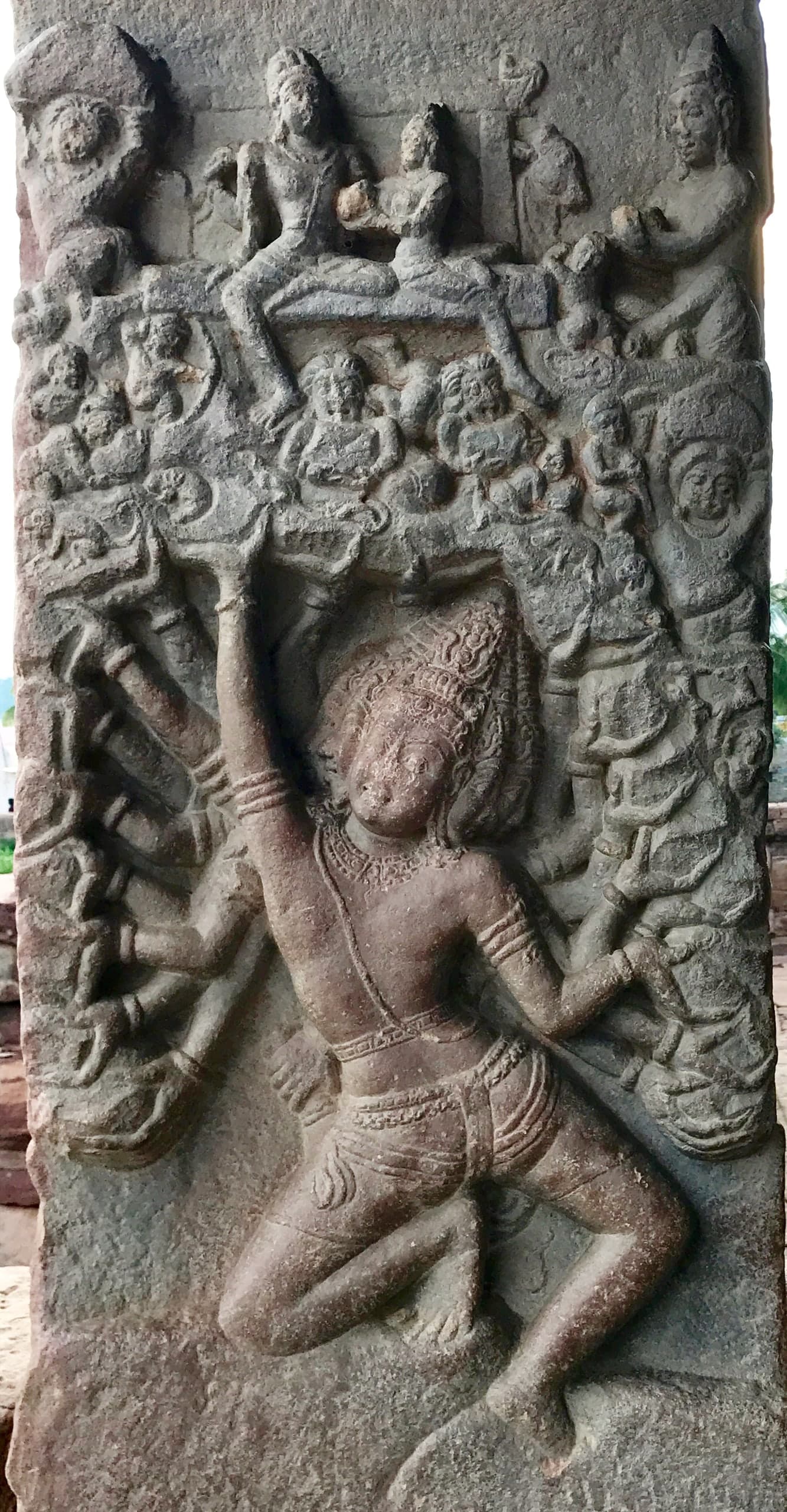
A small relief of Rāvaṇa shaking Mount Kailāsa is carved on a pillar of the south porch S4S8S5. The episode belongs to the Uttarakāṇḍa, the epic’s last book, and Cummings counts it with the south-wall group S8.
Inside, broad bands of relief on the great hall pillars tell scenes from the Rāmāyaṇa and the Mahābhārata. Cousens followed one Rāmāyaṇa run from Śūrpaṇakhā and Khara and Dūṣaṇa, through Mārīca as the golden deer, to the abduction and Jaṭāyu’s fight; another shows Sītā in the aśoka grove, Hanumān’s leap to Laṅkā and the burning of the city S4. Some figures are labelled with their names, and Cousens noticed that one label is wrong: it names the vulture Jaṭāyu as “Śūrpaṇakhā” S4.
Walked in the usual clockwise direction, the south-side scenes run backwards: Rāvaṇa at Kailāsa, then Vālin and Sugrīva, then the abduction, then the forest. Cummings offers two explanations, Śaiva and Pāśupata rules for walking round a Śiva shrine, or the model of Pāpanātha’s reversed cycle, and leaves the question open S8. The second would need Pāpanātha’s cycle to be the earlier, which Buchanan’s dating (below) disputes.
What Vālmīki’s text says
- Lakṣmaṇa, at Rāma’s word, cuts off Śūrpaṇakhā’s ears and nose S12.
- The vulture-king Jaṭāyu fights Rāvaṇa, tearing at him with talons and beak, as he carries Sītā away S12.
- In the first fight Rāma cannot tell Vālin and Sugrīva apart and holds his arrow; before the second, Lakṣmaṇa hangs a flowering gajapuṣpī creeper round Sugrīva’s neck S12.
05 · Architecture and narrative
Pāpanātha: the epic labelled
Pāpanātha puts a northern-style curvilinear tower over a temple whose walls, cornices and parapets follow the southern manner S5S7S4. Along its south wall, continuing onto the east face, it tells a long Rāmāyaṇa sequence S5S8.
In the ASI guide’s walk-through the sequence runs from Daśaratha’s sacrifice for sons, through the exile, Śūrpaṇakhā, the golden deer, the abduction, Jaṭāyu, Vālin and Sugrīva and the building of the bridge, to the war and the coronation S5S8S10.
Many of the reliefs carry short labels naming the figures, mostly in Kannada or Prakrit forms: Rāman, Sīte, Lakkaṇa, Jaṭāyu, Sugrīvan, Bāli, Aṅgada, Rāvaṇan, Suppanaki, Khara-Dūṣaṇa, Nalan, Vibhīṣaṇan and Kumbhakarṇa S1S4S5. Fleet found such labels on both the north and south faces; his list also includes Bhīmasena, from the Mahābhārata reliefs S1. Fleet and Cousens disagreed about how old the letters are, and neither gave a firm date S1S4.
Cummings, following Wechsler, describes the story running against the usual clockwise path: the earliest scenes are near the sanctum and the climax is at the entrance, where Rāma’s coronation is carved on the south pillar of the east porch, while a Mahābhārata sequence on the north wall ends the same way on the north pillar S8S10. The ASI guide likewise tells visitors to read the series counter-clockwise S5. Cummings also reports Wechsler’s reading of the arrangement as royal legitimation: visitors entering meet a coronation and a victory, the defining acts of kingship, which point to a royal patron S8S10. That is an interpretation, and no inscription read for this page names Pāpanātha’s patron S8.
Its date is disputed. Cousens put it at c. 650 at the latest, and the ASI guide gives the seventh to mid-eighth century S4S5. Cummings, following Buchanan, describes three building phases, c. 690, c. 692 and a final phase after Lokeśvara, c. 745–755, to which Buchanan assigns the extensive Rāmāyaṇa reliefs S8S11. If that holds, Pāpanātha’s wall cycle is later than Lokeśvara’s niches; this page does not decide which came first.
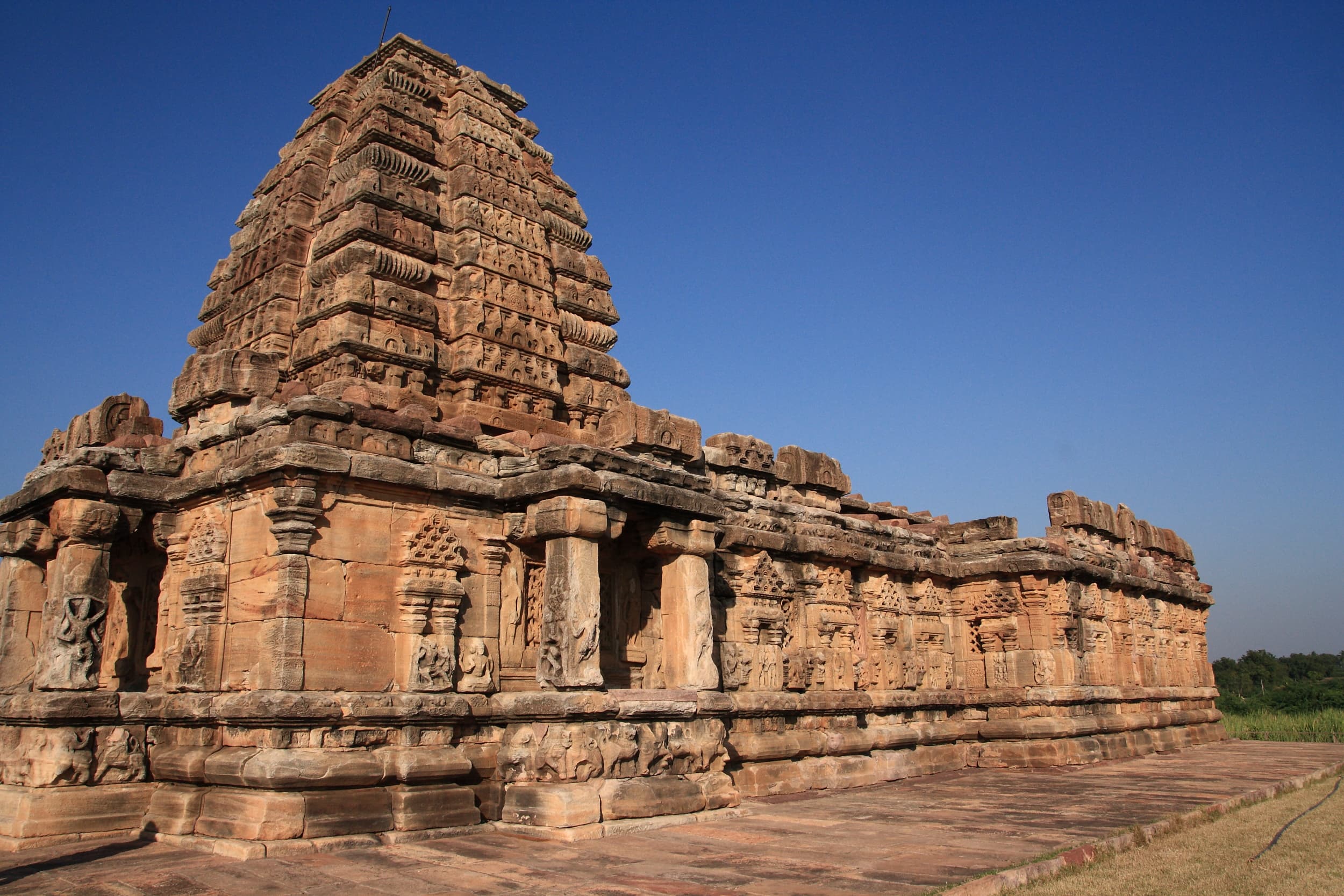
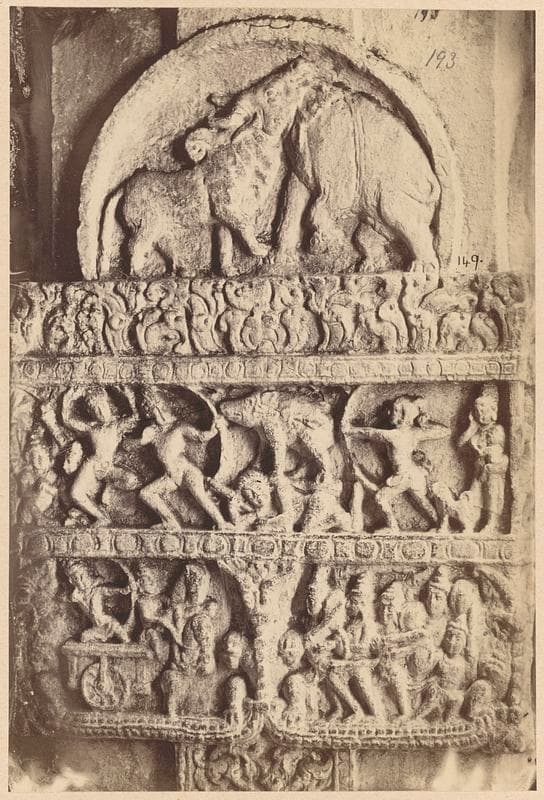
No Pāpanātha panel is pictured
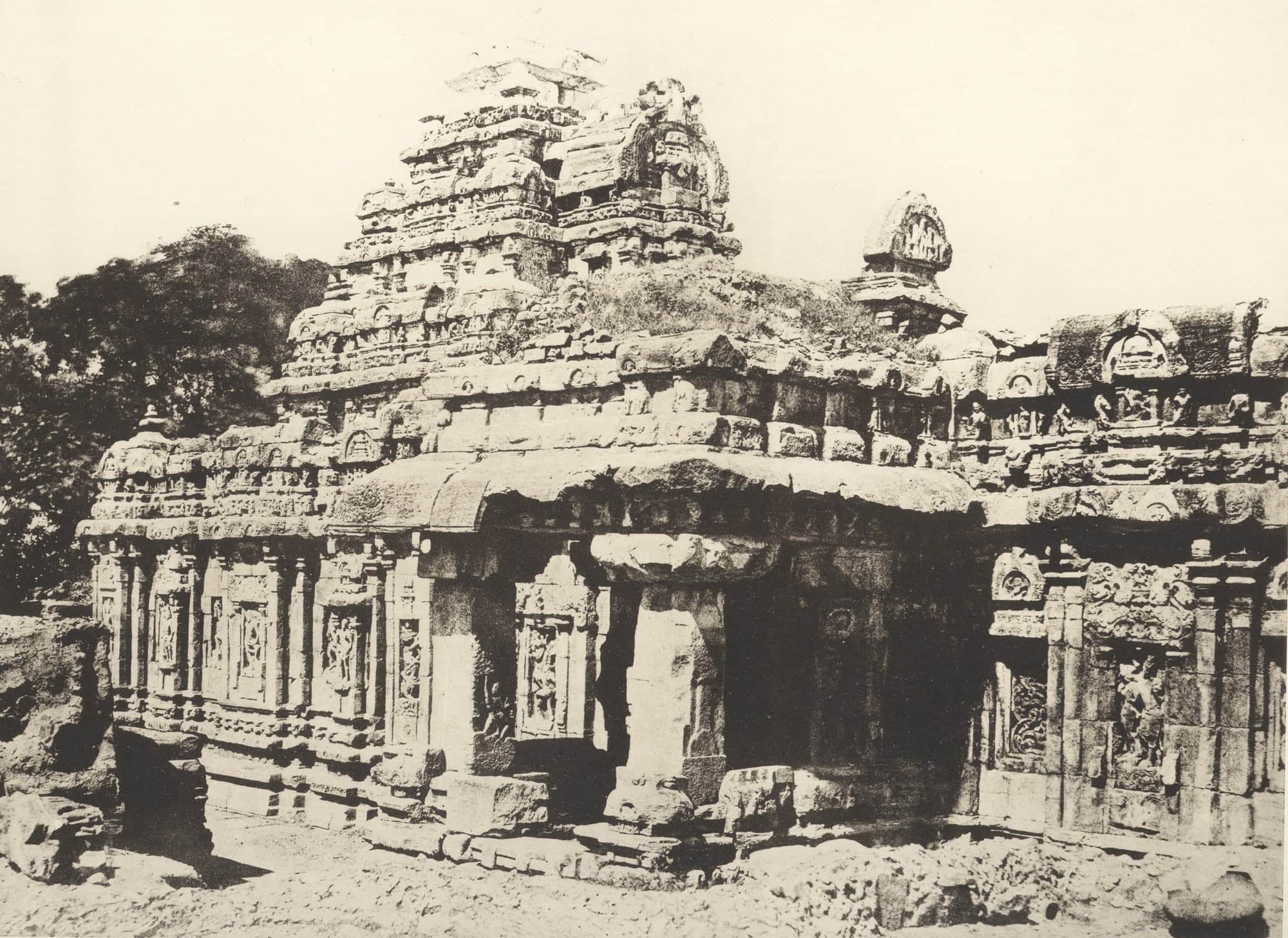
No photograph of a Pāpanātha Rāmāyaṇa panel with a verified identification and location was found, so none is shown. The wall pictured here is not identified as north or south, and no panel is identified from a photograph S5.
06 · Builders and sculptors
Who carved it
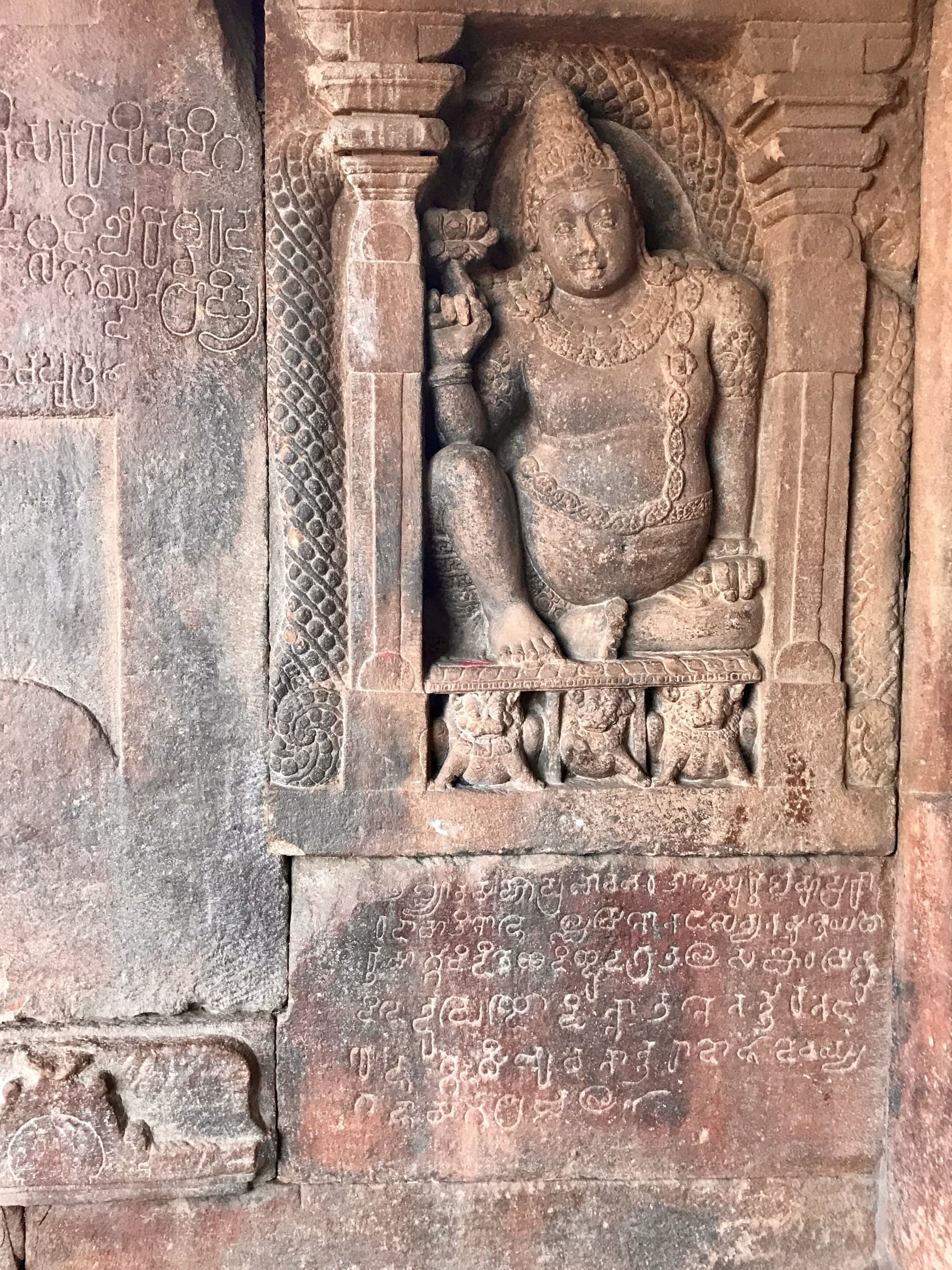
The ASI guide reads short inscriptions beside individual sculptures at both temples as the names of the sculptors who carved them S5. Which sculptor carved which panel rests on the 2008 ASI guide alone, and the guide is not always consistent S5.
At Pāpanātha an inscription high on the east face praises Chattara-Revaḍi-Ovajja, of the Sarvasiddhi-ācāryas, who “made the southern country”. Fleet took this to mean he was the celebrated builder of the south, and thought it “hardly to be doubted” that he built this temple; Cousens agreed, and the ASI guide reads it as naming him architect of the temple’s southern side S1S4S5. Either way, it ties a Pāpanātha builder to the Sarvasiddhi-ācāryas named at Virūpākṣa, whom Fleet thought a guild of builders S1.
| Question | What the evidence says | Status |
|---|---|---|
| Sculptors left their names beside their work | The ASI guide transcribes several such names at both temples. Individual attributions have not been checked on site S5S1. | Established · the practice |
| What Revaḍi-Ovajja “made” | The Kannada phrase can mean “made the southern side” or “made [the temples of] the south” S1S4S5. | Debated |
| Baladeva: a sculptor, or a name in the story? | Fleet’s 1881 list of names carved over Pāpanātha’s reliefs includes Śrī-Baladeva among the figures’ labels. The ASI guide reads Baladeva as a sculptor’s signature, crediting him with the panel of Lakṣmaṇa maiming Śūrpaṇakhā, but gives his parentage two different ways S1S4S5. | Debated |
07 · Scholarship
Northern models
Cummings counts Lokeśvara’s south-wall niches among the first representations in south India of the Rāmāyaṇa as a series of temple wall panels. Earlier southern examples, in her account, are isolated scenes or small friezes on plinths and pillars S8.
She argues that the choice and order of the scenes follow northern Gupta-period models rather than Pallava ones: every scene in the sixth-century Nachna Rāmāyaṇa panels reappears at Lokeśvara, and several Deogarh scenes recur S8. It is an argued position, not a recorded fact.
In the translations Cummings quotes, earlier Chāḷukya inscriptions compare their kings with Rāma: Maṅgaleśa claims, like Rāma, never to have been conquered; Vikramāditya I is called Rāma’s rival as an archer; and Pulakeśin II is said to have resembled Rāma and Yudhiṣṭhira S8. They are given here as she quotes them.
A reading, not an inscription
Cummings reads the niches as royal statements: Vikramāditya II casting himself as a king equal to Rāma in martial prowess, moral rectitude and dharmic authority, with scenes chosen from passages of the epic that discuss the duties of a king S8S9. No inscription at the temple compares the king with Rāma.
08 · Chronology
Then and now
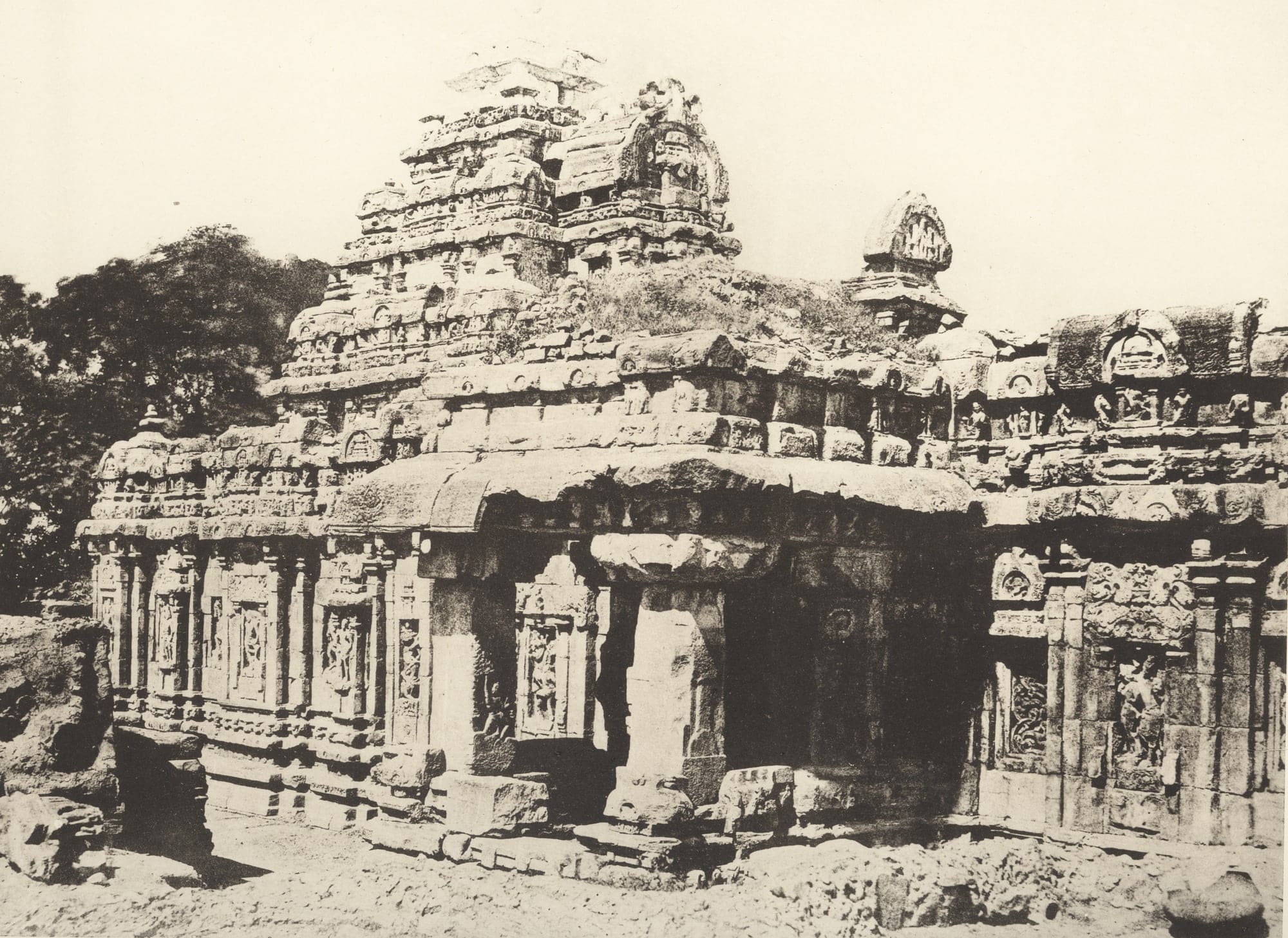
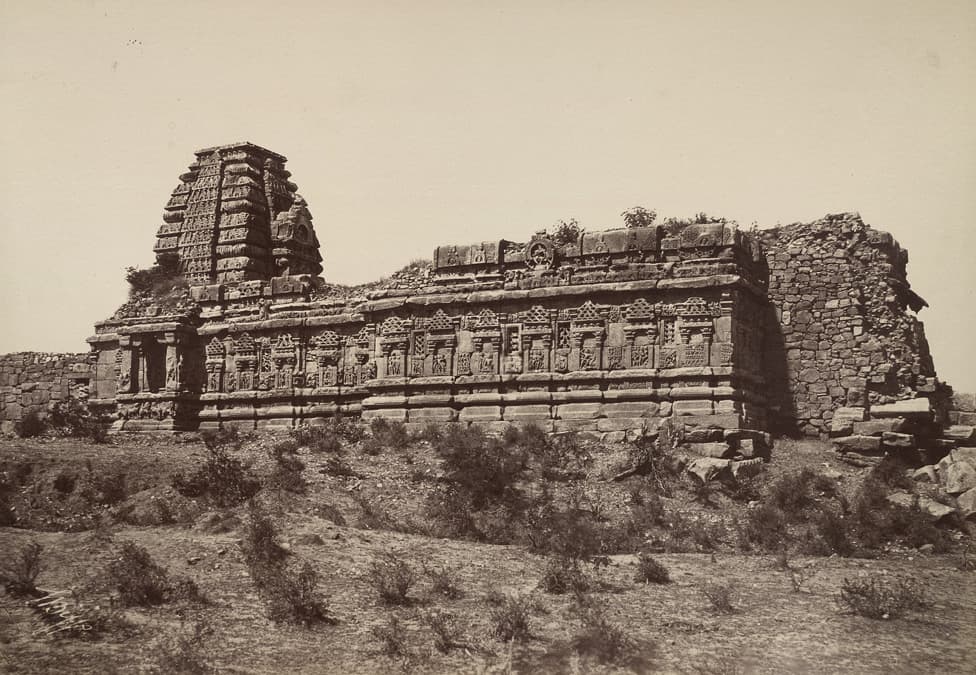
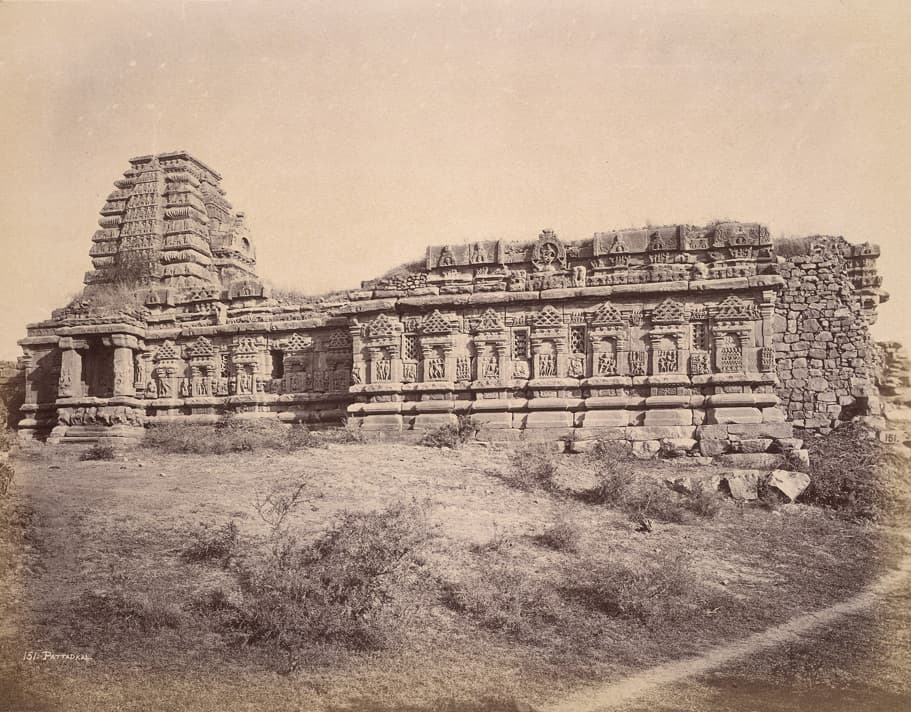
Photographs from 1855 to 1897 show the two temples among rubble and scrub. In the 1920s Cousens found Pāpanātha disused at the edge of the village, serving as part of the village wall and used as a cattle byre; elsewhere in the group, village houses had been built against temple walls S4.
Virūpākṣa is still a temple in worship; in 1987 ICOMOS recorded the daily morning rite at its Nandi pavilion S7.
Local tradition remembers Pattadakal as a coronation place, and Fleet explained its name as “the stone of the anointing, or coronation” S5S1. Later works such as the Siṅgirāja Purāṇa make legendary and early kings come here to be crowned, and the bend where the Malaprabhā turns north is held sacred S5. These are the site’s own traditions; none of them concerns Rāma S5.
c. 733–745
Lokeśvara is built
In the reign of Vikramāditya II, for Queen Lokamahādevī; no inscription gives a foundation year S1S8S4.
754 CE
The pillar inscription
Kīrtivarman II’s inscription names the three royal temples and their patrons; Fleet dates it from a total solar eclipse S2.
1855
Biggs photographs Pattadakal
Thomas Biggs photographs at Pattadakal; his view of Pāpanātha is shown below S1.
1876–77
Fleet reads the inscriptions
Fleet examines the inscriptions in person and takes his own impressions; he publishes them in 1881 S1.
1926
Cousens’s survey
Cousens describes the pillar bands and labels, and finds Pāpanātha serving as part of the village wall S4.
1987
World Heritage
Pattadakal is inscribed on the World Heritage List under criteria (iii) and (iv) S6S7.
09 · Evidence
What we know, and what remains open
The inscriptions, the epic text, the scholars’ readings and the site’s traditions each carry their own weight.
| Statement | Basis | Status |
|---|---|---|
| Pattadakal is a place in the Rāmāyaṇa | It is not; the link is what was carved here S12S5. | Established · not in the epic |
| Virūpākṣa was the temple of Lokeśvara, built for Queen Lokamahādevī | Inscriptions on the temple and the 754 pillar S1S2. | Established · in the inscriptions |
| Guṇḍa was its master builder | The north gateway inscription S1. | Established · in the inscription |
| It was built as a monument to the Kāñcī victories | Read so by Fleet, UNESCO and Cummings; the inscriptions name the conquests but not the purpose S1S6S8. | Strong inference |
| The year of the victory | ICOMOS gives 731, before the reign dates most scholars use S7S8. | Debated |
| Many of Pāpanātha’s Rāmāyaṇa figures are labelled by name | Recorded by Fleet, Cousens and the ASI guide S1S4S5. | Established |
| When Pāpanātha was built | From c. 650 (Cousens) to a final phase c. 745–755 (Buchanan, via Cummings) S4S5S8. | Debated |
| Pāpanātha has the largest Rāmāyaṇa at the site | Not supported: Cummings calls the Early Chāḷukya treatment most elaborate “especially on and in the Lokeśvara Temple”, counting its pillar bands S8. | Unknown |
| Lokeśvara’s niches are among the first Rāmāyaṇa wall series in south India | Cummings’s judgement, in her words “among the first” S8. | Strong inference |
| Lokeśvara’s scenes follow Gupta-period models | Cummings’s argument from Nachna and Deogarh S8. | Strong inference |
| Pāpanātha’s order was meant as royal legitimation | Wechsler’s reading, as Cummings reports it S8S10. | Strong inference |
| Why Lokeśvara’s scenes run backwards | Cummings offers two explanations and leaves it open S8. | Debated |
| Pattadakal as a coronation place of ancient kings | Local tradition and later Purāṇic works S5. | Later tradition |
| Virūpākṣa is still in worship | ICOMOS recorded the daily rite in 1987; the present ritual schedule is not given here S7. | Established |
Open questions
These are gaps in the surviving record rather than settled conclusions. Each remains open until primary documentation or published scholarship closes it.
- Whether Pāpanātha’s wall cycle is earlier or later than Lokeśvara’s Rāmāyaṇa niches.
- Who paid for Pāpanātha; no inscription read here names a patron.
- A panel-by-panel record of Pāpanātha’s Rāmāyaṇa, with verified photographs and labels.
- Whether the sculptors’ names read by the ASI guide hold up on site.
- Whether the temple had one master builder or two.
- The year of Vikramāditya II’s victory at Kāñcī.
- Why Lokeśvara’s Rāmāyaṇa scenes run backwards.
- The present ritual calendar at Virūpākṣa.
10 · Sources
Source library
Every citation on this page links here.
- S1Primary inscription1881
Sanskrit and Old-Canarese Inscriptions, Nos. XCIX–CXV (Pattadakal)
Fleet’s edition and translation of the gateway and porch inscriptions of Virūpākṣa (Lokeśvara) and the name labels at Pāpanātha, with a facsimile of the gateway inscriptions.
Open indexed source ↗ - S2Primary inscription1894–95
Pattadakal Pillar Inscription of Kirtivarman II
The three royal Śiva temples and their patrons, and the date of 754 CE.
Open indexed source ↗ - S3Primary inscription1894–95
Kanchi Inscription of Vikramaditya
A Kannada inscription at Kāñcīpuram recording that Vikramāditya took Kāñcī and returned a temple’s riches to the god.
Open indexed source ↗ - S4ASI1926
The Chalukyan Architecture of the Kanarese Districts
A former ASI Superintendent’s description of the two temples, their pillar bands, labels and condition in the 1920s. His dates and his view of the craftsmen’s origin are 1926 opinion.
Open indexed source ↗ - S5ASI2008
Pattadakal (World Heritage Series)
The ASI site guide: a wall-by-wall walk-through of Pāpanātha’s Rāmāyaṇa panels, the sculptors’ names and the site’s traditions. It contradicts itself in places.
Open indexed source ↗ - S6UNESCO1987
Group of Monuments at Pattadakal (property 239)
World Heritage inscription, criteria and brief description.
Open indexed source ↗ - S7UNESCO1987
Advisory Body Evaluation, World Heritage List No. 239
The 1987 evaluation: the victory year it gives, its reading of the builders, and the daily rite at Virūpākṣa.
Open indexed source ↗ - S8International scholarship2006
A Study of the Iconographic Program of the Lokesvara (Virupaksa) Temple, Pattadakal
The queen’s patronage, the south-wall Rāmāyaṇa niches, their order, the royal reading and the northern models, with summaries of Wechsler and Buchanan on Pāpanātha.
Open indexed source ↗ - S9International scholarship2014
Decoding a Hindu Temple: Royalty and Religion in the Iconographic Program of the Virupaksha Temple, Pattadakal
The published book that grew out of the dissertation. Specific claims on this page rest on the dissertation.
Open indexed source ↗ - S10International scholarship1993
Royal Legitimation: Ramayana Reliefs on the Papanatha Temple at Pattadakal
Pāpanātha’s reversed sequences and the legitimation reading, known here through Cummings.
Open indexed source ↗ - S11International scholarship1985
Calukya Temples: History and Iconography
Pāpanātha’s building phases, known here through Cummings.
Open indexed source ↗ - S12Primary text1960–75
Vālmīki Rāmāyaṇa, Critical Edition — Araṇyakāṇḍa and Kiṣkindhākāṇḍa
What the epic says about the episodes carved on the two temples. It makes no claim about Pattadakal.
Open indexed source ↗