01 · Why Orchha
A palace, a temple, a king
At Orchha Rāma is worshipped as a king S8S9, in a building the Tentative List counts among the town’s palaces S1. Three kinds of evidence meet here: an epic, a royal court and its poetry, and a living cult.
The epic describes Rāma’s consecration and reign in Ayodhyā; it has no Orchha S4. Around 1600 the Bundela court’s poet Keśavdās wrote a Rāmāyaṇa in Braj, and Allison Busch reads one of his later works as casting his patron’s seizure of the throne in Rāmāyaṇa terms S3. Today the national and state tourism sites describe Rāma at Orchha as “Rāmrājā”, king Rāma, saluted by armed guards S8S9.
Between the court and the cult sits a legend: a queen of Orchha who brought Rāma from Ayodhyā. This page treats it as tradition and traces where it was written down.
- Established
Directly documented by primary evidence or Indian archaeological record; not in serious dispute.
- Strong inference
Well supported by epigraphy, chronology or architectural analysis, but reconstructed rather than explicitly recorded.
- Debated
Scholarly opinion differs, or the surviving evidence does not settle the question.
- Later tradition
Preserved in literary or regional tradition later than the monument itself; not contemporary testimony.
- Unknown
No surviving primary record establishes this, and it is left open rather than inferred.
- Investigative claim
A modern hypothesis or observation, recorded and examined here without being treated as established fact.
02 · The epic
What Vālmīki says about Rāma as king
In the critical edition, Rāma is consecrated king in Ayodhyā at the end of the Yuddhakāṇḍa, which closes with his reign. Orchha is not in it.
What the epic says
Which text
This page uses the critical edition’s Yuddhakāṇḍa (6.116) for Rāma’s consecration and reign S4. The Uttarakāṇḍa is not used here.
03 · Chronology
The Bundela court, 1531–1783
Orchha was the Bundela capital from 1531 until 1783, when the capital moved to Tikamgarh S1S2S3.
Its kings were drawn into the Mughal empire. Mughal forces first took Orchha in 1577, and Madhukar Shah accepted tributary status and Mughal service S2S3. His son Bir Singh Deo killed Akbar’s minister Abu’l Fazl for Prince Salim in 1602, and in 1605 Salim, now the emperor Jahangir, installed him as Raja in place of his elder brother Ram Shah S2S3.
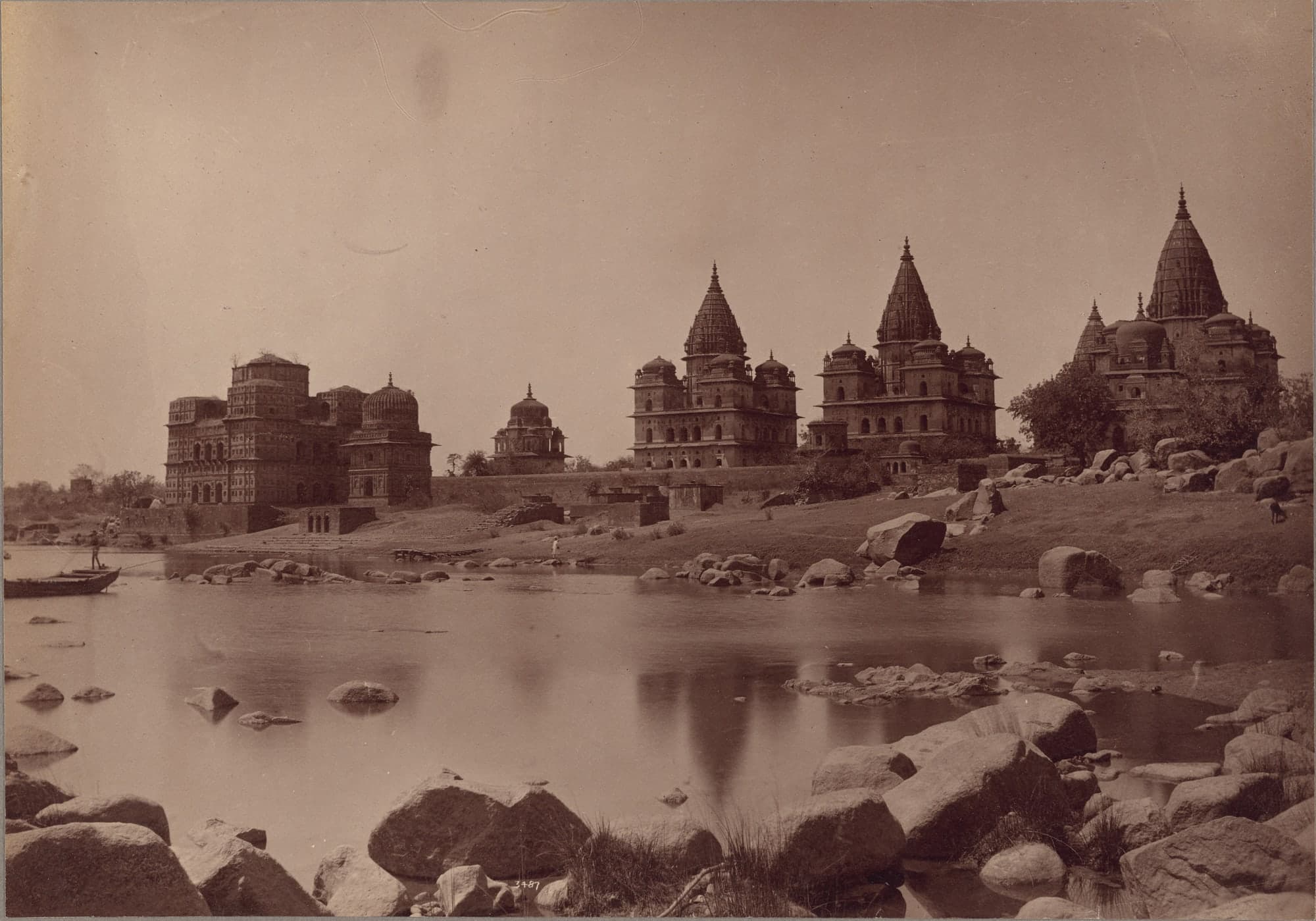
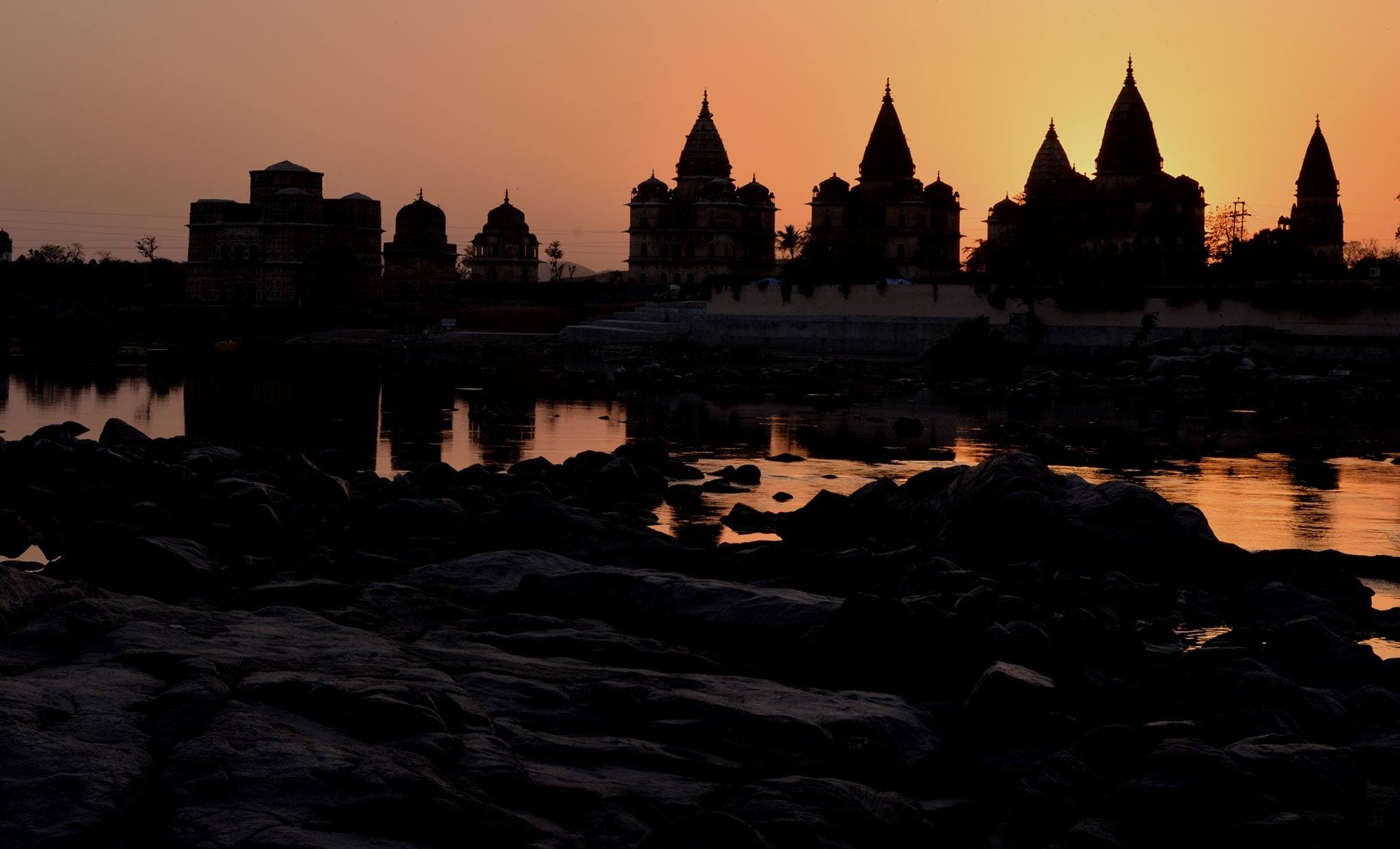
The rulers’ cenotaphs stand together on the Betwa below the fort, among them those of Bhāratīcand, Madhukar Shah and Bir Singh Deo; Bir Singh Deo’s was never finished S2S12.
1531
A new capital
Orchha becomes the Bundela capital S1S3. Who founded it is disputed (see below).
1554–1592
Madhukar Shah
Madhukar Shah rules Orchha. Mughal forces first take it in 1577, and he accepts tributary status S2S3.
1602
Abu’l Fazl killed
Bir Singh Deo kills Akbar’s minister Abu’l Fazl for Prince Salim S2S3.
1605–1627
Bir Singh Deo
Jahangir installs Bir Singh Deo as Raja in place of Ram Shah S2S3. The 1908 gazetteer credits him with most of the palace-fort on the Betwa island, though its buildings were raised at different times S2S1.
1783
The capital moves
| Question | What the sources say | Status |
|---|---|---|
| Who founded Orchha? | Busch names Rudrapratāp, who died the same year S3; the 1908 gazetteer’s town entry names his son Bhāratīcand S2; the Tentative List has Rudrapratāp found it and Bhāratīcand move the capital there S1. Not resolved here. | Debated |
| Madhukar Shah’s reign and the Mughal capture of 1577 | The gazetteer and Busch agree on the capture; Busch gives his death as 1592 S2S3. | Established |
| Bir Singh Deo’s accession in 1605 | With Jahangir’s backing, in place of his elder brother S2S3. | Established |
04 · The court poet
Keśavdās: Rāma at the Orchha court
The poet Keśavdās served Orchha’s kings from Madhukar Shah’s reign onward, as friend, adviser, guru and poet S3. At Orchha he wrote a Rāmāyaṇa of his own.
He completed the Rāmcandracandrikā, a Braj Rāmāyaṇa in thirty-nine cantos, in about 1600–01; Busch dates it to the year before his Chandmālā of 1602 S3. Allison Busch reads it as a court epic full of the royal themes of Vālmīki’s Rāmāyaṇa and also as a work of bhakti. Its probable patron was Madhukar Shah’s son Indrajit, whom Busch describes as a devotee of Rāma S3.
The court’s devotion was not only to Rāma. The Vrindavan poet Hariram Vyās is linked with Madhukar Shah, himself a celebrated bhakta, by three of Vyās’s poems and by seventeenth-century Vaiṣṇava hagiographies; Busch notes that the evidence is not definitive S3.
Allison Busch’s reading: Bharata inverted
In the Vīrsiṃhdevcarit of 1607, Busch reads, Keśavdās describes Bir Singh approaching Ram Shah’s palace in almost the same words as Bharata approaching Rāma in the Rāmcandracandrikā, and then inverts the epic: the younger brother takes the throne S3. This is Busch’s reading; the Braj texts were not read for this page.
05 · Architecture
Palace and temple: the buildings
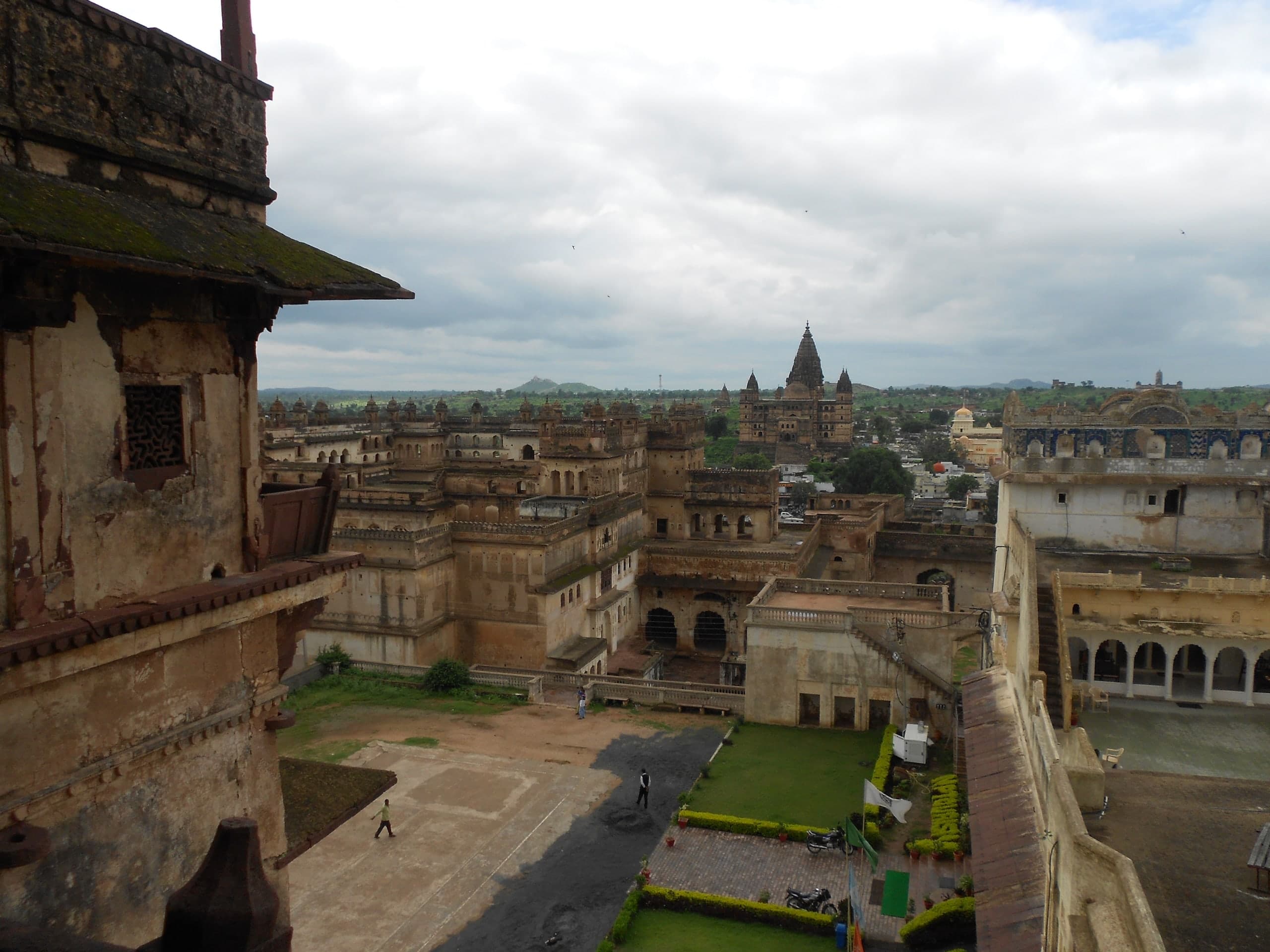
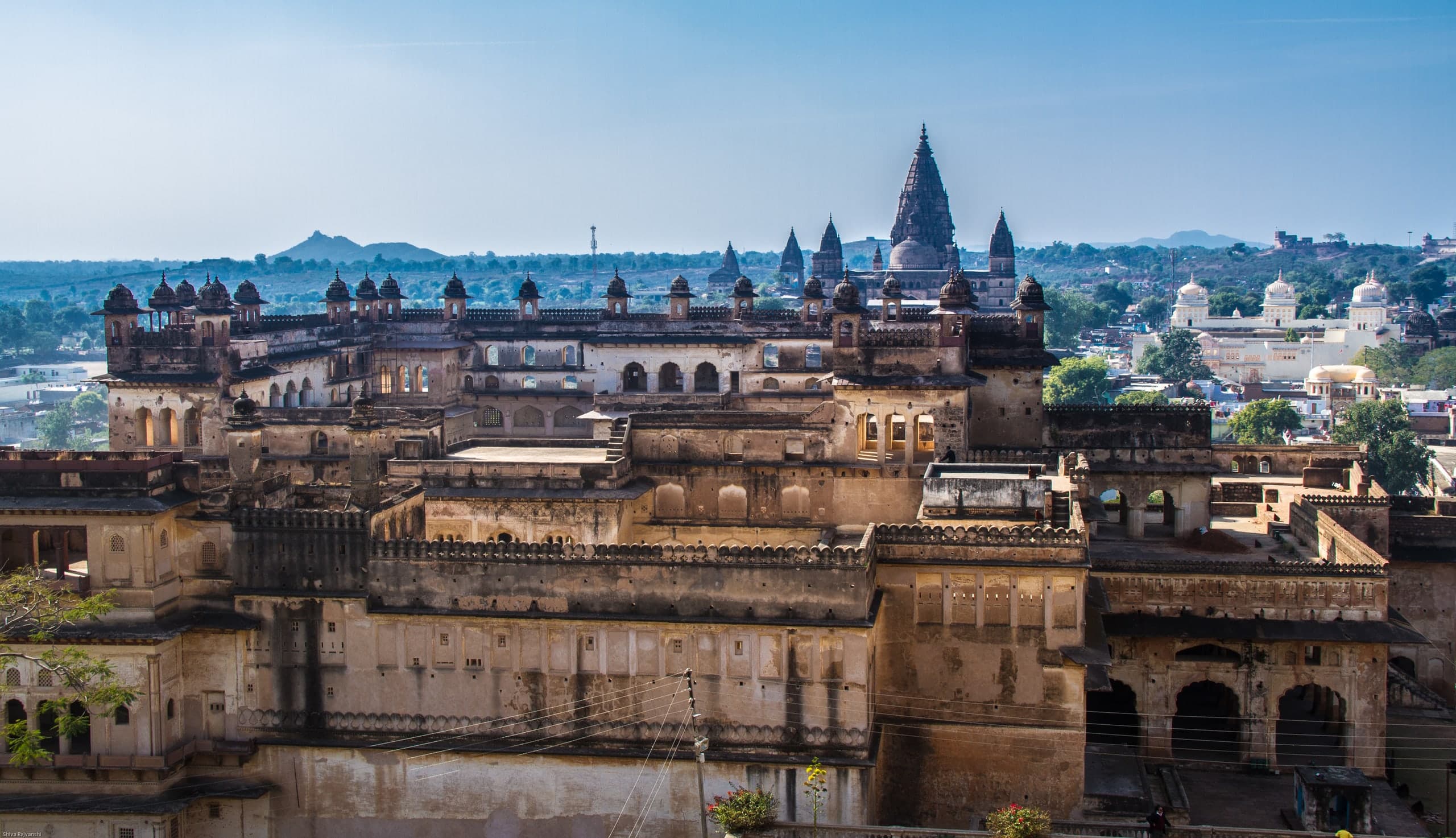
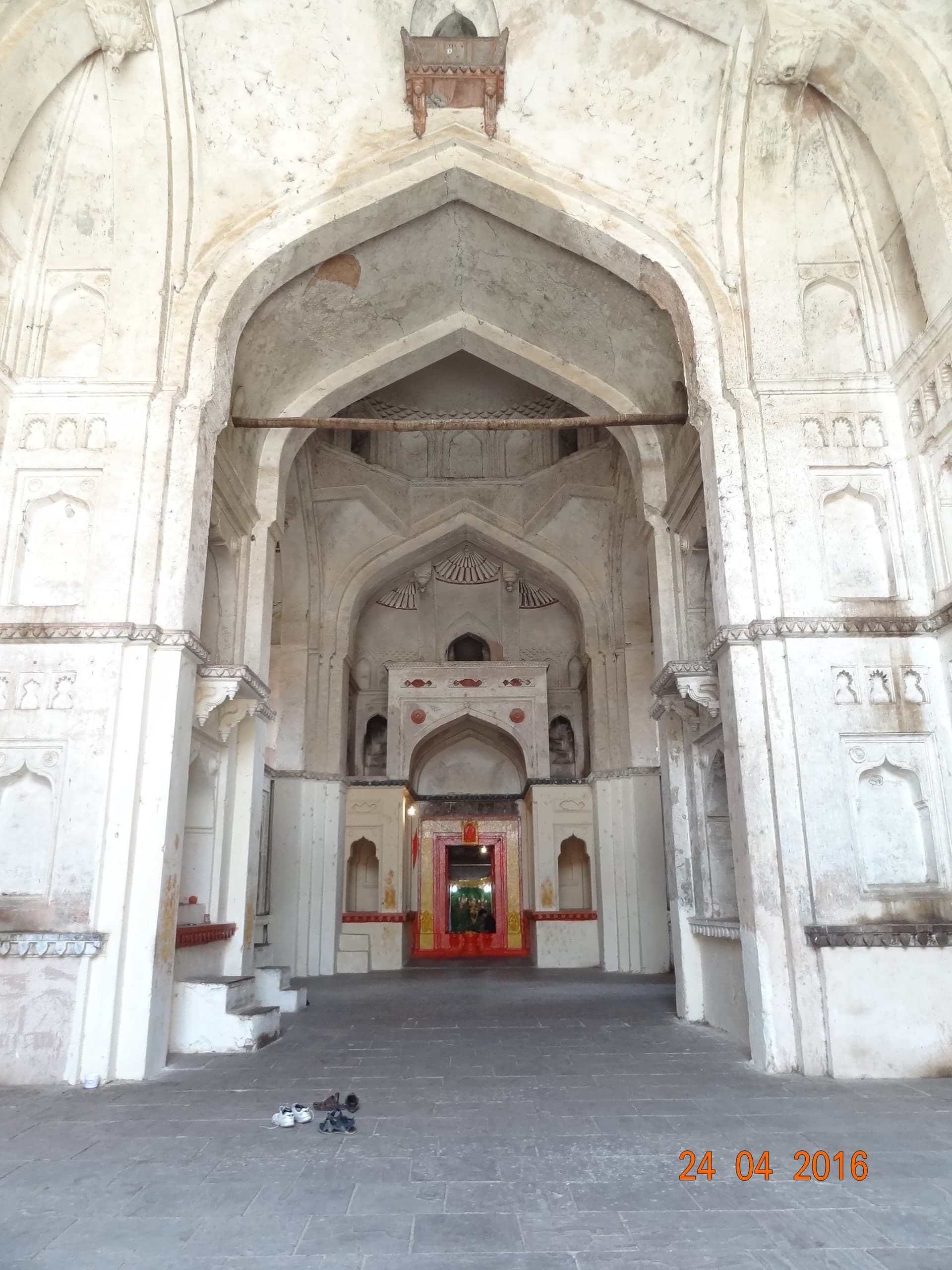
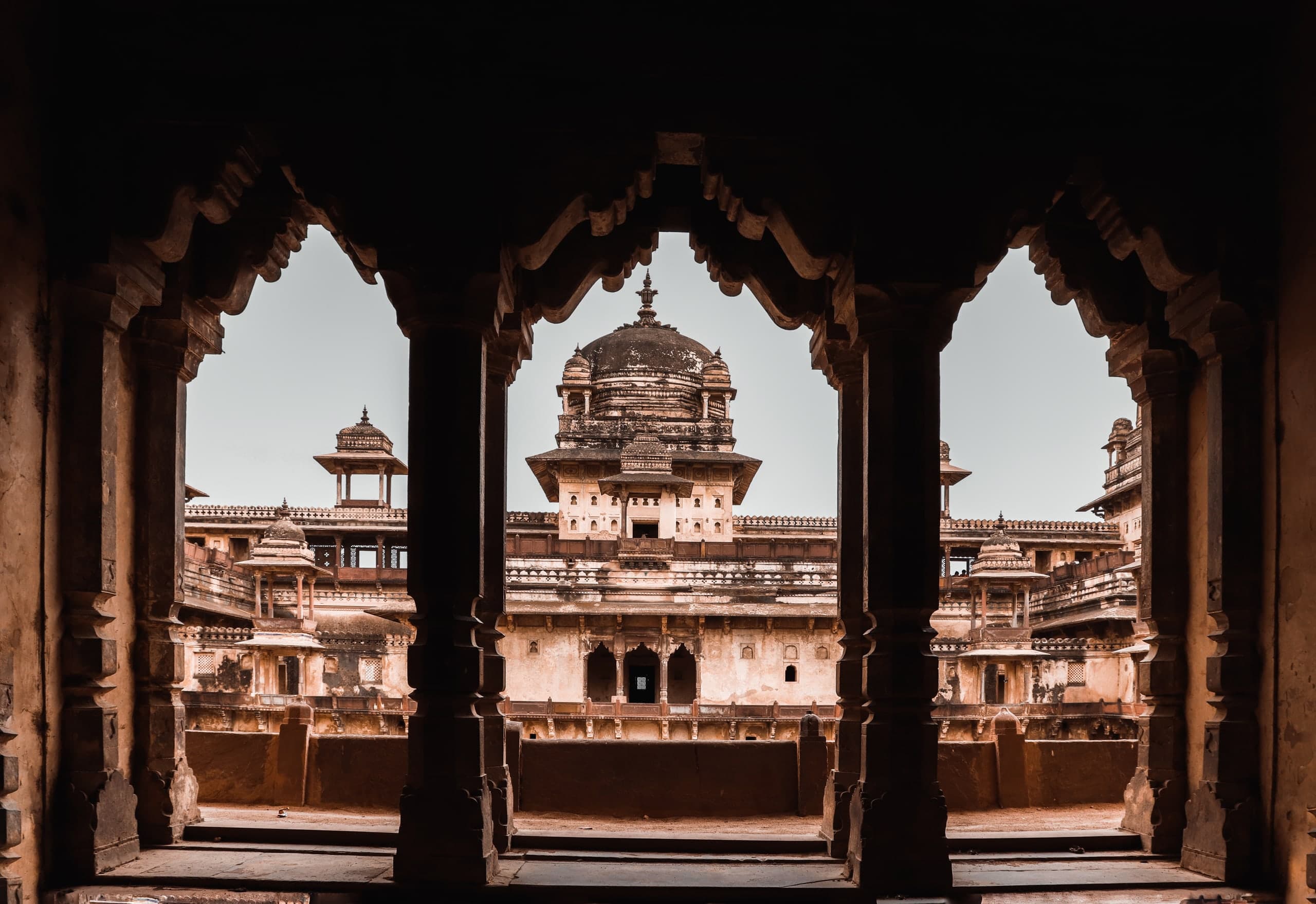
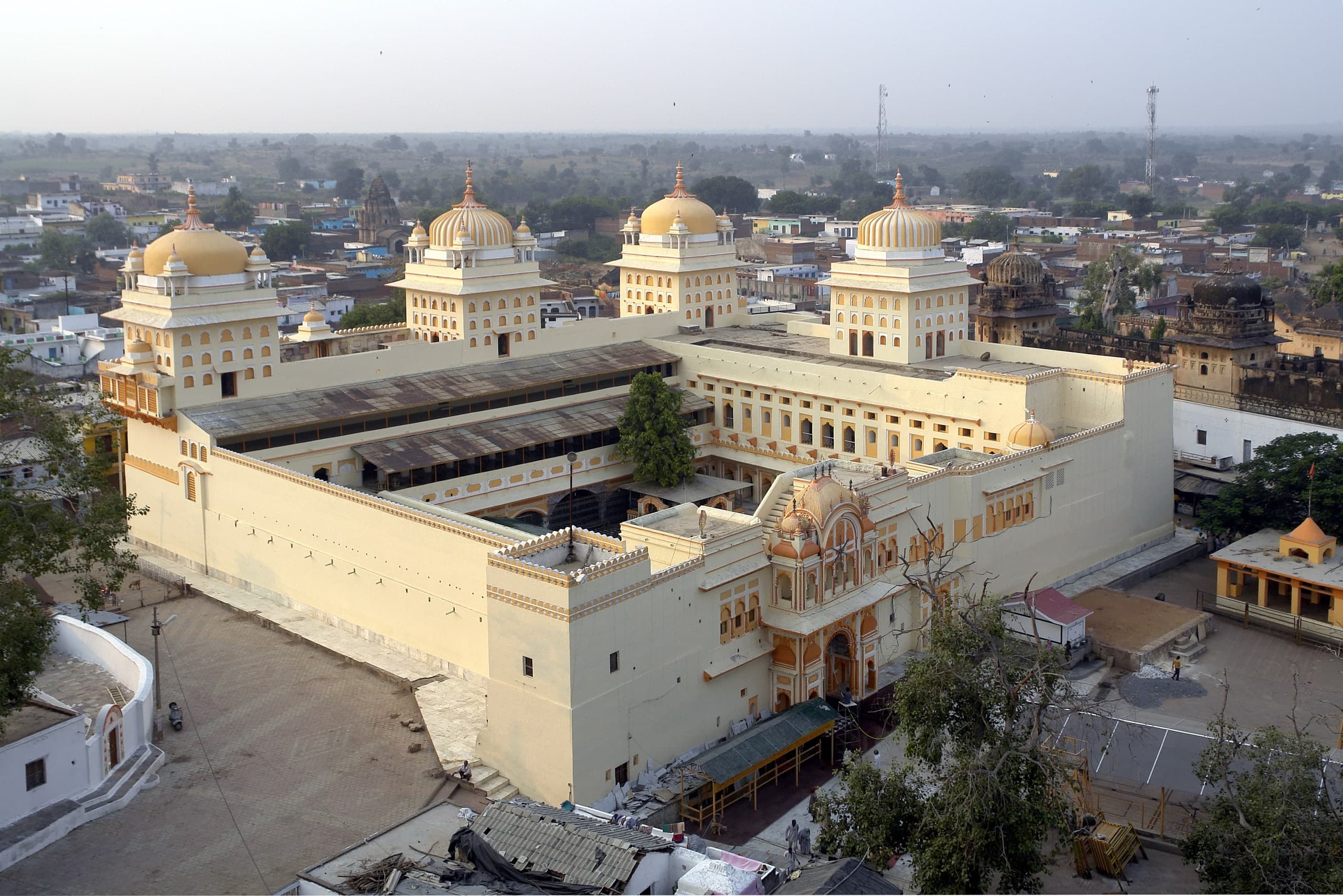
The Ram Raja temple occupies a building planned as a palace: the Tentative List counts the “Rani Mahal (now Ram Raja Temple)” among Orchha’s three mandala-plan palaces, with the Raja Mahal and the Jahangir Mahal S1.
That it was a queen’s palace rests on its name and on tradition S1S9. When, and by whom, it was turned into a temple is not known from any historical record; only the legend dates it S7. The 1908 Imperial Gazetteer’s account of Orchha’s buildings does not mention the Ram Raja temple S2. That shows only that its authors did not single it out, not that the shrine was inactive.
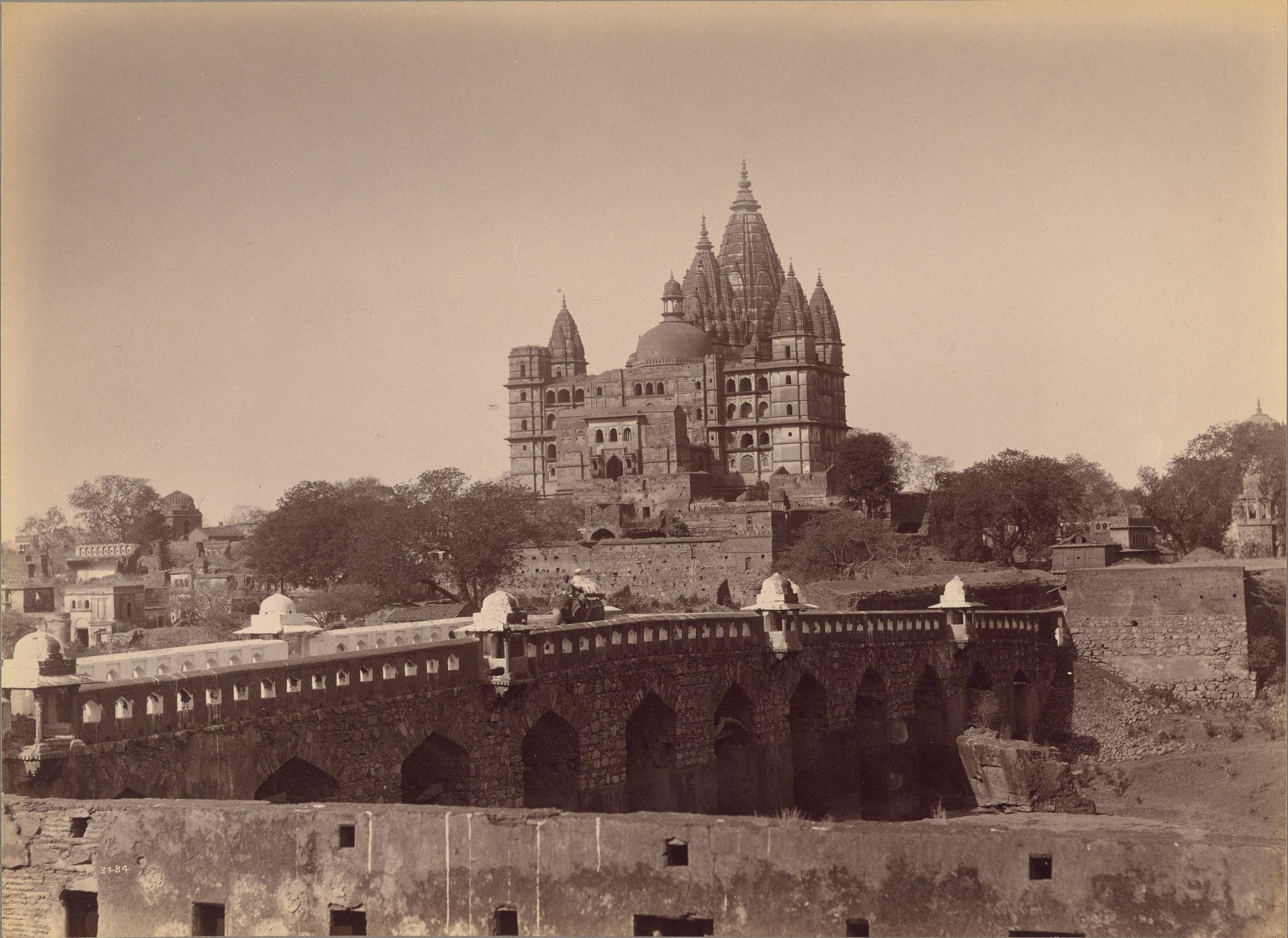
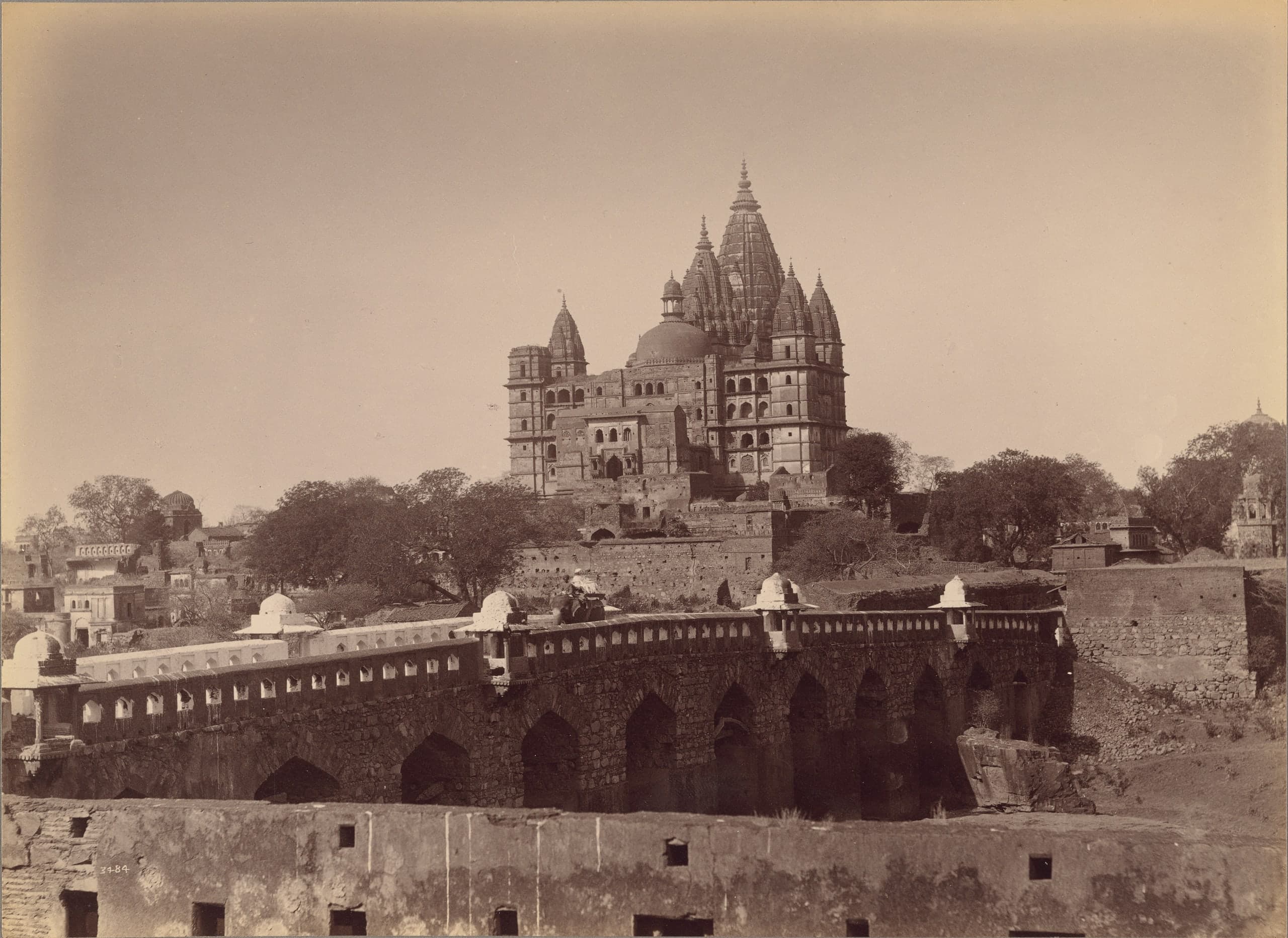
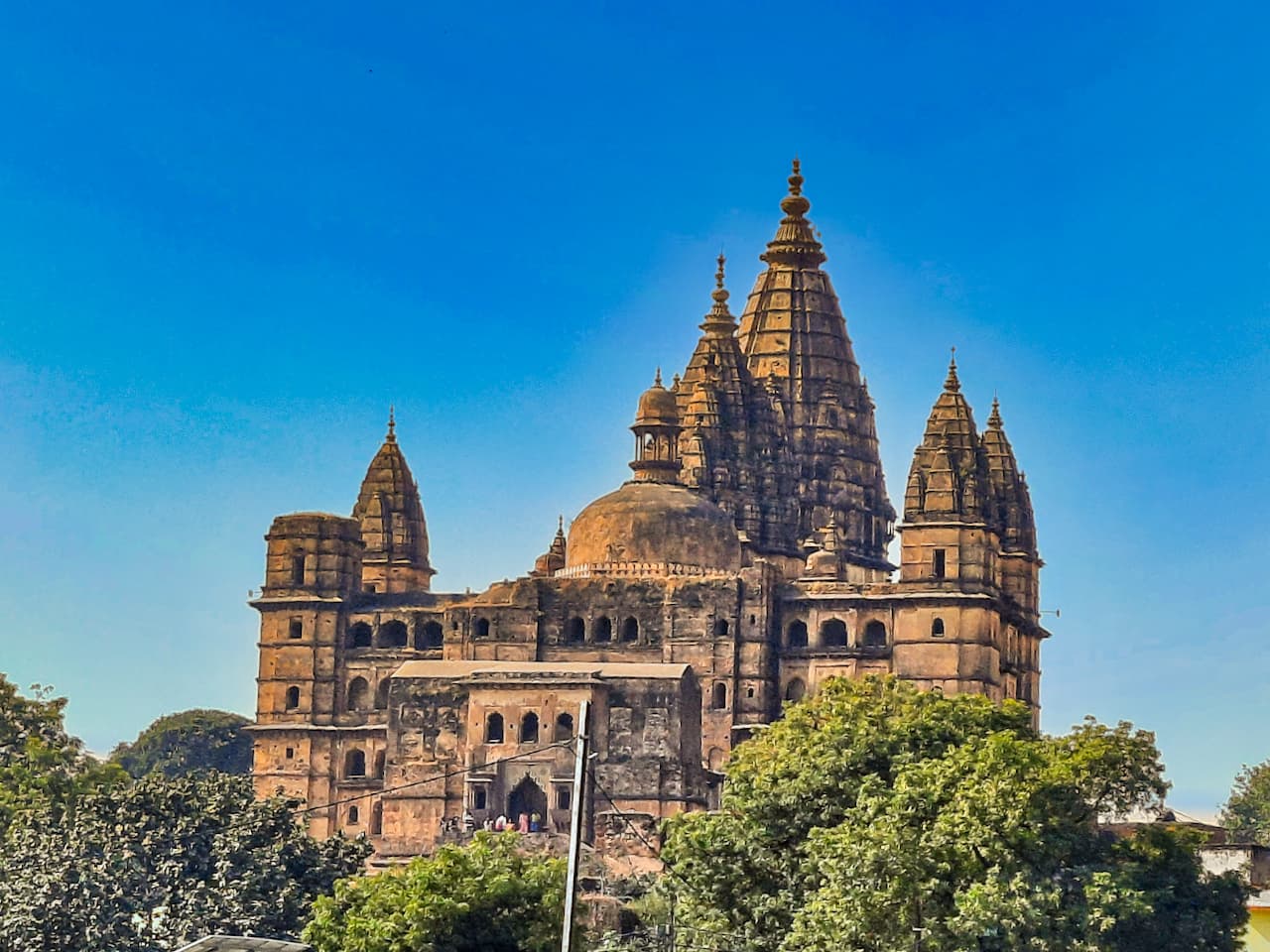
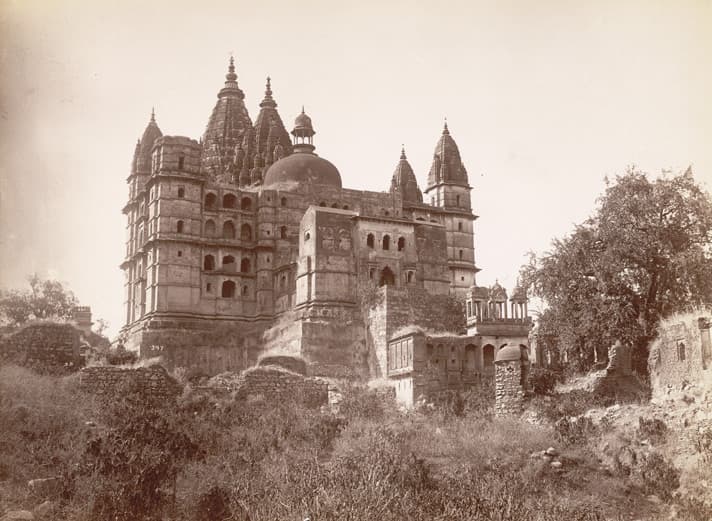
Beside it stands the Chaturbhuj temple, dedicated, as its name says, to four-armed Viṣṇu. It stands on a high stone platform, with a plain exterior and lofty, unornamented interiors that the gazetteer compared to a church S2. It stood by 1607, when, Busch reports, Keśavdās gave it a whole canto of his Vīrsiṃhdevcarit S3. Lala Deen Dayal photographed it in the 1880s S11S13.
On the fort island, the gazetteer singles out the Jahangir Mahal as the finest of the palace buildings S2.
| Question | What the sources say | Status |
|---|---|---|
| The Ram Raja temple was planned as a palace | The Tentative List and the state tourism site call it the former Rani Mahal; no building history was found S1S9. | Strong inference |
| When the palace became a temple | Not known from any historical record S1S2S7. | Unknown |
| Who built the Chaturbhuj temple? | Busch says Madhukar Shah began it and Bir Singh Deo renovated it S3; the 1908 gazetteer credits it to Bir Singh Deo S2. Unresolved here. | Debated |
| Was the Chaturbhuj temple built for Rāma? | The local legend says so S7; the gazetteer and the temple’s name describe a temple of four-armed Viṣṇu S2. Unresolved here. | Debated |
| The Chaturbhuj temple stood by 1607 | Busch’s report of canto 16 of the Vīrsiṃhdevcarit S3. | Strong inference |
| The palace-fort is mainly Bir Singh Deo’s work | The gazetteer and the Tentative List; building-by-building dates await an architectural study S2S1. | Strong inference |
06 · Later tradition
How the legend was written down
The temple’s founding story, of a queen who brought Rāma from Ayodhyā, is a tradition. Its written history can be traced: in the texts this research found, each layer of the story first appears in a different one, and most of those texts can be dated. What follows is the earliest written history this research found; older versions may exist.
Rūpkalā’s commentary is read here in a 1951 printing. According to its preface the first edition was published at Kāśī; its date is unconfirmed S6. Gaur cites a Kanak Bhavan Mahimā and a Madhukarśāh Caritra for the legend; neither was seen S7.
The date 1574–75, often repeated online, has no cited source. No record of the image’s arrival from the time of Madhukar Shah has been found S7.
Nābhādās, c. 1600
Priyādās, 1712
Rūpkalā, date unconfirmed
- The earliest written version of the image story this research found, given as a story “known to all good people of Bundelkhand” S6.
- The queen, a devotee of Rāma married to a Kṛṣṇa-devotee king, enters the Sarayū at Ayodhyā, and Rāma comes into her lap as a small image S6.
- The image travels to Orchha only under the Puṣya nakṣatra; when at last it agrees to sit, it says it will never rise again S6.
- It names neither the Chaturbhuj temple nor the palace, and does not call Rāma Orchha’s king S6.
Gaur, 1982
- A local history by a Ram Raja temple employee gives the story as it is told today S7.
- Rāma sets three conditions, among them that he will never leave the first building he is placed in and that he will be called Rāmrājā S7.
- He stays in the queen’s palace; the temple built for him receives images of Chaturbhuj instead S7.
- It dates the journey from Ayodhyā to Vikrama Saṃvat 1630–31, about 1573–74 CE S7.
| Statement | Basis | Status |
|---|---|---|
| Nābhādās names Gaṇesde Rānī among women devotees | The Bhaktamāl verse S5. | Established · the verse says this |
| Priyādās makes her the queen of Madhukar Sāh of Orchha | His commentary of 1712 S5. | Established · the commentary says this |
| A queen of Orchha brought Rāma’s image from Ayodhyā | Rūpkalā’s commentary and the 1982 local history S6S7. | Later tradition |
| Local tradition dates the image’s arrival to VS 1630–31 (about 1573–74 CE) | As dated in the 1982 local history; no contemporary record found S7. | Later tradition |
| The queen’s name | Gaṇesde or Gaṇeśdeī in the Bhaktamāl tradition, Gaṇeś Kuṃvari (also Kamalā) in the local history, and both “Ganesh Kunwari” and “Arundhati” on the national tourism site S5S6S7S8. | Debated |
07 · Living tradition
Rāma as king today: the guard of honour
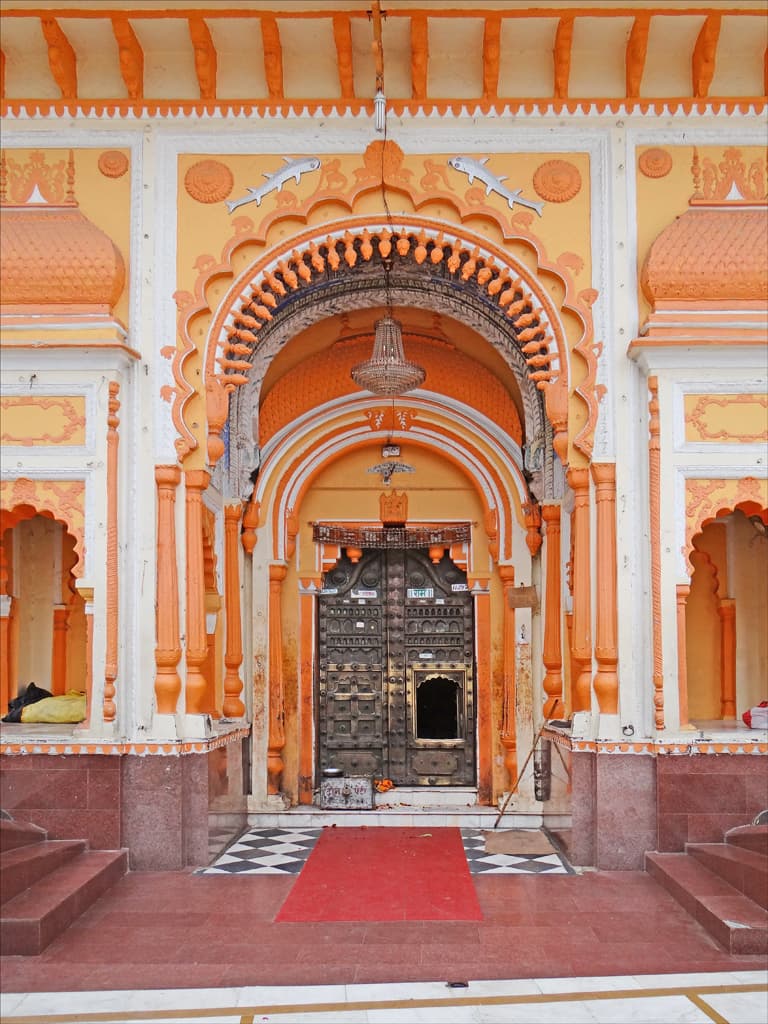
Rāma at Orchha is worshipped as a king, Rāmrājā S8S9S7. The Government of India’s tourism site describes the shrine as the place where he is worshipped as a sovereign rather than only as a deity S8.
Armed guards salute Rāma in the temple’s daily worship, as both the national and the state tourism sites report; the state site describes a gun salute at the evening ārati S8S9. A 2023 news report identifies the guards as police and gives the salute as four times a day S10.
The guard of honour’s age is not known. Reports give figures such as “about 450 years” without evidence S10. Its form has changed: in November 2023, the same report says, the temple management increased the guard from one to five S10.
What this page does not claim
That Rāma reigns at Orchha, which is the tradition’s own language; that this is the only temple where Rāma is honoured as king, as tourism texts say; or that the guard of honour is hundreds of years old. No government order or police record of the guard was found.
- Established
Directly documented by primary evidence or Indian archaeological record; not in serious dispute.
- Strong inference
Well supported by epigraphy, chronology or architectural analysis, but reconstructed rather than explicitly recorded.
- Debated
Scholarly opinion differs, or the surviving evidence does not settle the question.
- Later tradition
Preserved in literary or regional tradition later than the monument itself; not contemporary testimony.
- Unknown
No surviving primary record establishes this, and it is left open rather than inferred.
- Investigative claim
A modern hypothesis or observation, recorded and examined here without being treated as established fact.
08 · Evidence
What we know, and what remains open
The epic, the court, the legend and present worship each have their own evidence.
| Statement | Basis | Status |
|---|---|---|
| In Vālmīki, Rāma is consecrated king in Ayodhyā | Critical edition, 6.116 S4. | Established · in the text |
| Vālmīki mentions Orchha | It does not; the town was founded in the sixteenth century S4S1. | Established · absent from the text |
| Orchha was the Bundela capital from 1531 to 1783 | The Tentative List, the gazetteer and Busch S1S2S3. | Established |
| Who founded Orchha | Rudrapratāp or Bhāratīcand; the sources differ S1S2S3. | Debated |
| Busch: Keśavdās frames Bir Singh’s accession through the Rāma–Bharata scene | Allison Busch’s reading S3. | Strong inference |
| The Ram Raja temple was planned as a palace | The Tentative List S1. | Strong inference |
| Who built the Chaturbhuj temple, and whether for Rāma | Busch, the gazetteer and the legend disagree S2S3S7. | Debated |
| A queen brought Rāma’s image from Ayodhyā | Written down in Rūpkalā’s commentary and the 1982 local history S6S7. | Later tradition |
| Rāma is worshipped as king, with a guard of honour | As the official tourism sites and reporting describe present practice S8S9S10. | Established · present practice |
| How old the guard of honour is | Not known; reported ages are given without evidence S10. | Unknown |
| Any record of the image or the royal cult from Madhukar Shah’s or Bir Singh Deo’s time | None found in this research S3S5S6S7. | Unknown |
Open questions
These are gaps in the surviving record rather than settled conclusions. Each remains open until primary documentation or published scholarship closes it.
- When, and by whom, the palace was turned into a temple.
- Any record of the image’s arrival from Madhukar Shah’s or Bir Singh Deo’s time.
- When the guard of honour began, and any princely-state or police record of it.
- The first-edition date of Rūpkalā’s commentary.
- Who built the Chaturbhuj temple, pending the architectural studies not read for this page.
- Keśavdās’s Braj texts in an edition, beyond Busch’s readings.
09 · Sources
Source library
Every citation on this page links here.
- S1UNESCO2019
The historic ensemble of Orchha (Tentative List ref. 6404)
Tentative-List status; the Bundela capital 1531–1783; the founding; the three mandala-plan palaces, including the “Rani Mahal (now Ram Raja Temple)”. A State Party text, not peer-reviewed.
Open indexed source ↗ - S2Archival record1908
The Imperial Gazetteer of India, new edn, vol. XIX: “Orchha State” and “Orchha Town”
Colonial-era dynastic chronology; the 1577 Mughal capture; the palace-fort, the Chaturbhuj temple and the cenotaphs. Does not mention the Ram Raja temple.
Open indexed source ↗ - S3International scholarship2011
Poetry of Kings: The Classical Hindi Literature of Mughal India, ch. 1 “Keshavdas of Orchha”
The Bundela court: dates, patrons, Keśavdās and the Rāmcandracandrikā, and the Chaturbhuj attribution.
Open indexed source ↗ - S4Primary text1960–75
Vālmīki Rāmāyaṇa, Critical Edition — Yuddhakāṇḍa
What the epic says about Rāma as king: the consecration in Ayodhyā (6.116.54–56) and his reign (6.116.82–90).
Open indexed source ↗ - S5Primary textc. 1600 / 1712
Śrī Bhaktamāl, with Priyādās’s ṭīkā-kavitta
What Nābhādās says about the queen (a name in a list) and what Priyādās adds (queen of Madhukar Sāh of Orchha).
Open indexed source ↗ - S6Primary textbefore 1951
Bhaktisudhāsvād tilak, entry on Śrī Gaṇeśdeī Rānī
The earliest written version of the Ayodhyā-image legend found in this research, given as Bundelkhand oral tradition. Later devotional commentary, not history.
Open indexed source ↗ - S7Indian scholarship1982
Orchhā kā Itihās (Hindi)
A local history by a Ram Raja temple employee; used only as evidence of the fully developed legend and its Vikrama-era dates.
Open indexed source ↗ - S8Modern reportingundated
Divine Worship at Raja Ram Mandir Orchha
How the national tourism site presents the living tradition: Rāma worshipped as king, a guard of honour and gun salute. Not evidence for history.
Open indexed source ↗ - S9Modern reporting2022
Shri Ram Raja Temple in Orchha – Where Lord Rama is worshipped as a king
How the state tourism site presents the living tradition: “formerly known as the Rani Mahal”; a gun salute at the evening ārati.
Open indexed source ↗ - S10Modern reporting2023
ओरछा में नई परंपरा शुरू, 5 गार्ड 4 टाइम देंगे सलामी
Reports the police guard of honour, four times a day, increased from one guard to five in November 2023. Not evidence for the custom’s age.
Open indexed source ↗ - S11Archival record1885–1887
“The Great Temple from Fort, Orcha [sic]”, albumen silver print, 2016.135.15
A nineteenth-century photograph of the Chaturbhuj temple seen from the fort.
Open indexed source ↗ - S12Archival record1885–1887
“Mausoleums of Bundela Chiefs, Orcha [sic]”
A nineteenth-century photograph of the Bundela cenotaphs on the Betwa.
Open indexed source ↗ - S13Archival record1880s
Chaturbhuj temple, Orchha (Bellew Collection of Architectural Views)
A second nineteenth-century view of the Chaturbhuj temple.
Open indexed source ↗