01 · Why Rameswaram
Three histories on one shore
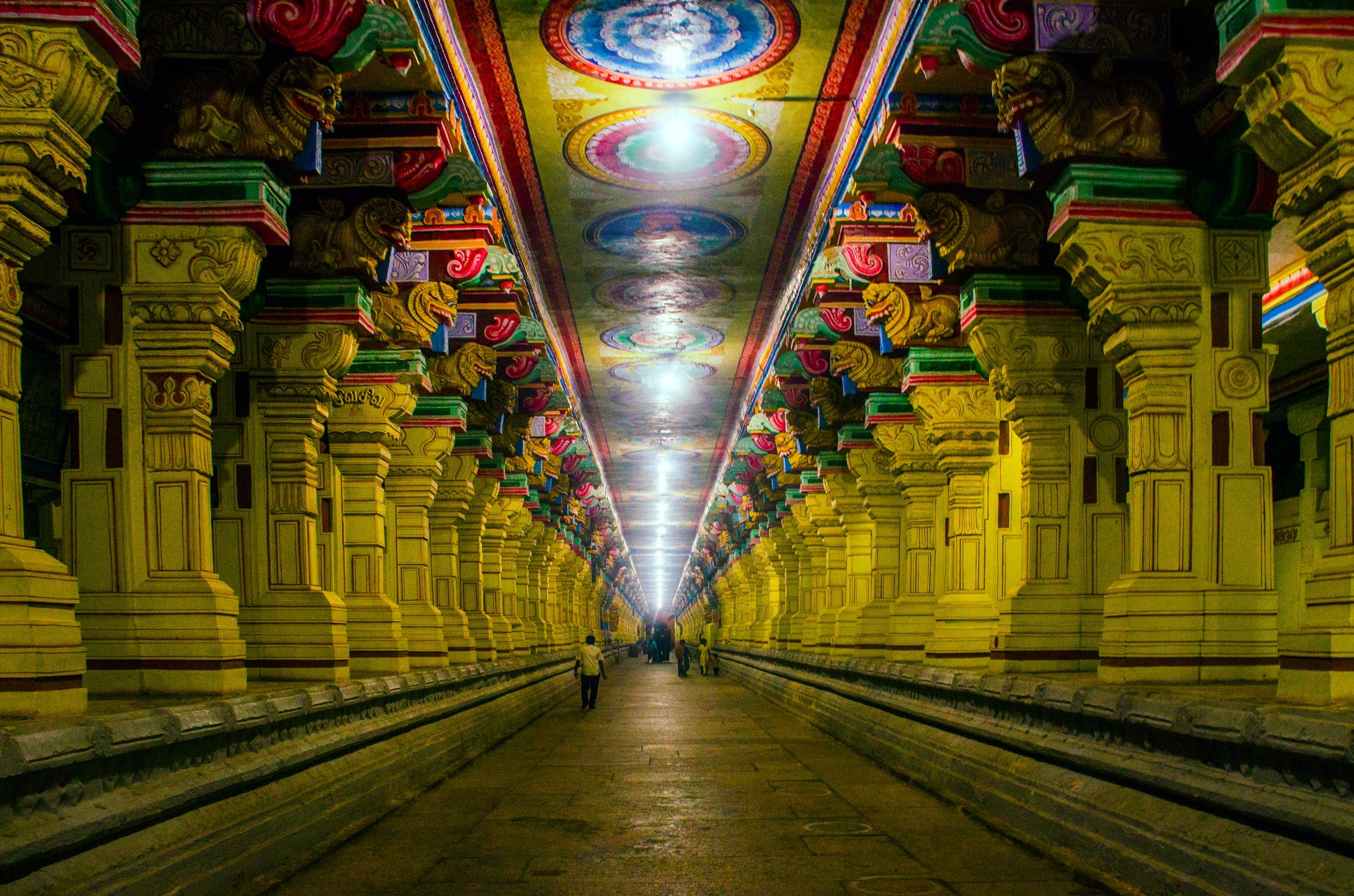
Rameswaram matters to the Rāmāyaṇa tradition because it is where the sea crossing is placed, to Śaiva devotion because of its liṅga, and to Hindu pilgrimage as a whole as one of the four dhāms. Those three histories began at different times.
The epic gives the shore and the Setu S1. The tradition that Rāma worshipped Śiva here is first heard in a seventh-century Tamil hymn S4. The temple that stands today was built over about a thousand years, mostly by the Setupati rulers of Ramnad S3.
- Established
Directly documented by primary evidence or Indian archaeological record; not in serious dispute.
- Strong inference
Well supported by epigraphy, chronology or architectural analysis, but reconstructed rather than explicitly recorded.
- Debated
Scholarly opinion differs, or the surviving evidence does not settle the question.
- Later tradition
Preserved in literary or regional tradition later than the monument itself; not contemporary testimony.
- Unknown
No surviving primary record establishes this, and it is left open rather than inferred.
- Investigative claim
A modern hypothesis or observation, recorded and examined here without being treated as established fact.
02 · The epic
What Vālmīki actually says
In the critical edition of the Rāmāyaṇa, the shore is where the army waits, the sea is crossed and the Setu is built. It is not where Rāma worships Śiva.
What the epic says
The southern recension
The southern version of the epic adds a line in which Rāma says that Śiva showed him grace at the Setu, and calls the Setubandha a tīrtha that destroys great sins S2. Even there, Rāma installs no liṅga.
03 · Later tradition
How Rāma’s liṅga entered the story
The temple’s founding story comes from Tamil hymns and Sanskrit Purāṇas, not from Vālmīki.
| Source | What it says | Status |
|---|---|---|
| Campantar’s Tēvāram hymn (c. 7th c.) | Rāma made the shrine of Rāmeccuram to remove the sin of killing Rāvaṇa S4. The earliest datable text to connect the two. | Established · the hymn says this |
| The Skanda Purāṇa’s Setu-māhātmya | Hanumān goes to Kailāsa for a liṅga; when he is late, Sītā shapes one from sand and Rāma installs it. Hanumān’s liṅga is to be worshipped first S5. | Later tradition |
| When was the Setu-māhātmya composed? | Not established; the text is undated S5. | Unknown |
| Before or after the war? | Traditions differ on whether the liṅgas were set up before or after Rāma’s victory, and on where Hanumān’s liṅga came from S3S5. | Debated |
| Where else is the shrine celebrated? | Absent from the Mahābhārata’s tīrtha lists, it is praised in the Śiva, Kūrma and Skanda Purāṇas and by the poets Appar and Campantar S3. | Established |
04 · History
The temple that stands today
The surviving temple is the work of many centuries. Its oldest stones are a thousand years old; most of what visitors see was built under the Setupatis of Ramnad in the 17th and 18th centuries S3.
The presiding deity is Śiva as Rāmanātha, with the goddess Parvatavardhinī. The temple holds two liṅgas, the Rāmeśvara liṅga and the Viśvanātha liṅga, the second associated in tradition with Hanumān S3.
c. 930
A royal ritual at Rāmatīrtha
The Chola king Parāntaka I performs a tulābhāra at “Rāmatīrtha, where the monkey flocks built the bridge” S3. The record names the tīrtha, not a temple.
10th–11th c.
The earliest surviving fabric
Five small stone shrines on the west side of the third enclosure are the oldest surviving buildings S3. Whether an earlier shrine stood here is unknown.
10th–14th c.
Kings from across the south
Royal rituals or monuments are recorded for Kṛṣṇa III (c. 959), Niśśaṅkamalla of Polonnaruwa (r. 1187–96), the Hoysalas and, in 1387 and 1390, the Vijayanagara prince Virūpākṣa “before Rāmanātha” S3.
1414
A Jaffna renovation
A king of Jaffna renovates the temple with stone brought from Trincomalee S3.
15th c.
The outer enclosure
The outer wall and its gopuras are built; the north and south gopuras stood only as stone bases until they were rebuilt in 2016 S3.
17th–18th c.
The Setupati temple
Most of the present temple, including its great corridors, is built under the Setupatis of Ramnad S3.
1890s–1920s
A modern renovation
Chettiar-funded work renovates the inner enclosures, roofing the inner shrines and rebuilding them in granite; the east gopura is completed in 1904 S3.
05 · Architecture
The great corridors
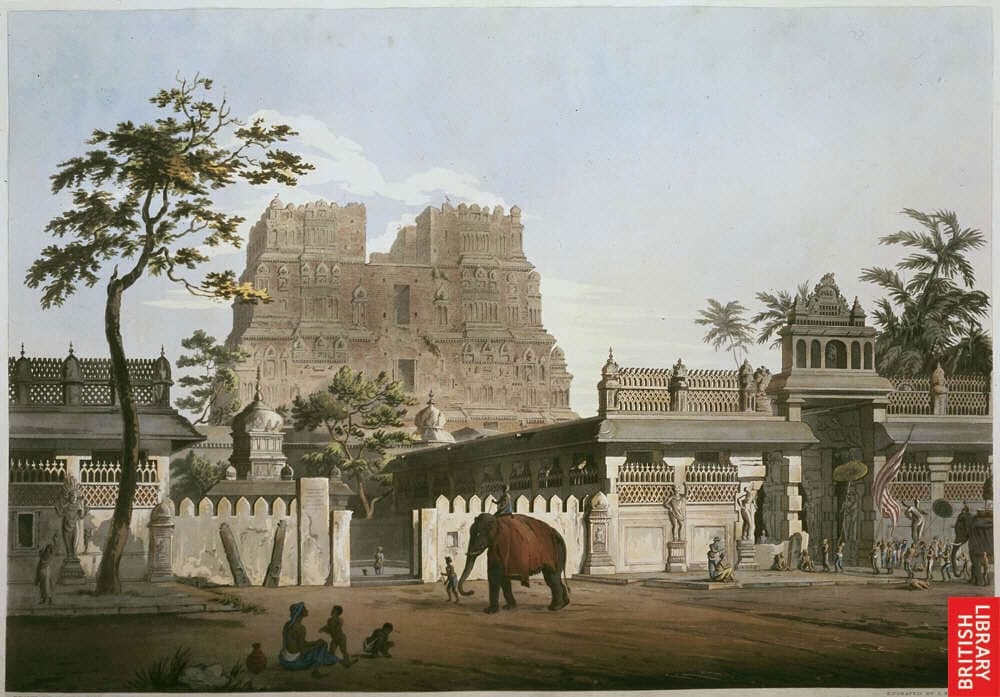
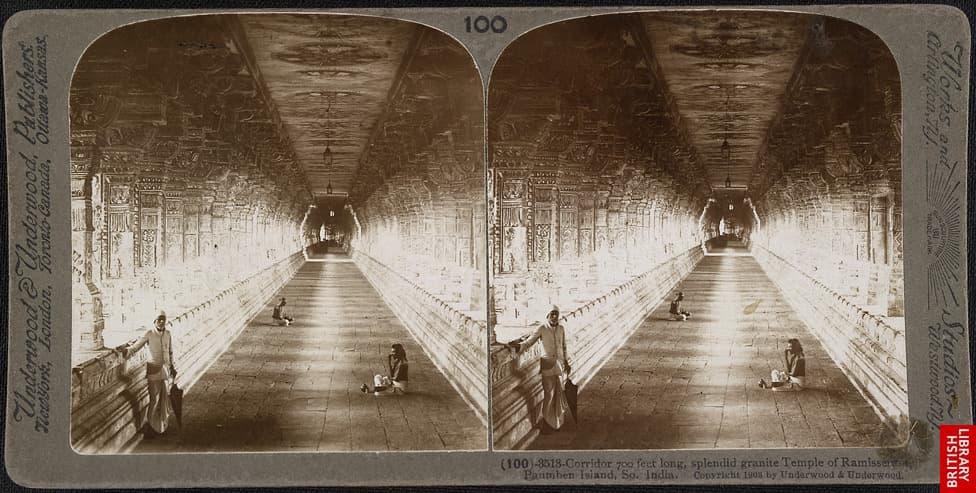
The third-enclosure corridors were built between about 1740 and the 1770s, at the height of Setupati power S3. They are the temple’s most celebrated architecture.
Across the temple, mostly along these corridors, stand just over a hundred life-size figures with hands joined in reverence, usually read as portraits of donors, more than in any other south Indian temple S3. The corridors are built of local sandstone S3.
Their length is often quoted, but authoritative sources do not agree on a figure, so none is given here.
06 · Sacred geography
The Setu and the shore
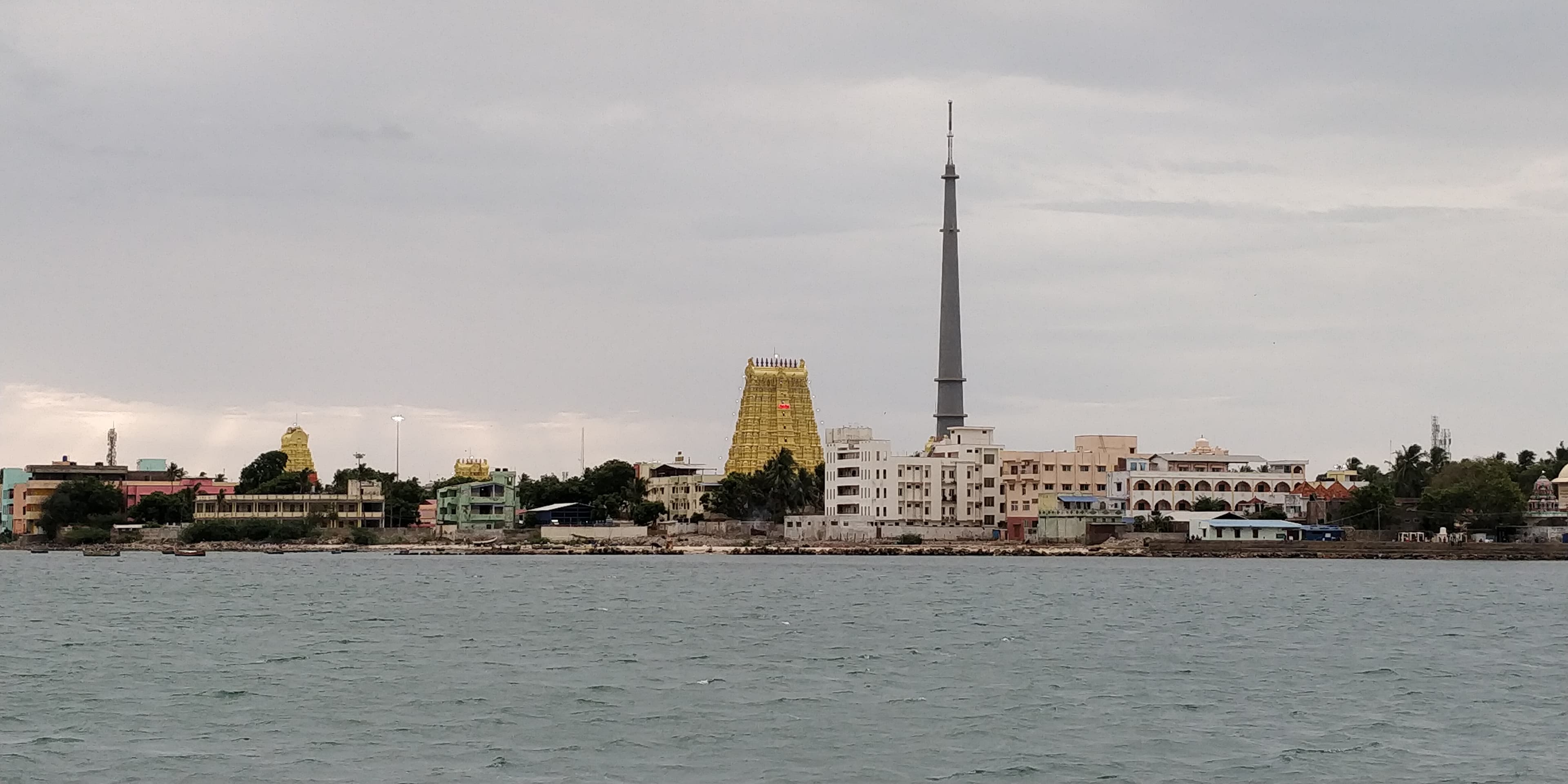
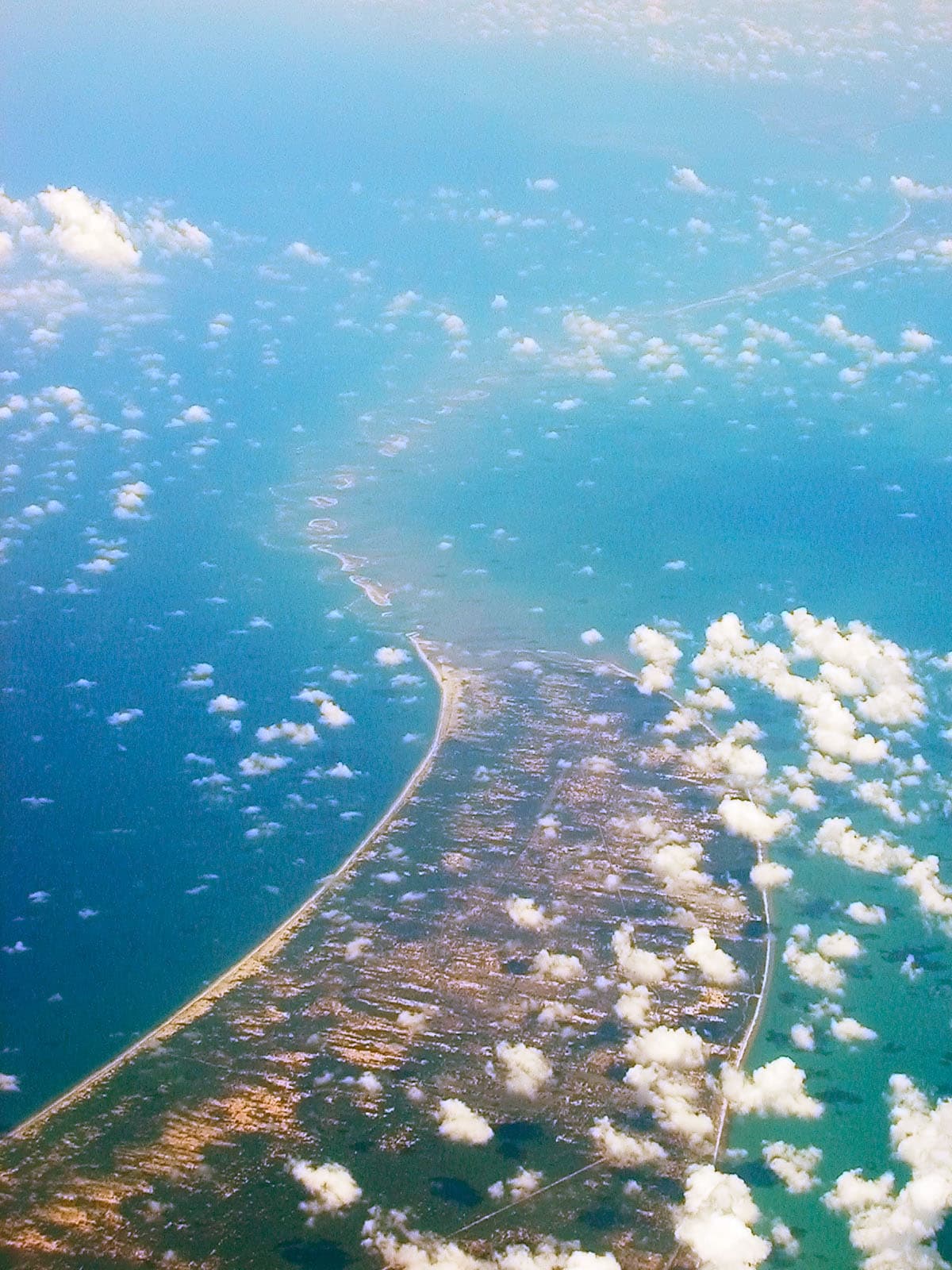
South-east of the temple the island runs out to Dhanushkodi, where a chain of shoals stretches towards Sri Lanka. Tradition identifies it with Nala’s Setu.
Satellite measurement describes Adam’s Bridge as a largely submerged chain of shoals about 29 km long between Dhanushkodi and Talaimannar S7. Their identification with Nala’s Setu is a tradition. Vālmīki does not place the Setu on any map, and the geological evidence does not establish the identification S1S7.
What this page does not claim
Vālmīki does not locate the Setu on a map, and nothing here treats the shoals as archaeological evidence for the epic’s crossing.
07 · Pilgrimage
A living tīrtha
Tradition counts Rameswaram among the twelve jyotirliṅgas and as the southern of the four dhāms S3. Its pilgrimage begins in water.
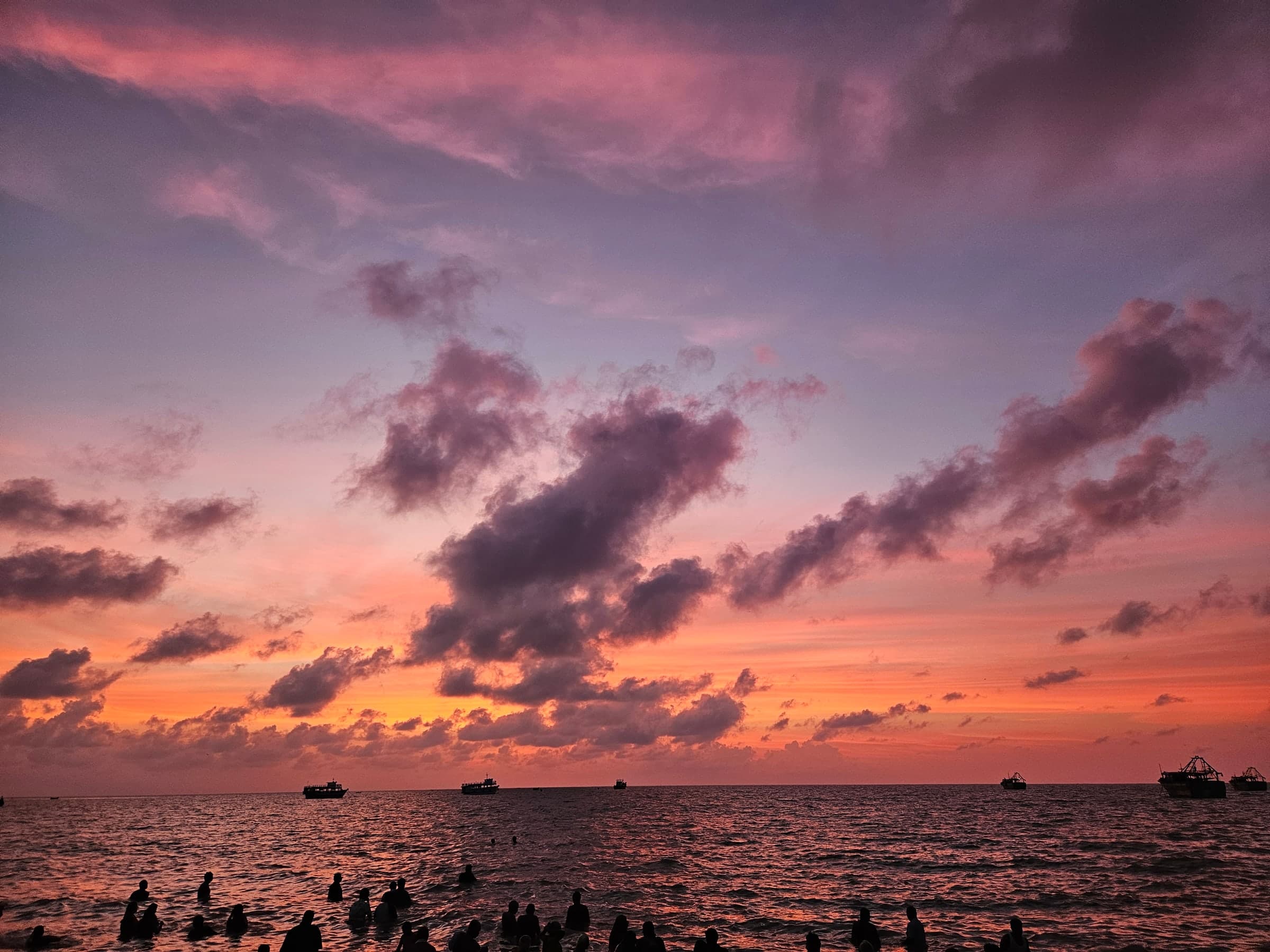
Pilgrims bathe in the sea at the Agni tīrtha in front of the temple, then at twenty-two tīrthas inside it, visited in sequence before they come before Śiva and the goddess S3. The Rāmeśvara liṅga has been counted among the twelve jyotirliṅgas from at least the twelfth century S3S6.
The pairing with Kāśī in the north is old: a 1690 letter written for the Dutch East India Company calls the temple and Kāśī “highly estimated places of all heathen kings” S3.
08 · Evidence
What we know, and what remains open
The epic, the tradition and the temple each have their own evidence.
| Statement | Basis | Status |
|---|---|---|
| In Vālmīki, Rāma crosses from the southern shore and Nala builds the Setu | The epic describes the shore and the Setu, with no named place S1. | Established · in the text |
| That shore is Rameswaram’s | A tradition; the earliest dated record linking the bridge to this tīrtha is Parāntaka’s, c. 930 S3. | Later tradition |
| Vālmīki names Rāmeśvara or a liṅga | Neither appears in the critical edition S1. | Established · absent from the text |
| Rāma founded the shrine to expiate killing Rāvaṇa | Tamil hymns from the 7th century and the Purāṇas S4S5. | Later tradition |
| The oldest surviving fabric is 10th–11th century | Architectural dating by Bes & Branfoot S3. | Strong inference |
| Most of the temple is Setupati work of the 17th–18th centuries | Bes & Branfoot S3. | Strong inference |
| The shoals of Adam’s Bridge are Nala’s Setu | A tradition; neither text nor geology establishes it S1S7. | Later tradition |
Open questions
These are gaps in the surviving record rather than settled conclusions. Each remains open until primary documentation or published scholarship closes it.
- Whether a shrine stood here before the surviving 10th–11th-century buildings.
- When the Setu-māhātmya and the other Purāṇic versions of the liṅga story were composed.
- How and when Rameswaram entered the list of twelve jyotirliṅgas.
- An authoritative measurement of the corridors.
- Who the hundred-odd portrait figures in the corridors represent.
- The origin and age of the shoals of Adam’s Bridge.
09 · Sources
Source library
Every citation on this page links here.
- S1Primary text1960–75
Vālmīki Rāmāyaṇa, Critical Edition — Yuddhakāṇḍa
What the epic says about the shore, the Setu and the return journey.
Open indexed source ↗ - S2Primary textonline edition
Vālmīki Rāmāyaṇa, southern recension — Yuddhakāṇḍa, sarga 123
The southern recension’s additions at the Setu.
Open indexed source ↗ - S3International scholarship2024
“From all quarters of the Indian world”: the temple at Rameshvaram, Hindu kings, and Dutch merchants
The temple’s history: its earliest fabric, royal patrons, renovations, corridors, portraits, tīrthas and pilgrimage status.
Open indexed source ↗ - S4Primary textc. 7th century
Tēvāram 3.10, “Tiru-Irāmeccuram”
The earliest hymn to the shrine, linking it with Rāma’s expiation.
Open indexed source ↗ - S5Primary textundated text
Skanda Purāṇa, Brahma-khaṇḍa, Setu-māhātmya, ch. 45
The story of the sand liṅga and Hanumān’s liṅga.
Open indexed source ↗ - S6International scholarship2009
Mapping sacred geography in medieval India: the case of the twelve Jyotirliṅgas
The history of the twelve-jyotirliṅga list (as cited by Bes & Branfoot).
Open indexed source ↗ - S7Indian scholarship2024
Physical features of Adam’s Bridge interpreted from ICESat-2
A satellite study of the shoals between Dhanushkodi and Talaimannar.
Open indexed source ↗ - S8Archival record1809
“Pagoda at Ramisseram”
An early nineteenth-century view of the temple.
Open indexed source ↗ - S9Archival recordc. 1903
Stereograph of a corridor, temple of Ramisseram
An early photograph of one of the corridors.
Open indexed source ↗