Rāmāyaṇa · Dharma & devotion
Why We Still Celebrate Rāma: Sītā’s Exile and the Moral Courage of Dharma
Courage, sacrifice and the restraint of power explain Rāma’s enduring appeal. Taking Sītā’s suffering seriously makes that reverence more demanding—and more humane.
Vedika Research · 11 min read · 5 primary sources cited
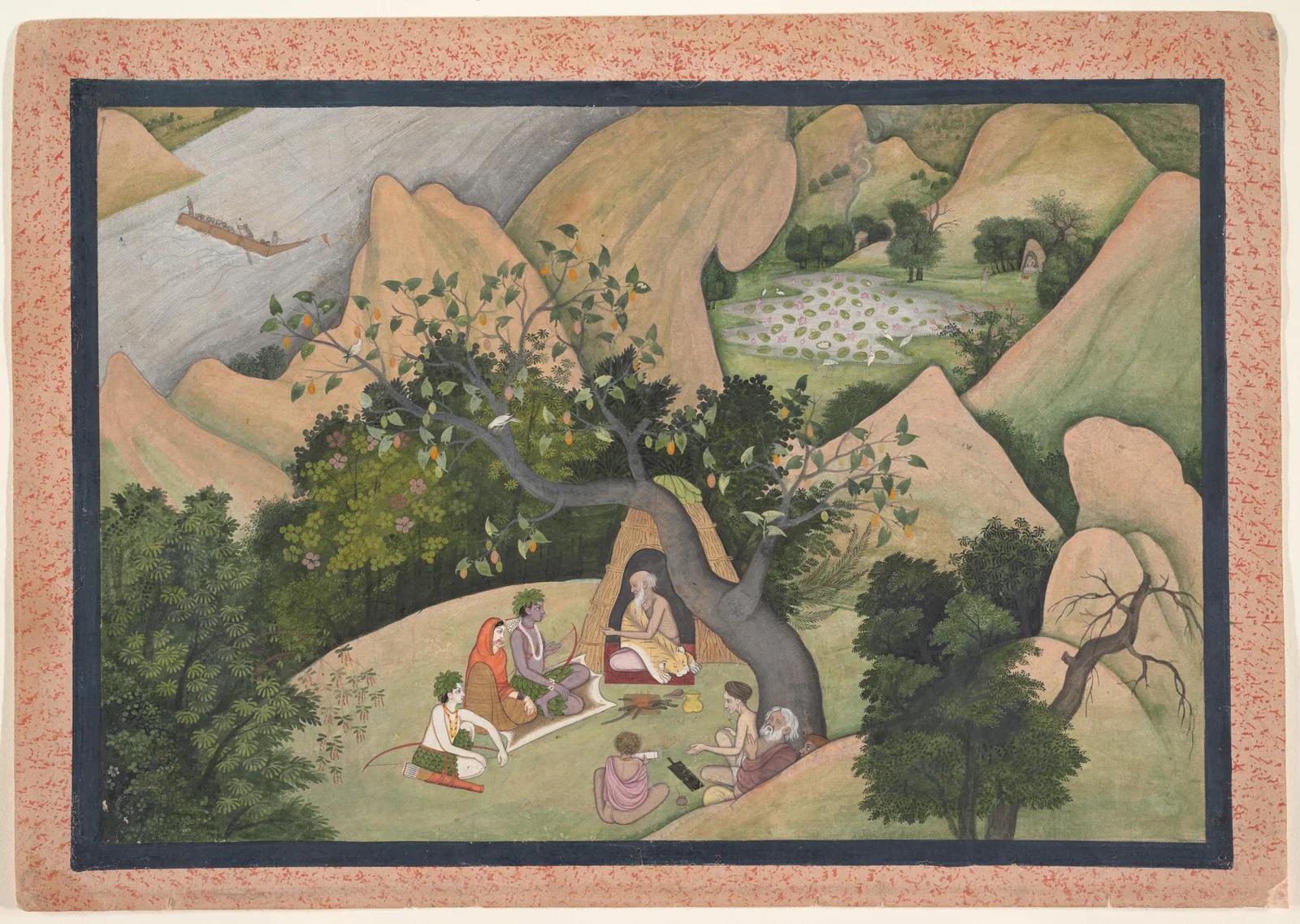
A question beneath the Diwali lights
At a Diwali procession in Watford, amid the lights, a Portuguese Catholic friend asks a sincere question: ‘Why do you celebrate Lord Rāma if he sent his innocent, pregnant wife into exile?’ The question brings a painful part of the Rāmāyaṇa into the midst of celebration. It deserves a considered answer, offered in the same spirit of openness in which it was asked.
For many Hindu communities, Diwali recalls Rāma’s return to Ayodhyā with Sītā after exile and the defeat of Rāvaṇa. The festival carries other meanings across regions and traditions; this is one cherished account, not its universal explanation. Within that account, the homecoming promises that estrangement can end, that courage can overcome oppression, and that a rightful order can be restored.
Yet readers of the epic’s seventh book know that another separation follows. The lights do not make that knowledge disappear. A serious answer must hold together the Rāma whose life inspires devotion and the Sītā whose suffering places a demand upon our conscience. Vedika’s argument is that reverence can do precisely this: honour the larger moral vision of Rāma’s life, while refusing to make an innocent woman’s exile a model for human conduct.
The greatness that draws people to Rāma
The opening of Vālmīki’s Rāmāyaṇa asks what an exemplary person would be like. Its catalogue includes courage, gratitude, truthfulness, knowledge of dharma and steadfastness in commitments. Nārada identifies Rāma as the bearer of these qualities. The epic therefore begins with an inquiry into character, and then gives that inquiry the demanding form of a life. Read the opening inquiry.
Rāma’s first great sacrifice is a kingdom. When his father’s promise requires him to leave Ayodhyā, he accepts fourteen years of exile. He relinquishes the security and status of royal life to preserve a pledged word. What gives this action its enduring force is the restraint it asks of someone who could otherwise insist upon his claim: power is placed under an obligation that personal advantage cannot simply cancel.
His struggle against Rāvaṇa develops another aspect of the ideal. Rāvaṇa abducts Sītā and attempts to make his desire sovereign over her will. Rāma’s campaign to recover her places courage in the service of resisting coercion. The long search, the dependence upon allies, and the dangers of battle give the victory its human weight. Devotion remembers a prince who endures loss and acts with resolve, rather than merely possessing overwhelming strength.
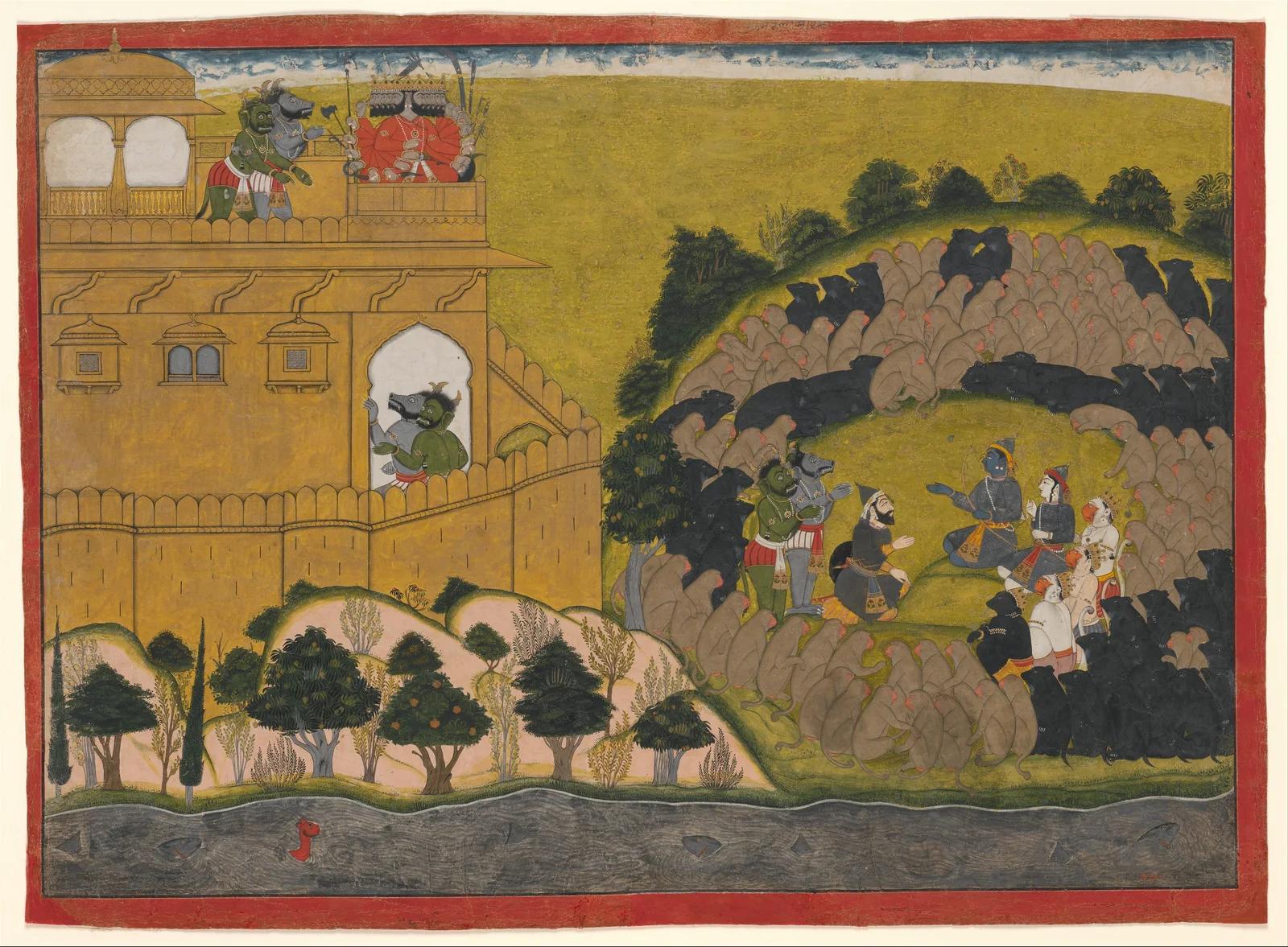
Restraint also matters within conflict. A painting attributed to Manaku shows Rāma releasing the captured spies Śuka and Sāraṇa. The Met’s account identifies their unarmed status as central to the scene. Such an image makes an important part of Rāma’s appeal visible: the capacity to conquer is joined to the discipline of deciding when force should be withheld. Museum account of the episode.
For devotees, these qualities belong within a relationship with the divine. Many worship Rāma as an avatāra of Viṣṇu and Sītā as divine in her own right. Their devotion cannot be reduced to approval of a historical ruler’s record. Nevertheless, truthfulness, sacrifice and the restraint of power help explain why the story speaks even to a reader approaching it through literature or ethics.
The wound that reverence must face
Two episodes need to be distinguished. The fire ordeal takes place after Rāvaṇa’s defeat, in the Yuddha Kāṇḍa. Following Rāma’s public repudiation, Sītā enters the fire; Agni returns her and affirms her innocence. Rāma then says that he knows her fidelity, explaining the ordeal in terms of assurance before the world. That explanation belongs to the narrative. It does not remove the anguish of making Sītā undergo it. Yuddha Kāṇḍa, sarga 118 in this online edition.
The later exile belongs to the Uttara Kāṇḍa, after their return to Ayodhyā. Sītā is pregnant. Public talk questions Rāma’s acceptance of a wife who has lived in another man’s captivity. Rāma knows her innocence, yet orders Lakṣmaṇa to leave her beyond the Gaṅgā near Vālmīki’s hermitage. She receives the protection of the sage’s community and gives birth to Lava and Kuśa. This is abandonment under the pressure of public reproach, not the discovery of wrongdoing by Sītā. Text and critical discussion: Goldman and Sutherland Goldman.
Her loss must remain concrete. A woman who has already survived abduction and endured public scrutiny is deprived of her home and her husband’s companionship during pregnancy. Sanctuary in an āśrama does not undo that rupture. Nor does Rāma’s own grief make the burdens equal: Sītā bears the consequences of a decision taken about her despite her innocence.
The distinction between motive and consequence matters. To describe Rāma simply as a jealous husband misstates this episode. To describe Sītā’s exile simply as a noble sacrifice obscures who made the decision and who had to live with it. Understanding the king’s reasoning and acknowledging the injustice to Sītā are both necessary to an honest reading.
When the duties of a king and a husband collide
Dharma can name obligations shaped by relationships and circumstances as well as a larger sustaining order. Rāja-dharma concerns the responsibilities of kingship; pati-dharma concerns a husband’s obligations. In the exile episode, Rāma understands his public role as demanding a renunciation that his relationship with Sītā makes devastating. His kingship is not imagined as a licence to disregard the people’s judgement.
The strongest traditional defence starts here. A ruler must not exempt his own household from the standards by which he governs. Rāma places the demands of office above personal happiness and accepts a separation that wounds him too. This reading recognises something admirable in his refusal to treat sovereignty as private privilege. It explains why many devotees see an unbearable burden of duty where another reader sees a disastrous decision.
But the defence encounters a question it cannot settle merely by naming royal duty. If the king knows an accusation is false, what does justice require him to do? Public confidence matters, but so does the protection of an innocent person. Sītā’s innocence is not a private preference to be balanced against the crowd. A conception of kingship that safeguards its reputation by abandoning her can be questioned on the grounds of dharma itself.
The text makes room for that questioning. Lakṣmaṇa’s criticism of the exile is discussed in the Goldmans’ introduction; the moral unease is already inside the received story. Vedika reads the conflict as a warning about an obligation pursued without sufficient regard for those it harms. That is an ethical interpretation, not a claim that all Hindu theological traditions regard Rāma as fallible.
This distinction lets us appreciate the seriousness of Rāma’s intention without turning intention into a complete defence. His determination to serve something beyond himself remains intelligible and compelling. Sītā’s treatment still asks whether that service has been rightly understood. The greatness of the ideal makes the question more searching, because a ruler committed to righteousness must answer to the innocent as well as to public opinion.
One sacred story, many acts of interpretation
The Rāma tradition has preserved more than one response to this difficulty. Kampaṉ’s Tamil Irāmāvatāram comprises six books and reaches its conclusion with the return and restoration. It does not narrate the later abandonment, although it retains the earlier fire episode. The University of California, Davis project describes a devotional poem in which divine identity and psychologically rich human experience coexist. The Kampaṉ Project.
Tulsīdās’s Rāmcaritmānas reinterprets the fire episode through the reflected or māyā Sītā: the real Sītā enters the protection of fire before the abduction, and the later scene restores her. The Mānas does not narrate the second exile. Its Uttara Kāṇḍa should therefore not be confused with the seventh book of Vālmīki’s epic simply because they share a name. Rāmcaritmānas excerpt, Araṇya Kāṇḍa 3.24.
The Adhyātma Rāmāyaṇa also employs the shadow-Sītā motif, within a strongly theological understanding of Rāma’s identity. Such interpretations change the premises of the narrative: divine reality exceeds the appearances through which the story unfolds. They deserve to be understood on their own terms. They should not be silently inserted into Vālmīki’s account as though every telling used the same explanation. Adhyātma Rāmāyaṇa, translation by P. R. Ramachander.
Other poets work through grief and protest. Kālidāsa’s Raghuvaṃśa gives Sītā a challenge to the propriety of abandoning her after her innocence has been established. Bhavabhūti’s Uttararāmacarita centres the pain of separation and ultimately reunites Rāma and Sītā. The French Institute of Pondicherry’s account confirms that restorative ending. These are acts of engagement with a revered story, showing that moral discomfort need not begin outside the tradition. Bhavabhūti’s drama.
Sītā-centred readings change the reader’s point of attention again. They ask what the story looks like from the life of the woman required to prove herself, rather than only from the throne required to govern. Modern retellings such as Volga’s The Liberation of Sita belong to this continuing conversation; they are creative interpretations, not evidence for the wording of Vālmīki. Their value includes the questions they bring back to readers of the older epic. Ruchi and Jha on Volga’s retellings.
The seventh book cannot simply be wished away
Textual scholarship introduces a further distinction. The Uttara Kāṇḍa belongs to the received seven-book Vālmīki Rāmāyaṇa and to its Critical Edition. A substantial scholarly tradition nevertheless regards much of it, along with portions of the first book, as compositionally later than the central books. The Goldmans review evidence and debate about those layers; precise chronology remains a matter of scholarship rather than an established date for a single addition.
‘Later textual layer’ does not mean ‘modern fabrication’. Nor does it mean that an ancient book’s influence can be cancelled by deciding it came later. The exile has shaped poetry, devotion and ethical discussion for centuries. Recognising textual development helps explain differences within the epic; it does not relieve readers of attending to a story that their tradition has transmitted.
That is also why this article names its texts rather than referring vaguely to what ‘Hinduism says’. A literary reading of Vālmīki, a devotional reading of Tulsīdās and a philosophical interpretation of divine līlā need not answer the same questions in the same vocabulary. Their differences should remain visible. Introduction to the scholarly Uttara Kāṇḍa translation.
Sītā’s dignity is part of the answer
In the received ending, Sītā is called before the assembly again. Vālmīki affirms her innocence, and Rāma acknowledges that he knew it. Sītā appeals to the Earth to receive her if she has remained faithful. The Earth receives her. She does not resume married life in Ayodhyā. The ending gives vindication without the domestic reconciliation that a reader might have hoped would repair the loss.
A devotee may understand this as the daughter of Earth returning to her divine mother. A literary reader may also understand it as a refusal to remain subject to an endless demand for proof. The latter is an interpretation of the scene, not a replacement for its religious meaning. Both approaches can recognise that Sītā’s dignity survives the judgement imposed upon her.
Her suffering should never be used to teach that a woman owes unlimited endurance to a family’s reputation. Contemporary commitments to dignity and equality belong in our ethical engagement with inherited literature. They prompt us to ask whose voice has been heard, whose truth has been discounted and whose life pays for an institution’s standing. The epic’s repeated affirmation of Sītā’s innocence gives those questions a firm starting point.
To honour Sītā is consequently essential to answering the question about Rāma. She cannot be treated as an awkward detail in an otherwise reassuring account of kingship. Her integrity helps define what righteousness must protect. A reading that makes Rāma admirable by making Sītā’s loss insignificant has failed to attend to the very person the narrative repeatedly vindicates.
Reverence asks something of the reader
Worship, moral example and literal imitation are distinct activities. For a devotee, Rāma’s divinity need not depend on the reader’s ability to resolve every narrated action. Divine līlā, the meaningful unfolding of divine action, offers one theological approach to what appears troubling. Other readers approach the same scenes as tragic literature or ethical argument. Human uncertainty in interpretation is not itself proof of imperfection in the divine.
What follows for conduct, however, requires discernment. A husband cannot turn an episode about ancient royal legitimacy into permission to abandon his wife because neighbours gossip. A leader cannot make an innocent person’s exclusion righteous merely by invoking public pressure. Admiring fidelity to duty asks us to think carefully about the duties we actually owe, including the duty to challenge an unjust accusation.
Here lies an enduring strength of the Rāmāyaṇa tradition. Its tellings preserve enough complexity for readers to return with new understanding, rather than exhausting the story in a single moral formula. The claim need not be that other religions lack moral inquiry. The more grounded claim is that this tradition contains abundant resources for it, alongside prayer, devotion and the aspiration to live well.
An imperfect world needs the courage Rāma represents. It also needs the capacity to recognise when a cherished conception of responsibility has failed someone. We are fallible in our loyalties, our judgements and our uses of authority. Reading the epic attentively can make us more accountable for those limitations, especially when its revered characters face obligations whose consequences cannot be made painless.
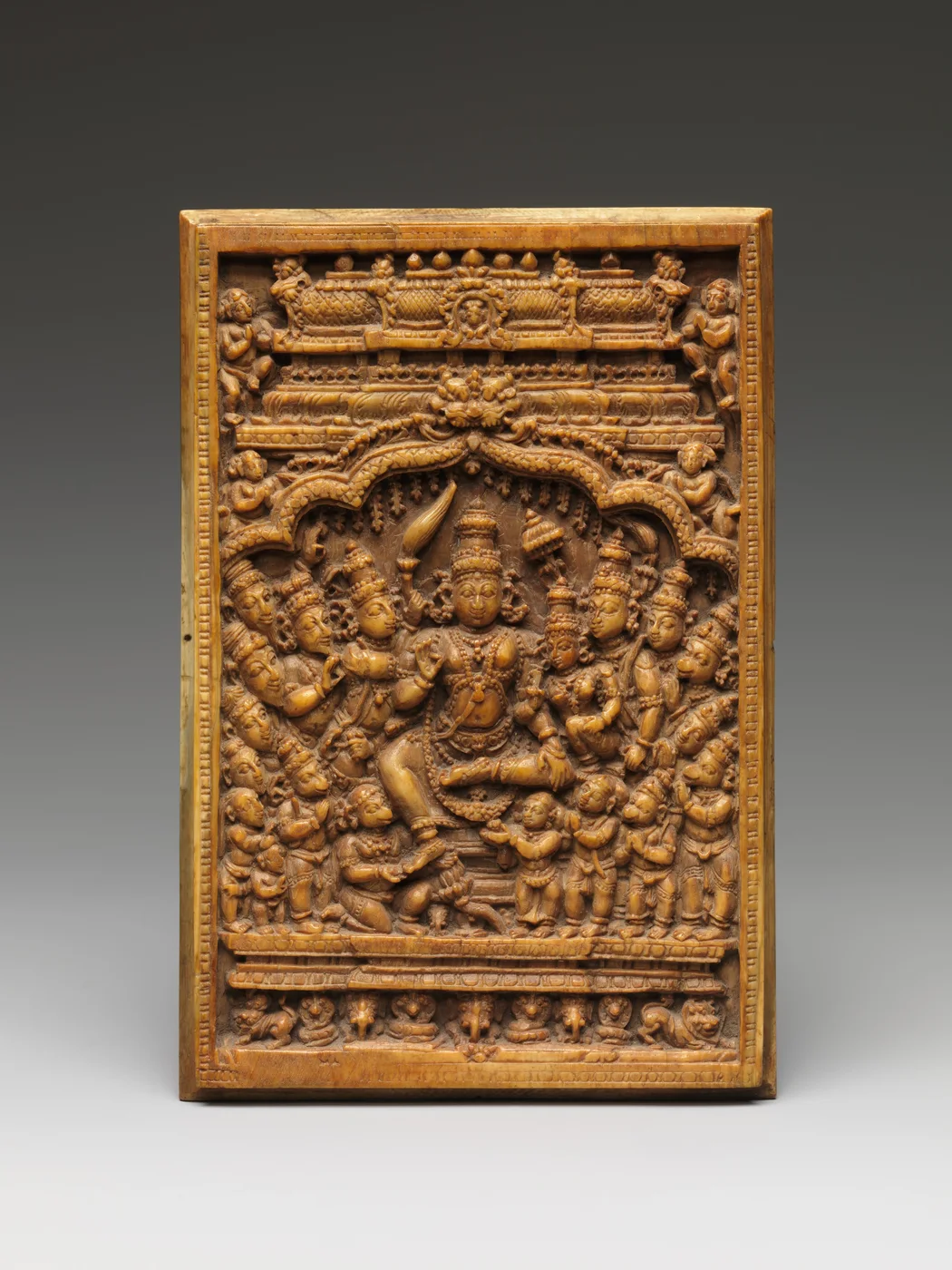
An answer worthy of the lights
The friend in Watford deserves an explicit answer. Rāma is celebrated for the larger moral and spiritual vision embodied in his life: courage against coercion, the surrender of personal advantage, fidelity to commitments, restraint and the conviction that power must serve dharma. For devotees, he is also the divine presence to whom those virtues draw the heart. Sītā’s exile does not erase that significance.
Neither does that significance make her exile acceptable as an example for contemporary life. We can honour Rāma without requiring Sītā’s suffering to become good. We can recognise the burden of kingship while asking whether public duty has protected the person most entitled to its care. Such questioning need not extinguish devotion; it can make the responsibility carried by devotion more exacting.
The lights of return recall a hope worth preserving: that courage and righteousness can restore a damaged world. To keep Sītā fully within that hope is to insist that restoration must include justice for the innocent. That is a reason to continue celebrating Rāma with seriousness, compassion and the moral courage to keep reading.
Sources and further reading
This essay distinguishes narrated events, theological interpretations and Vedika’s ethical reading. Sanskrit passages are paraphrased rather than presented as new translations. Chapter and verse numbering varies between recensions and the Baroda Critical Edition; no numbering equivalence should be assumed. The Watford encounter is the framing account supplied for this editorial; no additional dialogue or personal details have been reconstructed.
Vālmīki Rāmāyaṇa, Bāla Kāṇḍa 1. Opening account of Rāma’s virtues; online translation by Desiraju Hanumanta Rao and K. M. K. Murthy.
Vālmīki Rāmāyaṇa, Yuddha Kāṇḍa 118. Agni’s testimony and Rāma’s response, in K. M. K. Murthy’s online translation. This website’s numbering differs from the Critical Edition.
Robert P. Goldman and Sally J. Sutherland Goldman, Uttarakāṇḍa (Princeton, 2017). Publisher preview: introduction, especially “The Problem of the Uttarakāṇḍa” and “The Controversial Episodes”. Discusses textual layering, Sītā’s exile and classical responses, including Kālidāsa.
The Kampaṉ Project, University of California, Davis. Scholarly introduction to the six-book Tamil Irāmāvatāram; directed by Archana Venkatesan.
Tulsīdās, Rāmcaritmānas, selected verses (Shri Ram Charit Bhavan). Selected verses with an Awadhi prose rendering; edited by Omprakash Gupta, translated by Vineeta Mishra (2022). See printed page 51, Araṇya Kāṇḍa 3.24, for the reflected-Sītā episode. This is an abridgement, not a critical edition.
Adhyātma Rāmāyaṇa, translated by P. R. Ramachander. Volume 1, edited by T. N. Sethumadhavan; the preface describes the shadow-Sītā motif.
Bhavabhūti’s Uttararāmacarita, French Institute of Pondicherry. Critical-edition project outlining the drama’s separation and eventual reunion.
Kumari Ruchi and Smita Jha, “Reinventing Marginalized Voices” (2023). Journal of International Women’s Studies 25(5), article 2. A study of female agency in Volga’s The Liberation of Sita and Yashodhara.
Artwork and permissions
Rama, Sita, and Lakshmana at the Hermitage of Bharadvaja: Illustrated folio from a dispersed Ramayana series. Unidentified artist; ca. 1780; accession 1976.15. Seymour and Rogers Funds, 1976. Public domain, The Met Open Access (CC0). Resized and converted to WebP without cropping; no generated imagery.
Rama Releases the Demon Spies Shuka and Sarana: Folio from the Siege of Lanka series. Attributed to Manaku; ca. 1725; accession 19.24.1. Rogers Fund, 1919. Public domain, The Met Open Access (CC0). Resized and converted to WebP without cropping; no generated imagery.
Rama, Sita, and Lakshmana being Honored by Sages, Hanuman, and his Army. Unidentified artist; 17th–18th century; accession 62.34.2. Gift of Mr. and Mrs. John J. Klejman, 1962. Public domain, The Met Open Access (CC0). Resized and converted to WebP without cropping; no generated imagery.
Continue exploring
Explore the Rāmāyaṇa, compare the philosophical traditions, or return to the Research library.
Primary sources cited
More research