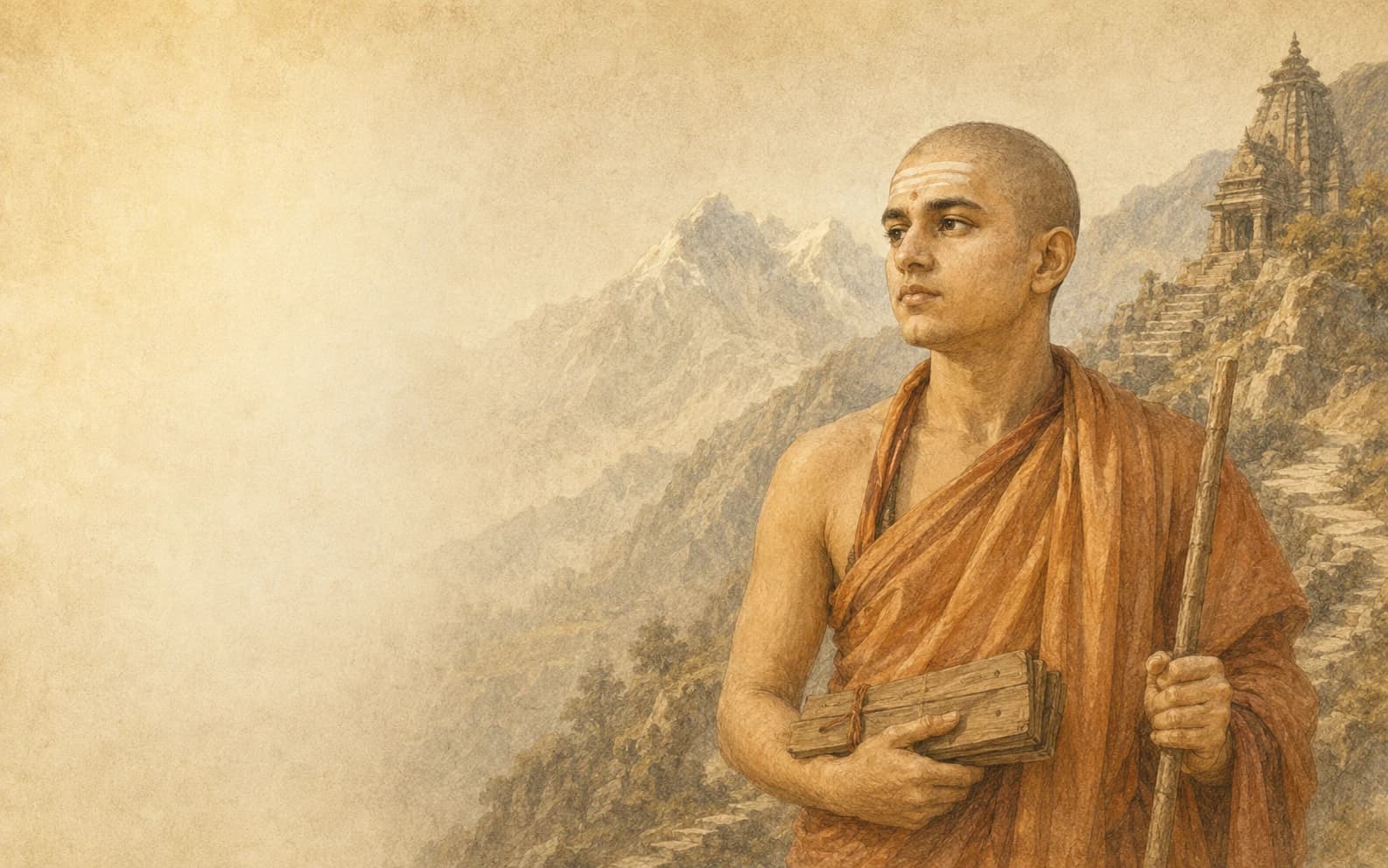
ACHARYA
आदि शङ्कराचार्य
Adi Shankaracharya
The philosopher who renewed Advaita Vedanta across the Indian subcontinent.
- Era
- c. 8th century CE
- Known for
- Acharya · Self
WHY ADI SHANKARACHARYA MATTERS
The early architect of Advaita Vedānta
Śaṅkara’s secure historical identity is carried above all by his commentaries. Later lineage narratives remember a brief, astonishing life of travel, debate, temple renewal, and monastic foundation; responsible biography keeps those two registers visible without forcing them into one.
LIFE & HISTORICAL RECORD
The early architect of Advaita Vedānta
Śaṅkara, usually placed in the eighth century CE, wrote the earliest complete surviving commentaries on the Brahma Sūtras, Bhagavad Gītā, and a major group of Upaniṣads. These works made non-duality a sustained philosophical, linguistic, and contemplative discipline.
For Śaṅkara, liberation is not the production of a new state. It is the removal of ignorance about the identity of ātman and brahman. That recognition must be prepared by ethical and contemplative maturity, heard from the teaching, examined through reasoning, and made steady.
History, lineage, and the Digvijaya memory
Modern scholarship can place Śaṅkara’s intellectual activity with more confidence than it can reconstruct his itinerary. His own works offer few autobiographical details. Broad agreement places him in early medieval India, with the eighth century now a common scholarly estimate.
What the record leaves open
Traditional Śaṅkara-vijaya narratives describe birth at Kālaḍi, early renunciation, discipleship under Govinda Bhagavatpāda, journeys of debate, and the establishment or renewal of monastic seats. These narratives shape living Advaita lineages, but many were written centuries later and vary in detail.
CORE TEACHINGS
Three threads to carry with you
Advaita does not simply claim that everything looks the same. It distinguishes changing experience from the awareness by which change is known, then questions whether the knower can finally be divided from limitless reality.
Śaṅkara’s teaching attends closely to error: we superimpose the properties of body, mind, action, and limitation upon the Self. Scriptural teaching and reasoning remove that confusion. Listening, reflection, and contemplation — śravaṇa, manana, and nididhyāsana — name a progressive discipline of understanding.
Ātman and brahman
The innermost Self is not a separate, finite object set against absolute reality.
Adhyāsa
Bondage begins in superimposition: confusing the Self with what is observed and changing.
Knowledge and freedom
Liberation is immediate in knowledge, while preparation and steadiness remain disciplined work.
WORKS & PRACTICES
A secure core inside a very large attributed corpus
The commentaries on the Brahma Sūtras, Bhagavad Gītā, principal Upaniṣads, and the independent Upadeśasāhasrī form the most secure core of Śaṅkara’s corpus. Hundreds of devotional, philosophical, and ritual works are attributed to him, but authorship varies from well supported to doubtful. Vedika treats attribution as part of the teaching, not a footnote. A beloved hymn can remain spiritually important even when it cannot be securely assigned to the historical Śaṅkara.
Prasthānatrayī bhāṣyas
Commentaries on the Upaniṣads, Bhagavad Gītā, and Brahma Sūtras.
Upadeśasāhasrī
An independent prose-and-verse teaching text generally accepted as authentic.
Practice
Ethical preparation, renunciation, listening, reflection, contemplation, and discriminative inquiry.
RELEVANCE TODAY
Precision before simplification
Śaṅkara remains a living teacher because his work refuses to separate textual interpretation from the transformation of the reader. Advaita is neither a mood nor a claim that ordinary differences do not matter; it is a demanding inquiry into what is ultimately real. Modern readers can learn from both his clarity and the debates he generated. Rāmānuja, Madhva, and later Vedāntins disagree with him in consequential ways. Reading those disagreements protects the tradition from becoming a single flattened slogan.
SOURCES & FURTHER READING
Follow the record
Śaṅkara — Stanford Encyclopedia of Philosophy
Scholarly overview of life, secure works, metaphysics, language, and liberation.
Open scholarly reference ↗Sri Sringeri Sharada Peetham — Guru Parampara
Living Advaita lineage account and institutional memory.
Open lineage source ↗History of Sri Sharada Peetham
Official lineage history of the Sringeri institution.
Open lineage source ↗CONTINUE THE JOURNEY