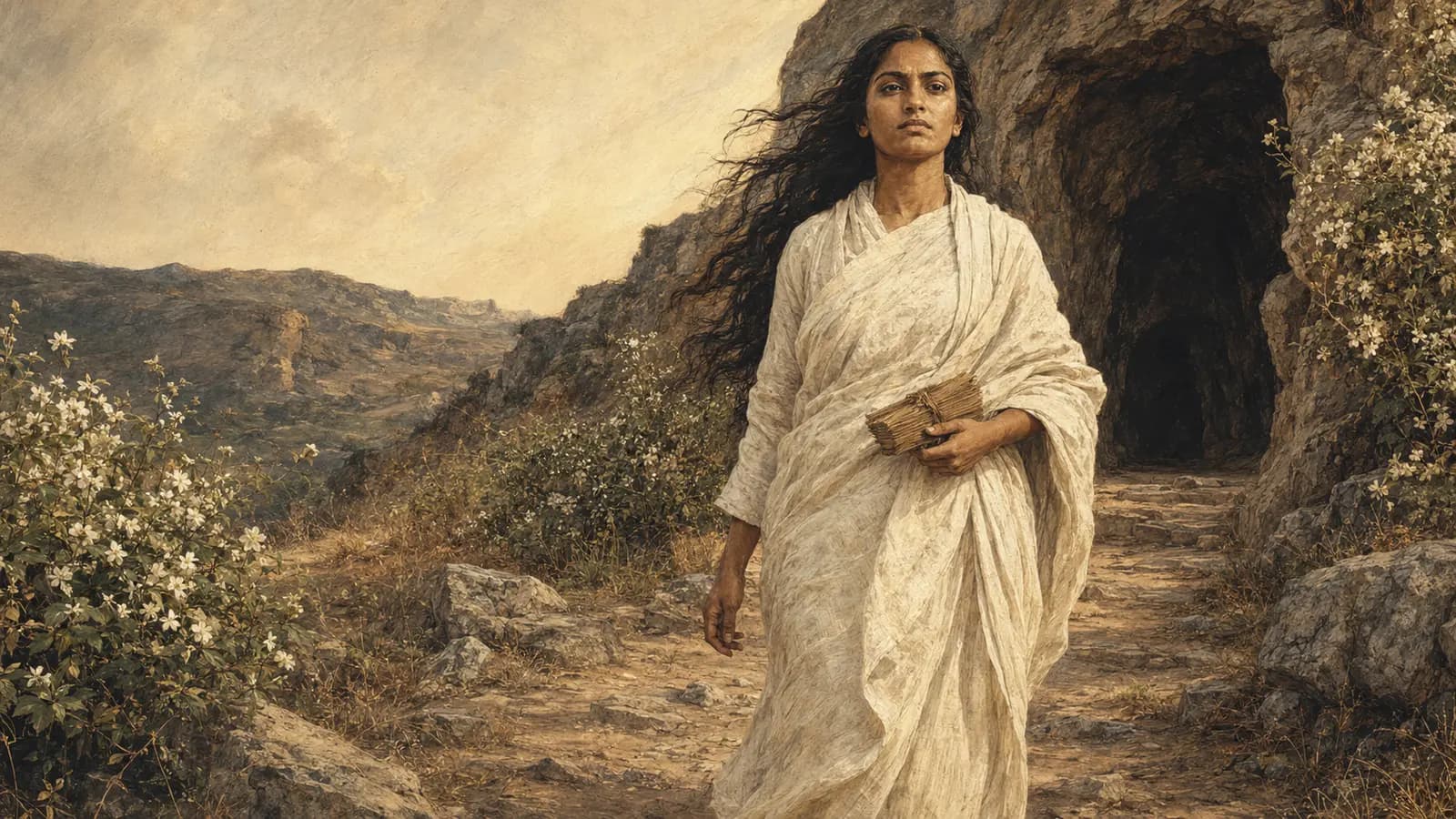
KANNADA POET-SAINT & MYSTIC
अक्क महादेवी
Akka Mahadevi
The Kannada woman mystic whose vachanas pursue Chennamallikarjuna with radical freedom and uncompromising love.
- Era
- 12th century CE
- Known for
- Kannada poet-saint & mystic · Freedom
WHY AKKA MAHADEVI MATTERS
A voice that would not be possessed
Akka Mahadevi is one of the most arresting voices of the Kannada vachana movement. Addressing Shiva as Chennamallikarjuna, “the Lord white as jasmine,” her poems refuse to let marriage, reputation, clothing or social judgement define the freedom of the self.
LIFE & HISTORICAL RECORD
A voice that would not be possessed
Akka’s vachanas join fierce longing with philosophical clarity. The body is transient, social approval unreliable, and divine love too demanding to remain a polite ornament.
Her remembered life is dramatic, but the poetry should not be reduced to a sensational story about renunciation. It is a sustained challenge to ownership—of a woman, a body, an identity or a spiritual voice.
Udutadi, Kalyana and the road to Srishaila
Traditions place Akka’s birth at Udutadi, describe conflict with a local king or husband, and remember her leaving conventional life to join the sharanas at Kalyana. Dialogues with Allama Prabhu and Basavanna test the depth of her renunciation.
What the record leaves open
She is then associated with Srishaila, sacred to Mallikarjuna. These episodes come through later literary and community memory; Vedika does not present every detail as independently documented biography.
CORE TEACHINGS
Three threads to carry with you
Chennamallikarjuna is not a decorative signature in Akka’s poems. The name gathers an absolute allegiance before which worldly claims become provisional.
Her freedom is not indifference. It is intense belonging redirected toward the Divine. The vachanas expose how fear of judgement can become a subtler bondage than any visible rule.
Chennamallikarjuna
Akka’s name for Shiva carries intimacy, beauty and uncompromising allegiance.
Radical freedom
Renunciation questions ownership of body, status and voice without romanticising hardship.
Practice cue
Notice one choice governed by fear of approval and meet it with honest awareness.
WORKS & PRACTICES
Vachanas, memory and the body
Hundreds of vachanas are attributed to Akka Mahadevi, transmitted within the broader Kannada sharana corpus. As with other medieval oral and manuscript traditions, attribution and biography require critical care. Modern retellings often focus on the tradition that she abandoned clothing. Vedika avoids voyeurism: the spiritual question is her rejection of possession and shame, not the consumption of a woman ascetic’s body as spectacle.
Speaking of Siva
A. K. Ramanujan’s translations and introduction used for Akka Mahadevi’s vachanas and the Kannada Virashaiva setting.
Roles and Rituals for Hindu Women
Scholarly collection used for a critical study of Akka Mahadevi, gender, asceticism and later interpretation.
RELEVANCE TODAY
Why she matters now
Akka matters because her voice survives attempts to domesticate it. She speaks to anyone negotiating the cost of authenticity under social pressure, especially where gender decides whose freedom appears respectable. For Vedika, she is not merely a companion page to Basavanna. She is an independent poet-philosopher whose devotion makes freedom exacting, embodied and personal.
SOURCES & FURTHER READING
Follow the record
Speaking of Siva
A. K. Ramanujan’s translations and introduction used for Akka Mahadevi’s vachanas and the Kannada Virashaiva setting.
Open primary text ↗Roles and Rituals for Hindu Women
Scholarly collection used for a critical study of Akka Mahadevi, gender, asceticism and later interpretation.
Open scholarly reference ↗CONTINUE THE JOURNEY