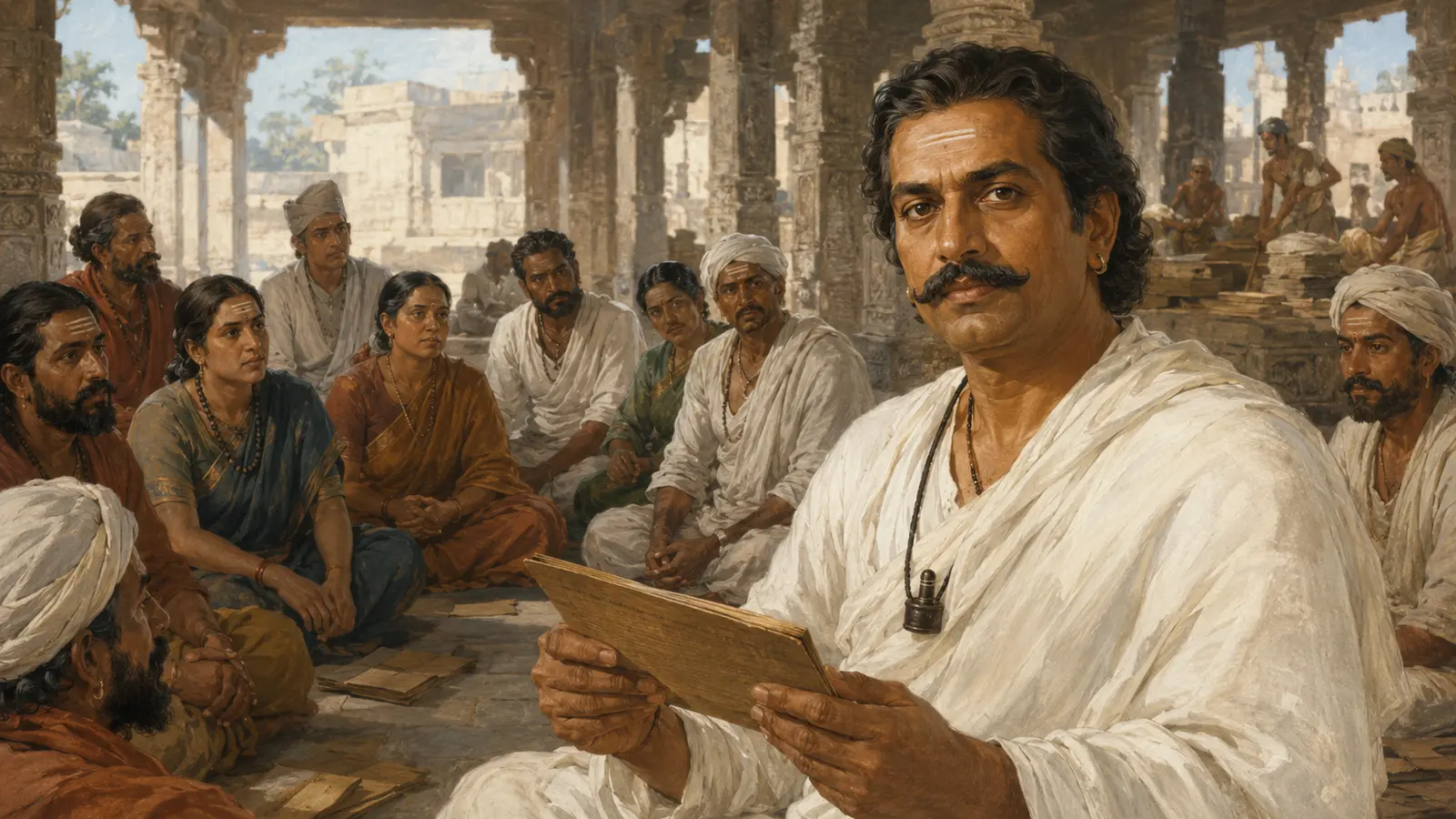
KANNADA POET & REFORMER
बसवण्ण
Basavanna
The Kannada vachana poet who joined direct Shiva devotion with ethical work, dignity and social challenge.
- Era
- 12th century CE
- Known for
- Kannada poet & reformer · Service
WHY BASAVANNA MATTERS
Work, worship and a public conscience
Basavanna belongs to the social and spiritual ferment of 12th-century Karnataka. Remembered as a poet, administrator and organising force among the sharanas, he made devotion speak in the language of work, accountability and the dignity of persons rather than inherited rank.
LIFE & HISTORICAL RECORD
Work, worship and a public conscience
Basavanna’s short Kannada vachanas address Shiva as Kudalasangama Deva and test religion against lived conduct. Temple, body, labour, wealth and status become material for urgent spiritual reflection.
Later tradition calls him the founder of Lingayatism. Historical scholarship more cautiously presents him as a major leader who energised and reshaped an existing Virashaiva current.
From administration to the sharana movement
Basavanna is associated with the court of Bijjala at Kalyana and with a community of sharanas that included people across occupation and gender. Traditional narratives connect this circle with the Anubhava Mantapa, an open space of spiritual deliberation.
What the record leaves open
Much of the continuous life story comes from later hagiographies, including the Basava Purana. Inscriptions and the 12th-century vachana milieu provide firmer historical anchors than every episode of the remembered biography.
CORE TEACHINGS
Three threads to carry with you
Basavanna’s legacy is often condensed into kayaka, honest work, and dasoha, sharing or service. The vachanas resist the separation of spirituality from livelihood and social behaviour.
The personal ishtalinga places worship close to the devotee, while the poetry repeatedly exposes empty display. Birth-status cannot substitute for integrity, and religious prestige cannot excuse exploitation.
Kayaka
Work becomes a field of spiritual integrity, not a barrier to it.
Vachana
Brief Kannada free-verse utterances test religious claims against lived truth.
Practice cue
Choose one piece of work today and do it without hierarchy, vanity or carelessness.
WORKS & PRACTICES
Vachanas and community memory
Vachanas attributed to Basavanna survive in collections shaped by a long manuscript and oral history. Individual attribution must sometimes be treated cautiously, even while the corpus preserves a recognisable ethical and devotional voice. Practice in this lineage is not reducible to social reform or private mysticism. The striking power lies in their conjunction: devotion examined through labour, sharing, equality and truthful speech.
National Biography: Basavanna
Public biographical study used for the historical setting, later traditions and circle of contemporary sharanas.
Speaking of Siva
A. K. Ramanujan’s translations and introduction used for vachanas attributed to Basavanna and the wider Kannada bhakti milieu.
RELEVANCE TODAY
Why he matters now
Basavanna matters wherever institutions proclaim values that everyday conduct contradicts. His poetry asks whether worship changes the way power, work and human dignity are handled. Vedika presents him neither as a modern politician in medieval dress nor as a harmless poet-saint, but as a devotional thinker whose social challenge grows from spiritual accountability.
SOURCES & FURTHER READING
Follow the record
National Biography: Basavanna
Public biographical study used for the historical setting, later traditions and circle of contemporary sharanas.
Open scholarly reference ↗Speaking of Siva
A. K. Ramanujan’s translations and introduction used for vachanas attributed to Basavanna and the wider Kannada bhakti milieu.
Open primary text ↗CONTINUE THE JOURNEY