TAMIL ALVAR POET-SAINT
आण्डाल्
Andal
The Tamil poet-saint whose Tiruppavai and Nachiyar Tirumoli make devotion intimate, communal and fearless.
- Era
- c. 8th–9th century CE
- Known for
- Tamil Alvar poet-saint · Devotion
WHY ANDAL MATTERS
Poetry that wakes a community
Andal is the only woman counted among the twelve Alvars of Tamil Vaishnava tradition. Her surviving poems do more than preserve a saintly memory: they speak in a confident woman’s voice, gathering a community toward Krishna and turning longing into sacred poetry.
LIFE & HISTORICAL RECORD
Poetry that wakes a community
Andal’s thirty-verse Tiruppavai is sung through the Tamil month of Margazhi, while the longer Nachiyar Tirumoli gives intense poetic form to longing for Vishnu. Together they hold collective observance and unmistakably personal desire.
Tradition remembers her as Kodai, raised by Periyalvar at Srivilliputhur, and as the garland-wearing devotee united with Ranganatha. Vedika honours that lineage memory while keeping it distinct from what the poems themselves establish.
Kodai of Srivilliputhur
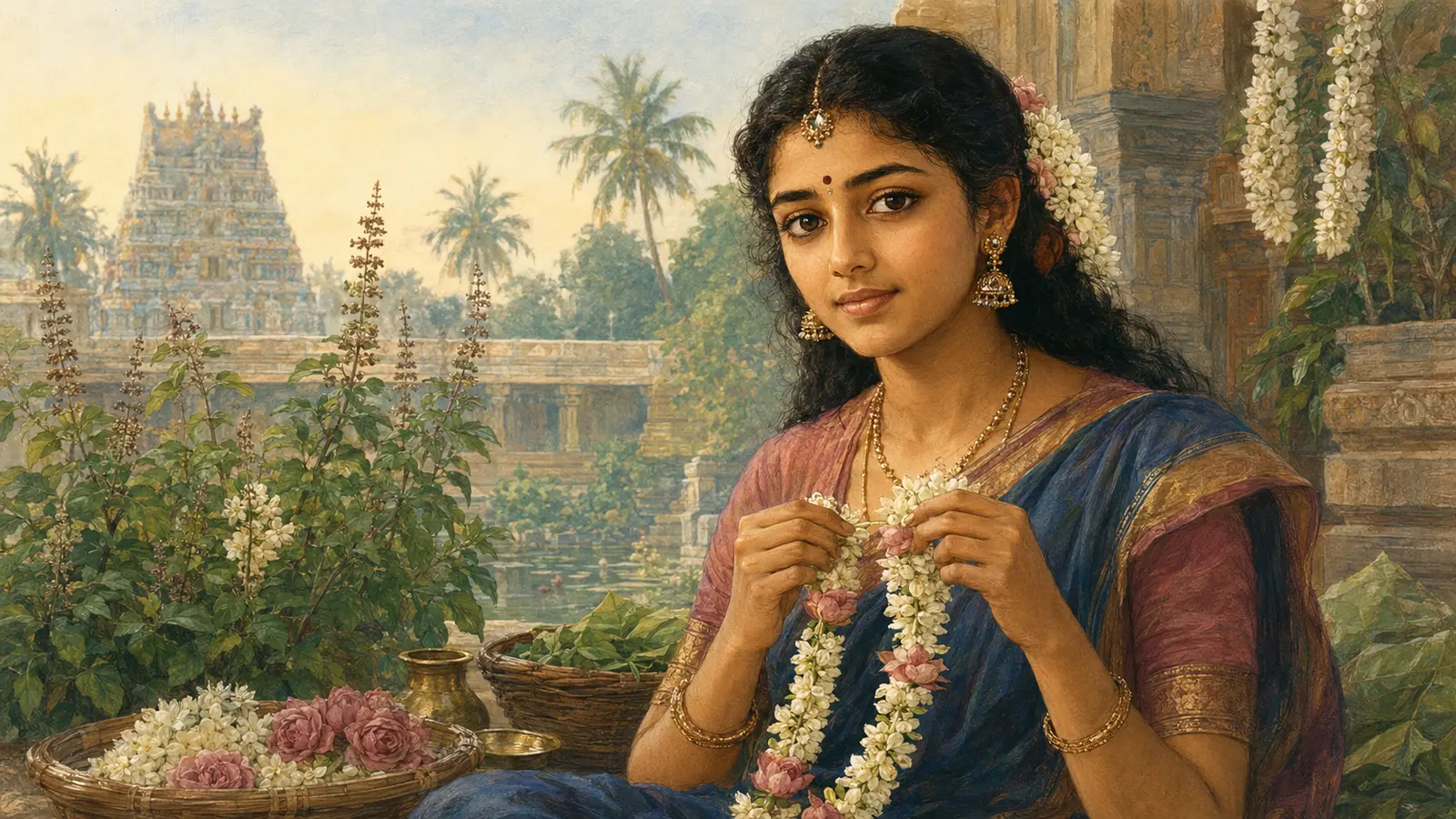
The familiar life story comes through Sri Vaishnava hagiography: Periyalvar finds the child Kodai near a tulasi garden; she secretly wears garlands prepared for the deity; Vishnu accepts the garlands she has worn; and her devotion culminates at Srirangam.
What the record leaves open
Precise dates and biographical details remain debated. What is secure is the place of two Tamil works attributed to Andal within the Nalayira Divya Prabandham and her exceptional authority as a woman’s devotional voice.
CORE TEACHINGS
Three threads to carry with you
The Tiruppavai does not imagine devotion as a private mood. Its speaker repeatedly calls companions to wake, bathe, sing and approach Krishna together. The path is embodied, seasonal and communal.
The Nachiyar Tirumoli is more intimate and sometimes startling: separation, dream, desire and divine marriage become languages of surrender. Andal refuses the idea that spiritual authority must sound detached.
Tiruppavai
Thirty Tamil verses join vow, song, community and surrender during Margazhi.
Nachiyar Tirumoli
Fourteen poetic units voice an intense and embodied longing for Vishnu.
Practice cue
Invite another person into one sincere act of devotion rather than keeping practice private.
WORKS & PRACTICES
Two works, a living calendar
Andal’s two attributed works remain active in temple and household practice. Tiruppavai recitation is especially prominent during Margazhi, demonstrating how poetry can become a shared religious calendar. Readers should meet the Tamil poems as poems, not only as evidence for a legendary biography. Their shifting speakers, images and emotional registers deserve attention in their own right.
Sree Tiruppavai by Andal
Tirumala Tirupati Devasthanams English edition used as a textual witness to Andal’s thirty verses and their devotional setting.
Andal’s Tiruppavai and Nachiyar Thirumozhi
Digital Library of India edition used to represent both works attributed to Andal.
RELEVANCE TODAY
Why she matters now
Andal matters because she combines inherited tradition with a voice that is neither timid nor secondary. Her devotion moves through friendship, ritual, imagination and desire. For Vedika, she expands the archive’s understanding of authority: a young Tamil woman’s poetry became scripture-like living memory for generations of devotees.
SOURCES & FURTHER READING
Follow the record
Sree Tiruppavai by Andal
Tirumala Tirupati Devasthanams English edition used as a textual witness to Andal’s thirty verses and their devotional setting.
Open primary text ↗Andal’s Tiruppavai and Nachiyar Thirumozhi
Digital Library of India edition used to represent both works attributed to Andal.
Open primary text ↗CONTINUE THE JOURNEY