PHILOSOPHER-SAGE
अष्टावक्र
Ashtavakra
The formidable young sage remembered in debate with Janaka and through a radical dialogue on the freedom of awareness.
- Era
- Epic and later Vedanta tradition
- Known for
- Philosopher-sage · Freedom
WHY ASHTAVAKRA MATTERS
Authority that appearance cannot measure
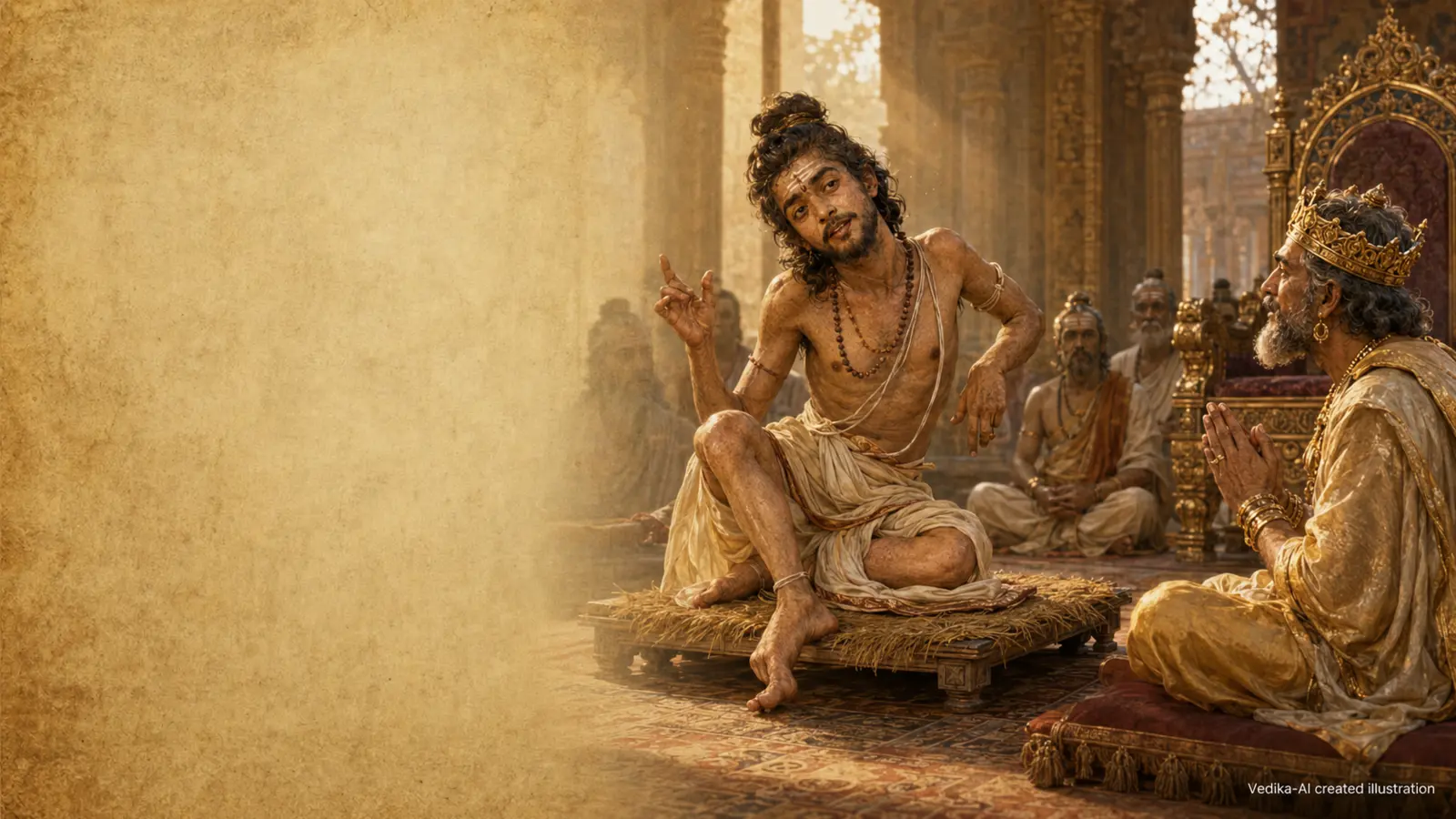
Ashtavakra appears in the Mahabharata as a brilliant young sage whose body is bent in eight places and whose learning overturns the court’s assumptions. A later text, the Ashtavakra Gita, places him in dialogue with King Janaka and voices an uncompromising vision of awareness as already free.
LIFE & HISTORICAL RECORD
Authority that appearance cannot measure
The Mahabharata story makes bodily judgement part of the philosophical challenge. Ashtavakra is mocked on entering the court, yet exposes the superficiality of those who evaluate wisdom by skin and form.
The Ashtavakra Gita intensifies another challenge: bondage persists through mistaken identification, while awareness itself is unattached. The epic figure and later dialogue are connected by tradition but not necessarily by common authorship or date.
A young debater in the court of Janaka
In the Mahabharata’s Vana Parva, Ashtavakra travels to King Janaka’s sacrifice and defeats the scholar Bandi in debate, securing the release of his father Kahoda and other learned men.
What the record leaves open
The account is sacred epic narrative, not a recoverable modern biography. Its lasting force lies in reversing the gaze: the court believes it sees deformity, while the young sage sees the court’s deformed judgement.
CORE TEACHINGS
Three threads to carry with you
The Ashtavakra Gita repeatedly distinguishes the witnessing self from body, thought, action and changing circumstance. Freedom is described less as a future acquisition than recognition of what was never bound.
Such radical language can be misused as permission for passivity. Read responsibly, it removes possessive identification while leaving ethical action in the realm of life and relationship.
Witnessing awareness
The dialogue refuses to reduce the self to body, role, emotion or mental movement.
Immediate freedom
Liberation is voiced as recognition rather than the production of a new spiritual identity.
Practice cue
Notice one sensation or thought and distinguish its changing content from the fact that it is known.
WORKS & PRACTICES
Epic sage and later nondual text
The Ashtavakra Gita is traditionally framed as a dialogue between Ashtavakra and Janaka, but its author and date are unknown. Its polished nondual teaching belongs to a later literary world than the epic debate narrative. Practice requires both openness and caution: allow the text to question identification, but do not turn “I am free” into a concept that bypasses responsibility, pain or disciplined self-observation.
Mahabharata, Vana Parva: Ashtavakra
Primary epic source used for the young sage’s family narrative, court debate and encounter with King Janaka.
Ashtavakra Gita
Public-domain Sanskrit and English resource used as the textual witness for the later dialogue on awareness and freedom.
RELEVANCE TODAY
Why he matters now
Ashtavakra matters because he breaks two habits at once: judging intelligence through appearance and treating freedom as an improved public image. His archive page also demonstrates Vedika’s evidence method. A revered figure may be carried through several texts whose relationship is spiritually meaningful yet historically uncertain.
SOURCES & FURTHER READING
Follow the record
Mahabharata, Vana Parva: Ashtavakra
Primary epic source used for the young sage’s family narrative, court debate and encounter with King Janaka.
Open primary text ↗Ashtavakra Gita
Public-domain Sanskrit and English resource used as the textual witness for the later dialogue on awareness and freedom.
Open primary text ↗CONTINUE THE JOURNEY