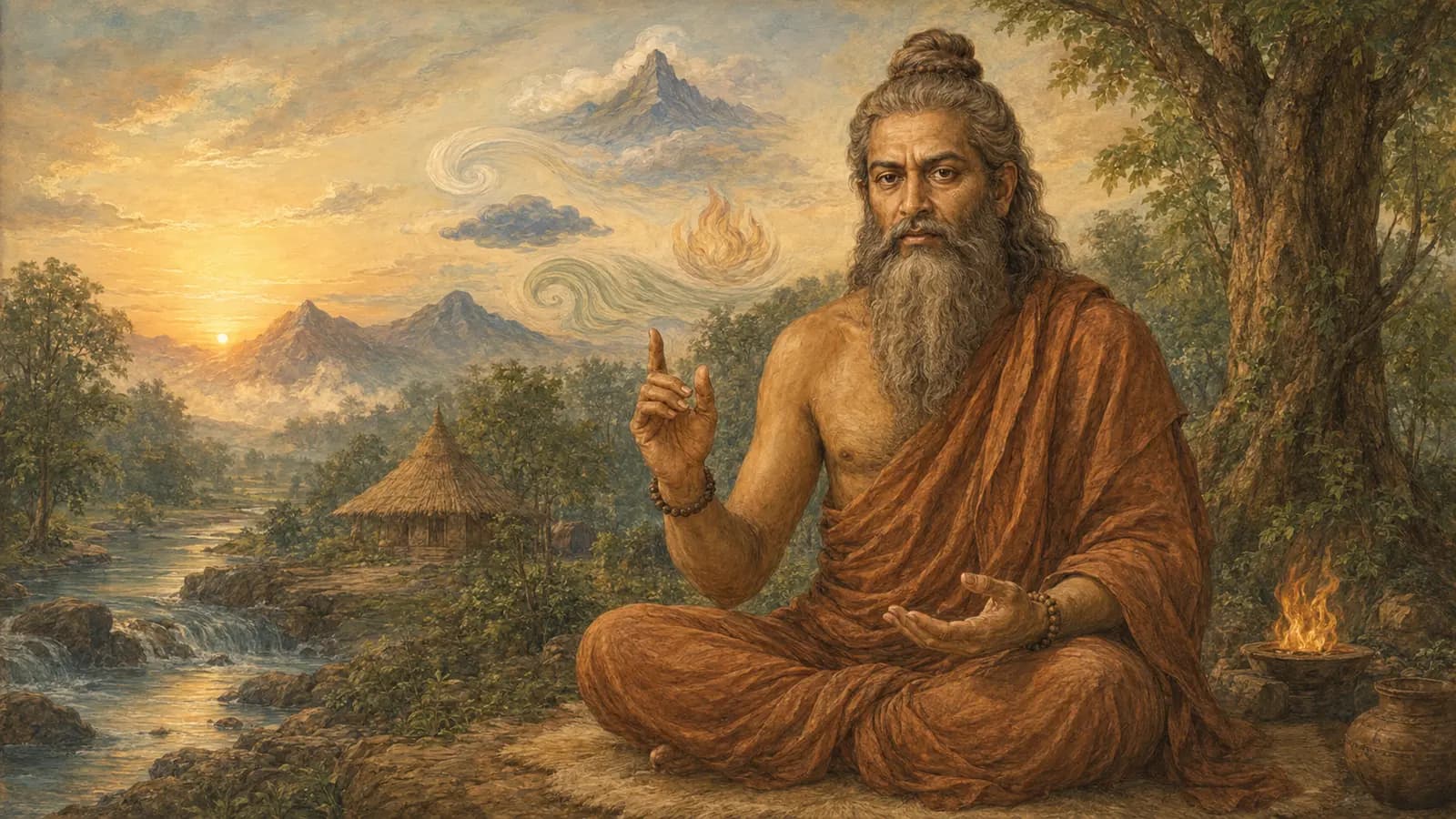
LEGENDARY PHILOSOPHER-SAGE
कपिल
Kapila
The legendary sage associated with Samkhya and its distinction between consciousness and nature.
- Era
- Ancient · date unknown
- Known for
- Legendary philosopher-sage · Self
WHY KAPILA MATTERS
Learning to distinguish the seer from the seen
Kapila stands at the remembered beginning of Samkhya, one of India’s oldest systematic traditions of inquiry. The historical person cannot be securely dated, but the questions carried under his name—what is conscious, what belongs to nature, and how confusion becomes bondage—remain foundational.
LIFE & HISTORICAL RECORD
Learning to distinguish the seer from the seen
Indian tradition remembers Kapila as an early master, and often the founder, of Samkhya. Scholarship is more cautious: no surviving work can be securely assigned to him, and stories about him belong to several textual worlds.
His importance therefore lies less in a recoverable biography than in a durable philosophical lineage. Samkhya analyses experience so that consciousness, purusha, is no longer confused with prakriti—the changing field of body, senses, mind and world.
A life held in tradition, not chronology
References to Kapila appear across epic and Puranic literature, including devotional presentations in the Bhagavata Purana. These accounts are spiritually important, but they do not provide a modern historical chronology.
What the record leaves open
The earliest complete surviving classical statement of Samkhya is Ishvarakrishna’s Samkhya Karika, composed many centuries later. Vedika therefore names Kapila as a legendary philosopher-sage and does not turn an uncertain ancient figure into a falsely precise historical life.
CORE TEACHINGS
Three threads to carry with you
Classical Samkhya describes two irreducible principles: purusha, conscious witness, and prakriti, nature in all its material and mental transformations. Suffering persists when the witness identifies with what changes.
Discriminative knowledge does not destroy the world; it corrects a confusion. One learns to see thoughts, moods and roles as movements within nature rather than the whole truth of the Self.
Purusha
Consciousness is the witnessing principle, distinct from material and mental change.
Prakriti
Nature includes body, senses, mind and the three gunas: sattva, rajas and tamas.
Practice cue
Notice one changing experience and ask: what is aware of this change?
WORKS & PRACTICES
A lineage without an extant book by Kapila
No extant text can be confidently called Kapila’s own work. Later sources preserve different Kapilas and different forms of Samkhya, so attribution needs restraint. For practice, the living contribution is analytical attention: observe the distinction between awareness and its contents without turning that distinction into emotional withdrawal or indifference.
Internet Encyclopedia of Philosophy: Samkhya
Scholarly overview used for the uncertainty around Kapila, the surviving textual history and the classical system.
Bhagavata Purana: Kapila and Devahuti
Gaudiya Vaishnava edition of the Bhagavata’s Kapila cycle, used as a lineage witness to the devotional Kapila tradition rather than as neutral historical biography.
RELEVANCE TODAY
Why he matters now
Kapila matters in an age that easily equates identity with thought, productivity or mood. Samkhya offers a disciplined vocabulary for seeing that mental activity is experienced, not the entirety of the experiencer. Vedika presents him with historical humility and philosophical clarity: a remembered source of a tradition whose mature texts still sharpen the inquiry into consciousness.
SOURCES & FURTHER READING
Follow the record
Internet Encyclopedia of Philosophy: Samkhya
Scholarly overview used for the uncertainty around Kapila, the surviving textual history and the classical system.
Open scholarly reference ↗Bhagavata Purana: Kapila and Devahuti
Gaudiya Vaishnava edition of the Bhagavata’s Kapila cycle, used as a lineage witness to the devotional Kapila tradition rather than as neutral historical biography.
Open lineage source ↗CONTINUE THE JOURNEY