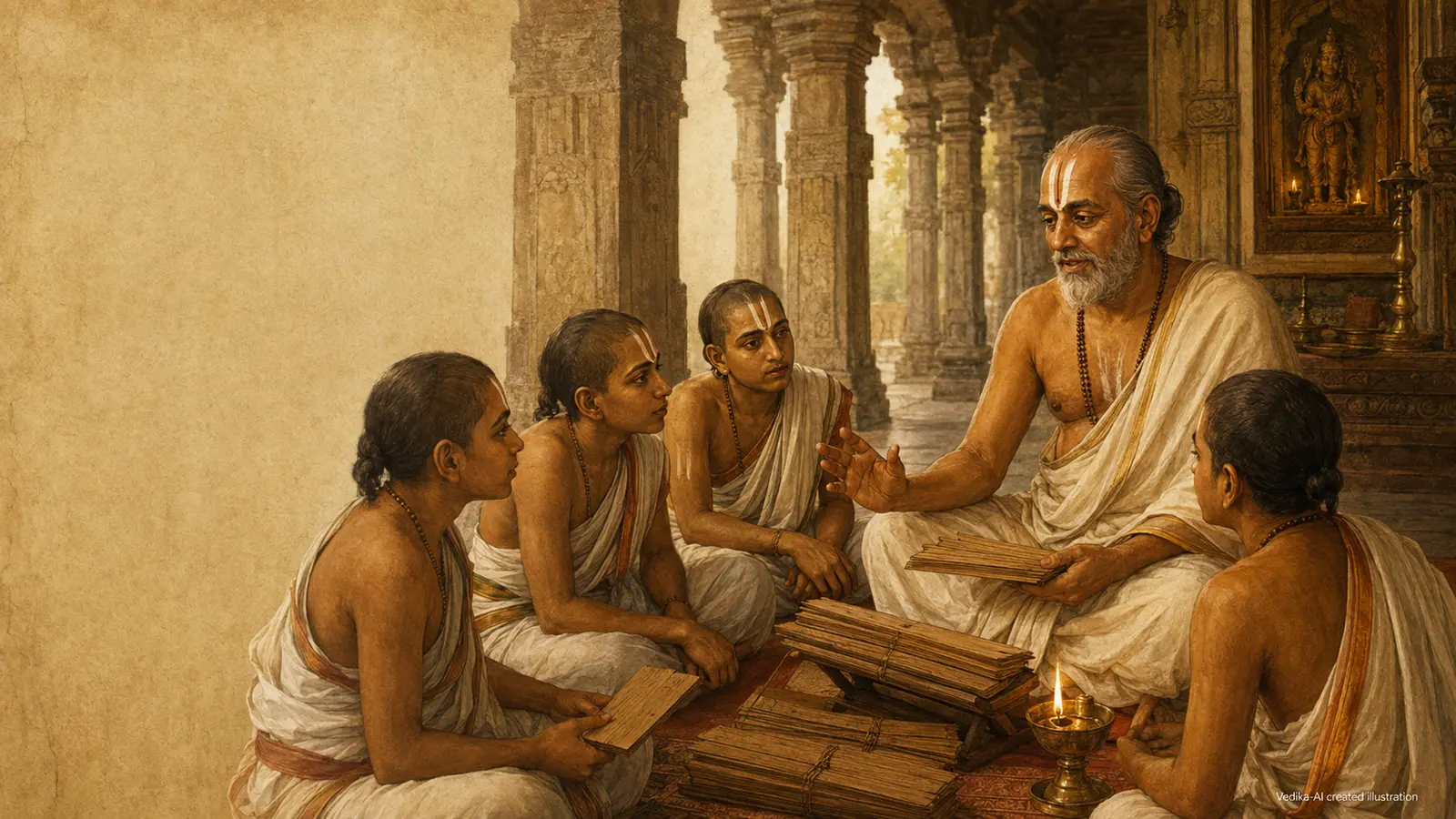
SRI VAISHNAVA ACHARYA
पिल्लै लोकाचार्य
Pillai Lokacharya
A Sri Vaishnava teacher whose concise Manipravala works made surrender, grace and lived dependence central to spiritual instruction.
- Era
- 1205–1311 · traditional dates
- Known for
- Sri Vaishnava acharya · Devotion
WHY PILLAI LOKACHARYA MATTERS
A theology written for transmission
Pillai Lokacharya is a major Sri Vaishnava theologian associated especially with the Tenkalai inheritance. His eighteen Rahasya Granthas use Manipravala prose to condense teachings on the soul’s dependence, divine grace, surrender and the meaning of the tradition’s secret mantras.
LIFE & HISTORICAL RECORD
A theology written for transmission
Lokacharya’s works are often compact, aphoristic and pedagogical. They gather lineage interpretation into forms suitable for memorisation, instruction and reflection.
Their centre is not self-generated spiritual achievement. The soul belongs to Narayana, and liberation depends fundamentally on divine compassion mediated through Sri and the acharya lineage.
Srirangam, lineage and remembered protection
Lokacharya belonged to the intellectual world of Srirangam and inherited teachings associated with Ramanuja, Nampillai and later commentators. Traditional dates place him across the thirteenth and early fourteenth centuries.
What the record leaves open
Lineage accounts remember him protecting sacred teaching and the temple community during invasion, eventually dying away from Srirangam. The broad period is historical; detailed episodes belong to community memory and require genre care.
CORE TEACHINGS
Three threads to carry with you
Lokacharya emphasises the soul’s seshatva—its condition of belonging to and serving the Divine. Prapatti is not a heroic technique by which the ego secures liberation; it exposes the limits of self-reliance.
The acharya matters because knowledge is relationally transmitted. Gratitude, trust and humility are therefore not secondary emotions but part of how truth is received.
Seshatva
The self is understood as belonging to Narayana and finding fulfilment in service.
Grace and prapatti
Surrender reveals dependence on divine compassion rather than celebrating spiritual self-sufficiency.
Practice cue
Notice one achievement you treat as entirely self-made and remember the people and conditions carrying it.
WORKS & PRACTICES
The eighteen Rahasya Granthas
Works traditionally grouped as eighteen Rahasya Granthas include the Sri Vachana Bhushanam, Mumukshuppadi and Tattvatrayam. They require commentary because their condensed formulations carry extensive lineage meaning. Practice includes study of mantra meaning, dependence on Narayana, reverence for Sri and the acharya, and conduct shaped by humility toward other devotees.
Sri Vachana Bhushanam resources
Sri Vaishnava lineage archive used for Lokacharya’s principal text, commentarial tradition and theology of grace and the acharya.
Srirangam acharya biography
Lineage account used for Lokacharya’s place in the Sri Vaishnava succession and the remembered Srirangam setting.
RELEVANCE TODAY
Why he matters now
Pillai Lokacharya matters in a culture that turns even spirituality into personal optimisation. His theology asks whether the deepest relation is received rather than achieved. Alongside Vedanta Desika, he allows Vedika to represent distinct Sri Vaishnava voices without turning them into a caricatured contest.
SOURCES & FURTHER READING
Follow the record
Sri Vachana Bhushanam resources
Sri Vaishnava lineage archive used for Lokacharya’s principal text, commentarial tradition and theology of grace and the acharya.
Open archive ↗Srirangam acharya biography
Lineage account used for Lokacharya’s place in the Sri Vaishnava succession and the remembered Srirangam setting.
Open lineage source ↗CONTINUE THE JOURNEY