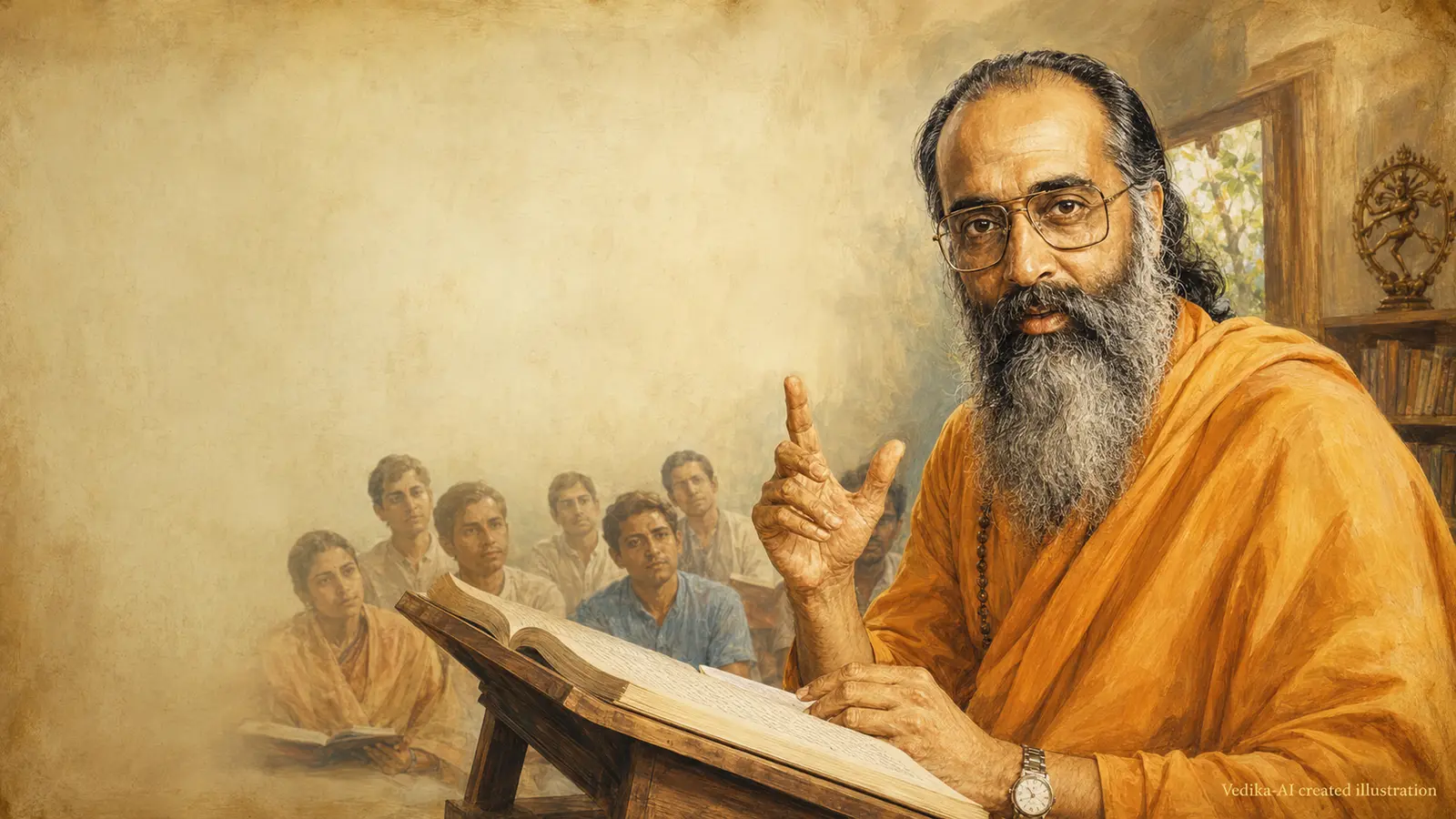
VEDANTA TEACHER & INSTITUTION-BUILDER
स्वामी चिन्मयानन्द
Swami Chinmayananda
The modern teacher who brought systematic Upanishadic and Gita study to large public audiences through the Chinmaya movement.
- Era
- 1916–1993
- Known for
- Vedanta teacher & institution-builder · Self
WHY SWAMI CHINMAYANANDA MATTERS
Vedanta taught as a disciplined public education
Swami Chinmayananda transformed from journalist Balakrishna Menon into a forceful public teacher of Advaita Vedanta. Through jnana yajnas, study groups, publications and the Chinmaya Mission, he created a modern educational infrastructure for sustained engagement with the Upanishads and Bhagavad Gita.
LIFE & HISTORICAL RECORD
Vedanta taught as a disciplined public education
Chinmayananda addressed modern educated audiences who often knew inherited religious forms but lacked systematic access to their philosophical texts. His lectures combined humour, argument and practical psychological observation.
He did not present Vedanta as passive cultural pride. The listener was expected to study, reflect, meditate and test whether understanding transformed action.
From sceptical journalist to Himalayan disciple
Balakrishna Menon worked as a journalist and had participated in India’s independence movement. He approached the Himalayas partly as an investigator of religious life and became a disciple of Swami Sivananda and later Tapovan Maharaj.
What the record leaves open
Beginning in Pune in 1951, his jnana yajnas grew into a broad teaching movement. Chinmaya Mission was founded in 1953 and later expanded into schools, rural service, youth work and global centres.
CORE TEACHINGS
Three threads to carry with you
Chinmayananda’s Advaita teaching follows the traditional movement of sravana, manana and nididhyasana: listen to scripture through a teacher, reason through doubts and assimilate the vision contemplatively.
He often analysed how identification with body, emotion and intellect creates limitation. The aim is not contempt for personality but recognition of the consciousness because of which every experience is known.
Jnana yajna
Public lecture series reframed scriptural study as a sustained offering of attention and inquiry.
Study groups
Small recurring groups turned inspiration into a distributed learning practice.
Practice cue
Take one teaching you admire and write the strongest doubt you still have about it.
WORKS & PRACTICES
Commentaries, talks and an educational movement
Chinmayananda wrote commentaries on the Bhagavad Gita and several Upanishads, along with introductory works and extensive recorded talks. His style is recognisably modern, while grounded in the Advaita teaching lineage of his gurus. The mission’s later institutions are part of his legacy but not substitutes for the textual discipline he emphasised. Service, education and study were meant to reinforce one another.
Chinmaya Mission: Swami Chinmayananda
Official lineage biography used for his life, teachers, jnana yajnas and institutional legacy.
Chinmaya Publications
Official catalogue used to verify commentaries, introductory works and primary teaching materials.
RELEVANCE TODAY
Why he matters now
Chinmayananda matters because he solved a product problem of spiritual education: how can deep texts become accessible at scale without becoming disconnected quotations? His answer—public teaching, local study communities, trained teachers and durable institutions—remains relevant to Vedika’s own ambition to make knowledge navigable without making it shallow.
SOURCES & FURTHER READING
Follow the record
Chinmaya Mission: Swami Chinmayananda
Official lineage biography used for his life, teachers, jnana yajnas and institutional legacy.
Open lineage source ↗Chinmaya Publications
Official catalogue used to verify commentaries, introductory works and primary teaching materials.
Open archive ↗CONTINUE THE JOURNEY