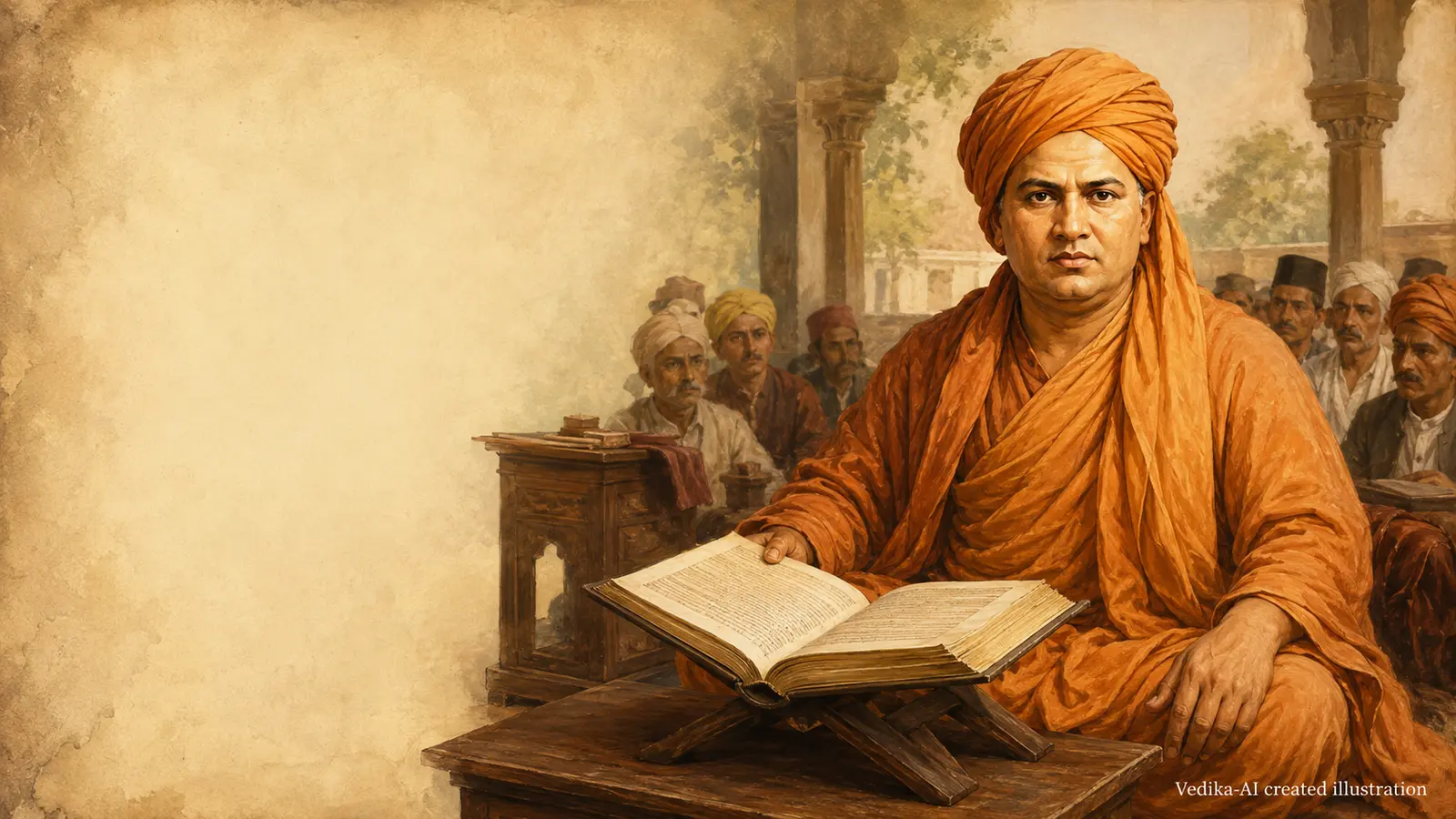
VEDIC REFORMER & ARYA SAMAJ FOUNDER
स्वामी दयानन्द सरस्वती
Swami Dayananda Saraswati
The nineteenth-century reformer who founded Arya Samaj, argued for a return to Vedic authority and linked religious renewal with education and social reform.
- Era
- 1824–1883
- Known for
- Vedic reformer & Arya Samaj founder · Dharma
WHY SWAMI DAYANANDA SARASWATI MATTERS
Reform through a return to Vedic authority
Swami Dayananda Saraswati, born Mool Shankar, founded Arya Samaj in 1875 and became one of nineteenth-century India’s most influential Hindu reformers. He called for a return to the Vedas, rejected image worship and hereditary religious privilege, promoted education and social reform, and advanced interpretations that remain both influential and contested.
LIFE & HISTORICAL RECORD
Reform through a return to Vedic authority
Dayananda believed later Hindu practice had accumulated error and that the Vedas preserved a rational, ethical and monotheistic foundation for renewal. His slogan “Back to the Vedas” summarises this orientation, though his readings were distinctly nineteenth-century interpretations rather than an unmediated recovery of one ancient consensus.
Arya Samaj turned those ideas into institutions: schools, debate, publishing, social campaigns and new forms of public Hindu organisation.
From Mool Shankar to a public reform movement
Born in Gujarat, Mool Shankar grew dissatisfied with inherited ritual explanations and left home in search of teachers. He later studied with the blind scholar Virajanand at Mathura, whose emphasis on Sanskrit learning deeply shaped him.
What the record leaves open
He founded the first Arya Samaj in Bombay in 1875 and revised its principles in Lahore. He travelled, debated and published extensively before dying in 1883 after poisoning and medical complications; details surrounding the poisoning are reported differently.
CORE TEACHINGS
Three threads to carry with you
Dayananda affirmed one formless God, the authority of the Vedas and the importance of disciplined reasoning. He rejected murti worship, pilgrimage economies, superstition and claims of birth-based spiritual entitlement.
He supported women’s education, widow remarriage and opposition to child marriage and untouchability, while some positions and polemical readings reflect his historical context and remain contested. A rigorous page neither sanitises nor caricatures him.
Vedic reform
The Vedas become the standard through which later custom is examined and often rejected.
Education and organisation
Arya Samaj built schools, publications and civic institutions to turn reform ideas into durable practice.
Practice cue
Examine one inherited practice by asking both what source supports it and what ethical effect it has now.
WORKS & PRACTICES
Satyarth Prakash and the Arya Samaj programme
Satyarth Prakash, “The Light of Truth,” is Dayananda’s best-known work. He also wrote Vedic commentaries and polemical texts and helped formulate Arya Samaj principles. The movement’s later history includes DAV education, Gurukul institutions, shuddhi campaigns and reform activism. These developments grew from his programme but should not all be attributed to decisions made personally by Dayananda.
Encyclopaedia Britannica: Dayananda Sarasvati
Reference overview used for his life, Arya Samaj, Vedic reform programme and social influence.
Satyarth Prakash
Digitised English edition used as a primary witness to Dayananda’s arguments, reform positions and polemical method.
RELEVANCE TODAY
Why he matters now
Dayananda matters because he made scriptural interpretation publicly consequential. Reading the Vedas, for him, demanded reform of education, social practice and religious authority. He also invites critical engagement with reform itself: returning to origins is never neutral, and interpreters must remain accountable for what they select, reject and build in the present.
SOURCES & FURTHER READING
Follow the record
Encyclopaedia Britannica: Dayananda Sarasvati
Reference overview used for his life, Arya Samaj, Vedic reform programme and social influence.
Open scholarly reference ↗Satyarth Prakash
Digitised English edition used as a primary witness to Dayananda’s arguments, reform positions and polemical method.
Open primary text ↗CONTINUE THE JOURNEY