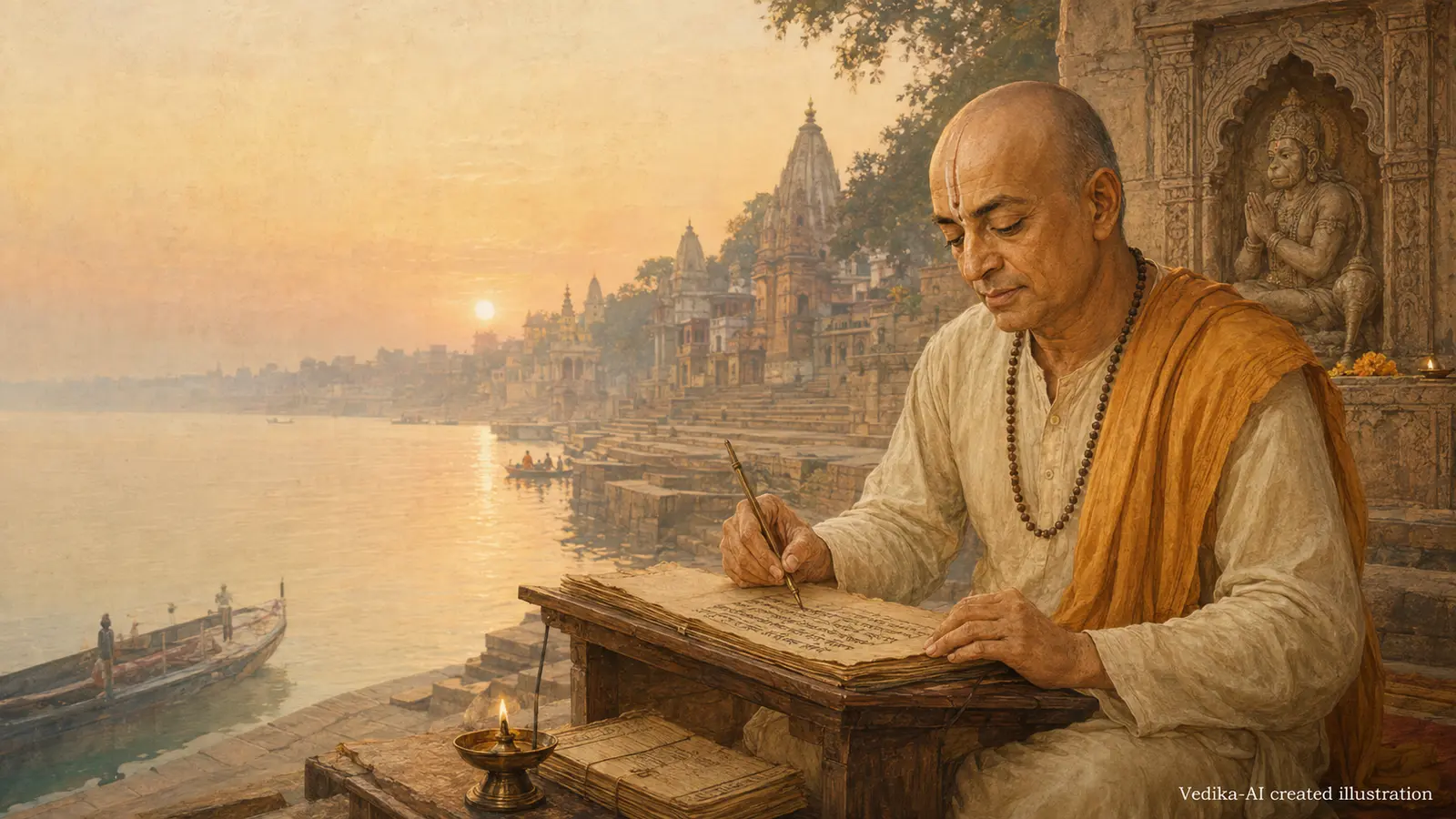
HINDI POET-SAINT
तुलसीदास
Tulsidas
The poet-saint whose Ramcharitmanas brought the story and devotion of Rama into an enduring Awadhi masterpiece.
- Era
- c. 1532–1623 · dates debated
- Known for
- Hindi poet-saint · Devotion
WHY TULSIDAS MATTERS
Rama’s story in the language of living devotion
Tulsidas transformed the North Indian devotional landscape through the Ramcharitmanas, a retelling of Rama’s story in Awadhi that became scripture-like in household, temple and performance traditions. His biography is richly hagiographic; his literary corpus and historical influence are firmer than many familiar episodes of his life.
LIFE & HISTORICAL RECORD
Rama’s story in the language of living devotion
The Ramcharitmanas is not a simple vernacular copy of Valmiki. It is a theological and poetic recreation shaped by bhakti, earlier Sanskrit traditions and the expressive resources of Awadhi.
Its public life extends beyond reading. Recitation, Ram Lila, music, proverb and memory made the work part of how communities imagine ideal action, devotion, kingship and family relationship.
A poet surrounded by devotional memory
Traditional biographies describe Tulsidas’s difficult childhood, marriage, renunciation, visions of Hanuman and Rama, and residence in places including Chitrakoot and Varanasi. Versions differ and were composed within communities of reverence.
What the record leaves open
The poet’s own works offer some autobiographical hints but not a complete chronology. Even his birth and death years vary across sources, so Vedika uses qualified dates.
CORE TEACHINGS
Three threads to carry with you
For Tulsidas, Rama is both the supreme Divine and the intimate centre of devotion. The divine name, remembered with love, becomes accessible across circumstance and learning.
Narrative carries ethics. Characters reveal how duty, compassion, pride, loyalty and surrender unfold under pressure, without reducing the poem to a list of moral rules.
Ramcharitmanas
Awadhi poetry makes Rama’s story a devotional world with its own literary and theological architecture.
Rama-nama
The divine name becomes a portable practice of remembrance, trust and reorientation.
Practice cue
Read one episode slowly and ask which character quality it is training you to notice in yourself.
WORKS & PRACTICES
A corpus beyond one epic
Works traditionally associated with Tulsidas include the Vinaya Patrika, Kavitavali, Gitavali, Dohavali and Hanuman Chalisa, alongside the Ramcharitmanas. Attribution and textual histories differ by work. Living practice includes recitation, communal exposition, festival drama and the repeated name of Rama. Responsible reading also faces difficult social and gendered passages within their historical and literary contexts rather than pretending they do not exist.
Encyclopaedia Britannica: Tulsidas
Reference overview used for the poet’s historical setting, Ramcharitmanas and the uncertainty surrounding his biography.
Ramcharitmanas digital text
Public-domain text resource used as a primary witness to the structure and devotional language of the work.
RELEVANCE TODAY
Why he matters now
Tulsidas matters because he shows how translation can become cultural creation. By writing in a major vernacular, he did not merely simplify Sanskrit learning; he formed a new classic. His vast influence also makes critical literacy essential. Love for a text can include attention to genre, reception, contested lines and the difference between devotional authority and every later political use.
SOURCES & FURTHER READING
Follow the record
Encyclopaedia Britannica: Tulsidas
Reference overview used for the poet’s historical setting, Ramcharitmanas and the uncertainty surrounding his biography.
Open scholarly reference ↗Ramcharitmanas digital text
Public-domain text resource used as a primary witness to the structure and devotional language of the work.
Open primary text ↗CONTINUE THE JOURNEY