SAGE & POET
वाल्मीकि
Valmiki
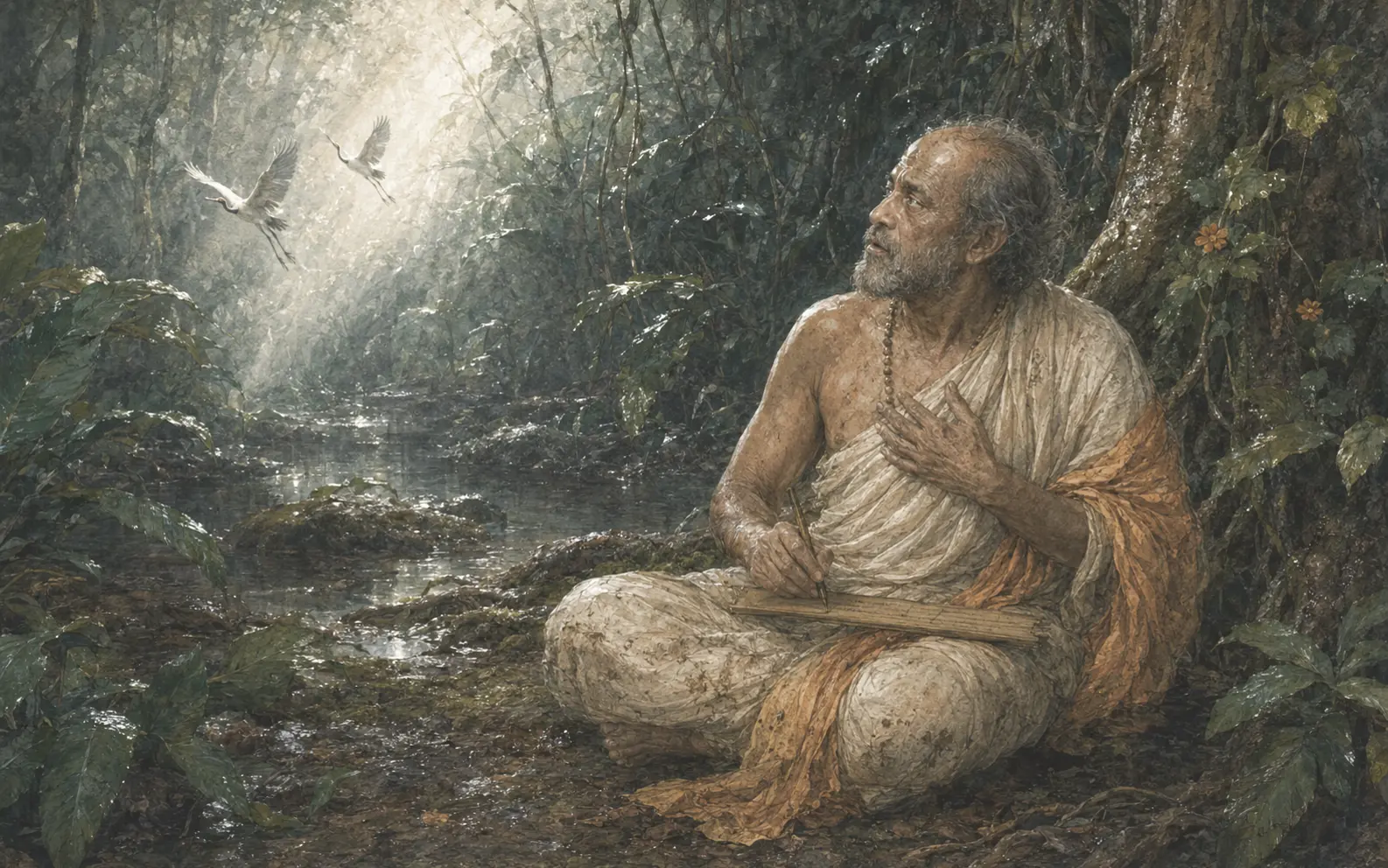
The Adikavi, traditionally revered as the author of the Ramayana.
- Era
- Traditional chronology
- Known for
- Sage & poet · Dharma
WHY VALMIKI MATTERS
The poet who turns grief into dharma
Valmiki is revered as Adikavi, the first poet, and as the traditional composer of the Ramayana. His page belongs to the Itihasa layer: a sacred literary memory where authorship, poetic insight and dharma are preserved through story rather than modern biography.
LIFE & HISTORICAL RECORD
The poet who turns grief into dharma
The Ramayana tradition presents Valmiki as the sage-poet who gives Rama’s story its classical Sanskrit form. The famous origin scene links poetry to compassion: the shloka emerges from grief at violence.
Whether read devotionally, ethically or literary-historically, Valmiki gives Indian civilization one of its deepest narrative grammars for duty, exile, loyalty, loss and moral ambiguity.
Traditional biography and literary authorship
Traditional accounts remember Valmiki as a transformed figure and as the teacher who shelters Sita and raises Lava and Kusha. These episodes are part of the sacred narrative world of the Ramayana.
What the record leaves open
Modern scholarship studies the Ramayana as a layered epic with a long compositional history. Vedika therefore honours Valmiki as the traditional author while noting that textual formation is more complex than a single modern act of writing.
CORE TEACHINGS
Three threads to carry with you
Valmiki’s teaching is not a list of doctrines. It is a narrative field where dharma is tested by family, kingdom, forest, war, grief and public responsibility.
The Ramayana asks readers to feel before they judge. It trains moral imagination by showing that right action is often costly, and that virtue must survive pressure rather than remain an idea.
Poetry as seeing
The poet does not decorate dharma; he reveals its emotional and ethical weight.
Compassion before verse
The origin of the shloka links art to sensitivity toward suffering.
Dharma under pressure
The epic explores what duty means when every choice carries consequence.
WORKS & PRACTICES
The Ramayana as a living text
The Sanskrit Valmiki Ramayana is the primary textual anchor for this page. Later Ramayana traditions in many languages and regions extend the story in distinctive devotional, literary and ethical directions. A Vedika practice is to read slowly across episodes: not only what Rama does, but what each character reveals about grief, speech, courage, loyalty and power.
Bala Kanda
The opening book frames Valmiki, Narada, the origin of poetry and the beginning of Rama’s story.
Sundara Kanda
A concentrated study in courage, devotion and intelligent action through Hanuman.
Living Ramayana traditions
Later regional retellings extend the text’s devotional and ethical life.
RELEVANCE TODAY
A guide to moral imagination
Valmiki remains alive because the Ramayana is not merely ancient content. It is a way of thinking with story when life becomes too complex for slogans. His page invites a reader to let poetry become ethical training: pause, feel the stakes and ask what dharma would require if comfort were no longer guaranteed.
SOURCES & FURTHER READING
Follow the record
Valmiki Ramayana
Sanskrit text and English translation organized by kanda.
Open primary text ↗The Ramayana of Valmiki
Critical scholarly translation series overview.
Open scholarly reference ↗Valmiki overview
Reference overview for the traditional sage-poet and textual tradition.
Open scholarly reference ↗CONTINUE THE JOURNEY