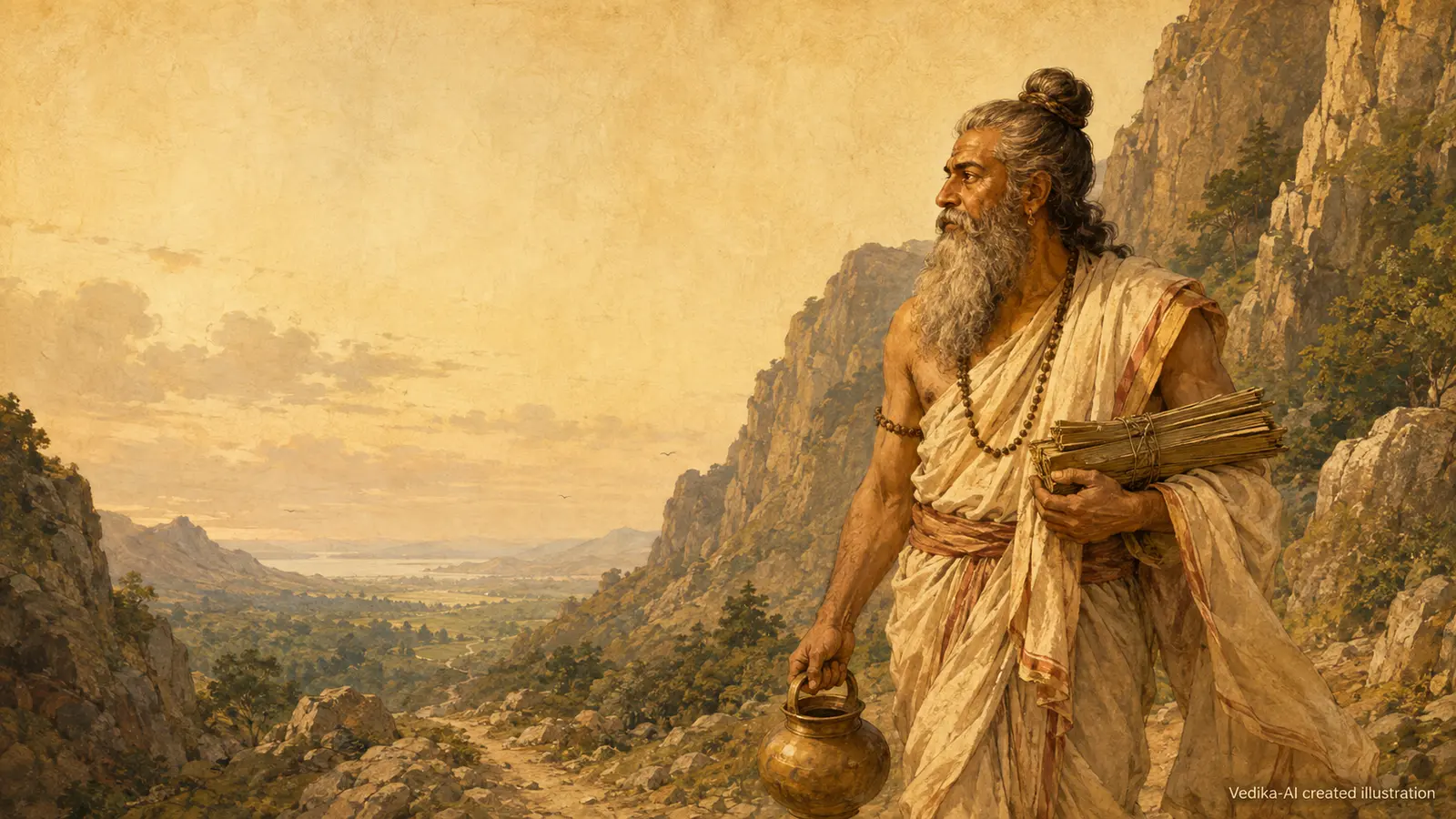
VEDIC RISHI
अगस्त्य
Agastya
A Vedic seer remembered across northern and southern traditions as poet, teacher and bearer of sacred knowledge.
- Era
- Vedic antiquity · date unknown
- Known for
- Vedic rishi · Dharma
WHY AGASTYA MATTERS
A seer whose memory travelled south
Agastya is not preserved as a single modern biography. He appears first as a Vedic seer associated with hymns of the Rigveda and later becomes a wide-ranging culture hero in epic, Puranic and South Indian memory. His page therefore follows the history of a name and lineage without collapsing every Agastya tradition into one datable life.
LIFE & HISTORICAL RECORD
A seer whose memory travelled south
The Rigveda associates Agastya and the Agastya family with a substantial hymn cycle. Those hymns place the name securely inside Vedic poetic tradition, while offering only fragments rather than a continuous life.
Later literature remembers Agastya crossing the Vindhyas, teaching kings, receiving Tamil associations and bringing disciplined sacred culture southward. These traditions shaped Indian religious geography, but they belong to different periods and genres.
From Vedic poet to pan-Indian sage
The earliest Agastya is best approached through attributed hymns and family tradition. The famous dialogue with Lopamudra in Rigveda 1.179 also preserves a household dimension and complicates the later image of an entirely solitary ascetic.
What the record leaves open
Ramayana, Mahabharata and Puranic narratives greatly enlarge the figure. Southern traditions connect Agastya with Tamil learning, Siddha medicine and sacred sites. Vedika treats these as influential reception histories rather than proof that one individual authored every work later bearing his name.
CORE TEACHINGS
Three threads to carry with you
Across the traditions, Agastya represents spiritual force governed by restraint. His authority is repeatedly shown through speech, hospitality, ritual knowledge and the ability to restore balance when pride or disorder becomes excessive.
The Vedic material also resists a simple opposition between family life and contemplation. The Lopamudra hymn brings desire, obligation and ascetic aspiration into honest conversation.
Vedic voice
Agastya belongs first to a Rigvedic family of poets, not merely to later miracle stories.
Southern memory
His movement south became a durable symbol of knowledge crossing regions and languages.
Practice cue
Ask where strength in your life needs restraint, and where restraint needs courageous action.
WORKS & PRACTICES
Hymns, lineages and later attributions
Rigvedic hymns connected with the Agastya family are the strongest textual anchor. Numerous later texts on ritual, yoga, medicine and grammar are attributed to Agastya, but their dates and authors differ widely. A responsible practice of reading therefore begins with genre: Vedic hymn, epic story, temple legend and Siddha text each preserve a different layer of authority. Respecting those layers makes the tradition richer, not smaller.
Rigveda, Mandala 1: Agastya hymns
Sacred-text edition used for the Vedic hymn cycle, including the Agastya–Lopamudra dialogue and the earliest textual layer.
Encyclopaedia Britannica: Agastya
Reference overview used to distinguish the Vedic sage from his extensive later epic and South Indian reception.
RELEVANCE TODAY
Why he matters now
Agastya matters as an image of knowledge that travels without losing discipline. His reception links Vedic memory with the religious cultures of South India and invites readers to see Sanatana traditions as networks of transmission rather than one fixed centre. He also offers a mature spiritual question: can insight enter household, political and regional life without becoming either domination or retreat?
SOURCES & FURTHER READING
Follow the record
Rigveda, Mandala 1: Agastya hymns
Sacred-text edition used for the Vedic hymn cycle, including the Agastya–Lopamudra dialogue and the earliest textual layer.
Open primary text ↗Encyclopaedia Britannica: Agastya
Reference overview used to distinguish the Vedic sage from his extensive later epic and South Indian reception.
Open scholarly reference ↗CONTINUE THE JOURNEY