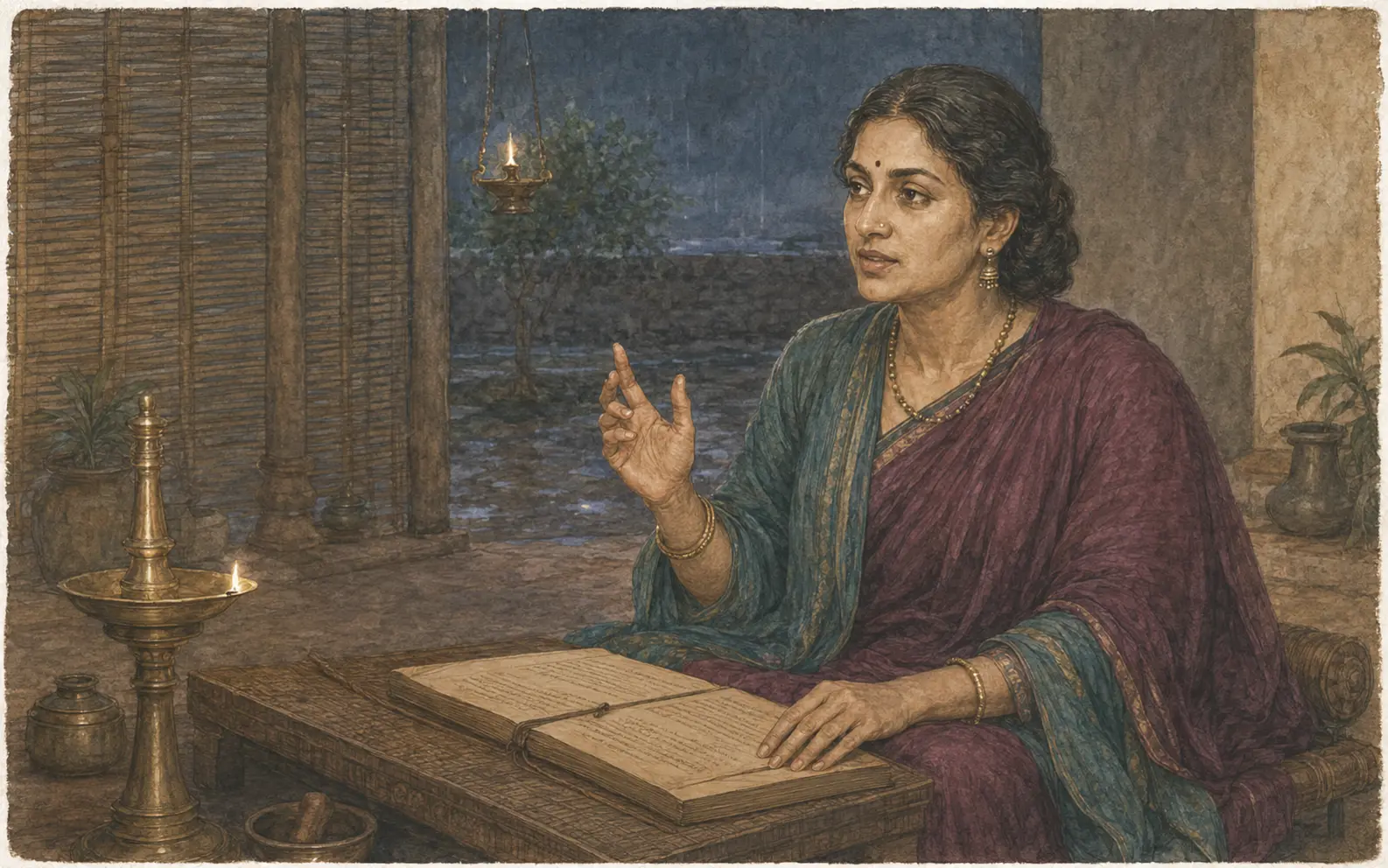
RISHIKA
लोपामुद्रा
Lopamudra
A woman seer whose hymns preserve an important voice in the Rigveda.
- Era
- Vedic period
- Known for
- Rishika · Self
WHY LOPAMUDRA MATTERS
A woman seer in a dialogue about the whole of life
Lopamudra enters Vedika through one of the most human voices in the Rigvedic archive: a dialogue hymn traditionally associated with her and Agastya, where desire, household life and sacred discipline meet without embarrassment.
LIFE & HISTORICAL RECORD
A woman seer in a dialogue about the whole of life
Rigveda 1.179 is traditionally associated with Lopamudra and Agastya. Its voice is striking because it does not treat spiritual life as an escape from the body, marriage or longing.
For Vedika, Lopamudra is important not because we can reconstruct every event of her life, but because the textual memory preserves a woman’s speech inside a sacred conversation.
What survives is voice, not chronology
Later traditions present Lopamudra as the wife of Agastya and surround her with narrative detail. The early textual basis is much narrower: a Rigvedic dialogue and a remembered seer-name.
What the record leaves open
That limitation tells us to honour the voice that survives without inventing a complete life story around it. Later biographies are reception, not settled history.
CORE TEACHINGS
Three threads to carry with you
Lopamudra’s preserved voice resists a false split between spiritual aspiration and human relationship. The hymn’s tension is precisely its value: austerity and intimacy both make claims on the seeker.
The teaching is not indulgence against discipline. It is wholeness against spiritual bypassing, a reminder that dharma must include embodied life.
Embodiment matters
The body is not treated as an accidental obstacle to sacred life.
A woman’s speech survives
The archive preserves feminine philosophical and poetic agency, though sparsely.
Household and tapas
The hymn asks how discipline and relational duty can be held together.
WORKS & PRACTICES
A Rigvedic dialogue hymn
No independent book can securely be attributed to Lopamudra. Her strongest textual presence is the dialogue hymn Rigveda 1.179. The best practice is close reading: notice speaker, setting, desire, restraint and what later retellings add. This protects her from being reduced either to romance or abstraction.
Rigveda 1.179
A dialogue hymn traditionally linked with Lopamudra and Agastya.
Reception history
Later accounts expand her life in relation to Agastya and household dharma.
Practice lens
Ask where spiritual language is being used to avoid ordinary human truth.
RELEVANCE TODAY
A corrective to flattened spirituality
Lopamudra is vital because she complicates easy categories. She is not merely “wife of a sage,” nor merely a symbol of female inclusion. She is a preserved voice in a sacred text. Her page invites readers to treat spiritual maturity as integration: body, duty, intimacy, longing and insight must be spoken about honestly.
SOURCES & FURTHER READING
Follow the record
Rigveda 1.179
Primary dialogue hymn associated with Lopamudra and Agastya.
Open primary text ↗Lopamudra overview
Reference overview for Vedic and later traditional material.
Open scholarly reference ↗Indian Philosophy overview
Context for ancient Indian philosophical traditions and textual interpretation.
Open scholarly reference ↗CONTINUE THE JOURNEY