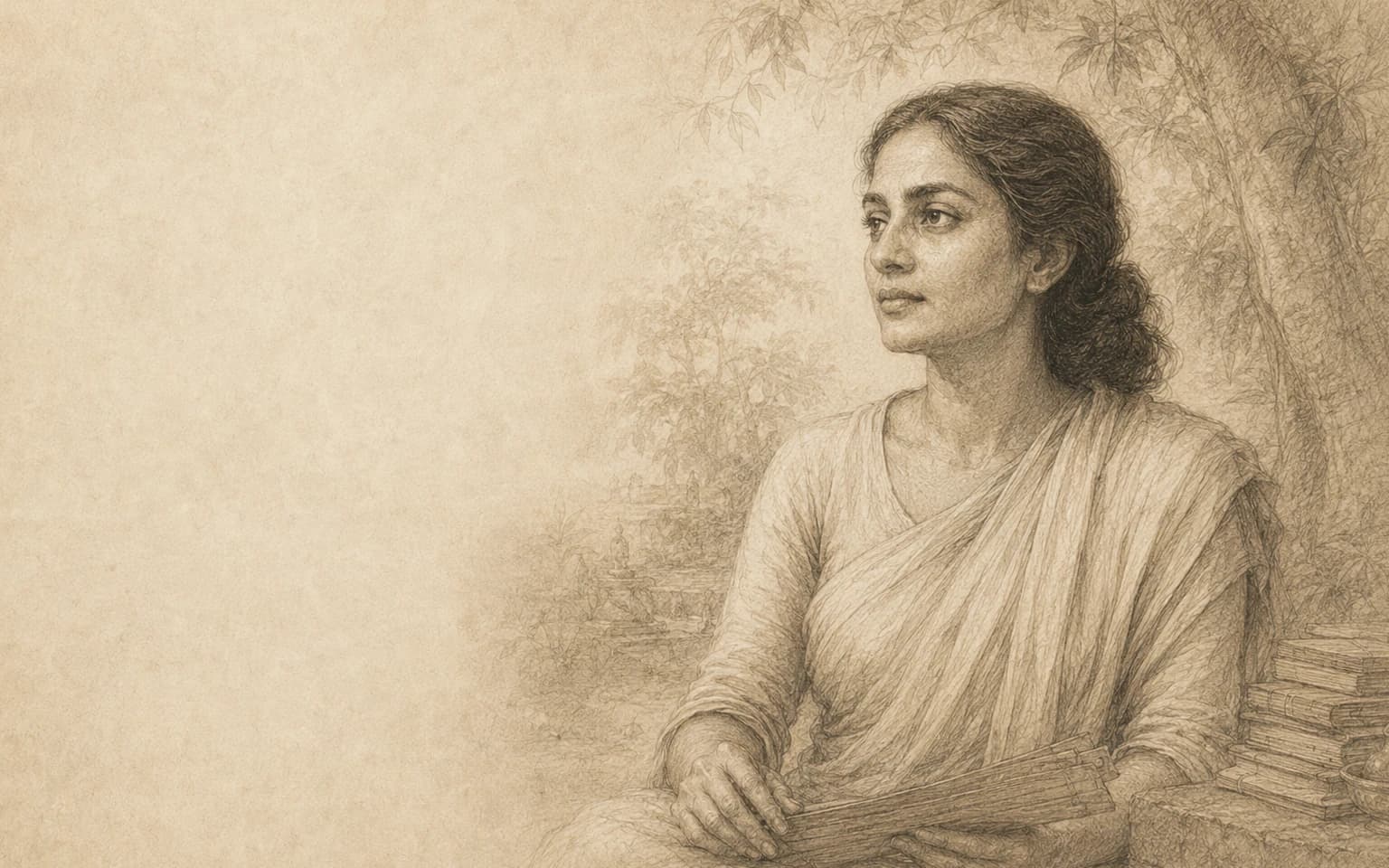
PHILOSOPHER-SAGE
गार्गी वाचक्नवी
Gargi
The fearless questioner who asked what lies beyond the fabric of existence.
- Era
- Upanishadic period
- Known for
- Philosopher-sage · Self
WHY GARGI MATTERS
A mind unwilling to stop at the surface
Gārgī enters the archive through a text, not through a later heroic biography. The Bṛhadāraṇyaka Upaniṣad remembers her asking questions in public that move from the structure of the cosmos to the ground on which every structure depends.
LIFE & HISTORICAL RECORD
A mind unwilling to stop at the surface
Gārgī Vācaknavī appears in the third chapter of the Bṛhadāraṇyaka Upaniṣad during a learned gathering convened by King Janaka. The text identifies her by name and patronymic, and gives her a speaking role among recognized teachers.
Her importance lies less in a recoverable personal chronology than in the quality of her inquiry. She asks what the world is “woven” upon, then follows each answer toward a more fundamental level. In her second exchange with Yājñavalkya, the questioning reaches ākāśa and then the imperishable, akṣara.
What the text says — and what it does not
The Upaniṣad calls her Vācaknavī, conventionally understood as “daughter or descendant of Vacaknu.” Beyond this textual identity and her participation in Janaka’s assembly, secure biographical details are scarce.
What the record leaves open
That scarcity matters. Later retellings often supply a full life, educational history, or social role, but the early source does not. Vedika therefore treats Gārgī’s presence in the dialogue as firm evidence while keeping dates, family narratives, and later honorific portraits explicitly provisional.
CORE TEACHINGS
Three threads to carry with you
Gārgī’s method is relational: if one level of reality is supported by another, what supports that? The image of warp and woof makes cosmology an inquiry into dependence. Her questions test whether an account of the world can stop at any object within the world.
Yājñavalkya’s answer turns to akṣara, the imperishable that is not another visible thing. The exchange does not hand the reader a slogan. It dramatizes disciplined inquiry at the boundary where ordinary description becomes inadequate.
Follow dependence
Do not mistake an intermediate explanation for the final ground of explanation.
Question in public
Philosophical authority is tested through reasoned exchange, not protected from it.
Respect the limit of language
The imperishable is approached through careful negation and discernment, not objectified.
WORKS & PRACTICES
A preserved dialogue, not an attributed book
No independent work can securely be attributed to Gārgī. Her surviving intellectual presence is the set of exchanges in Bṛhadāraṇyaka Upaniṣad 3.6 and 3.8. A faithful practice of her legacy is therefore close reading: track each question, distinguish the primary text from Śaṅkara’s later commentary, and notice where a translation adds explanatory language.
Primary passage
Bṛhadāraṇyaka Upaniṣad 3.6 — the first sequence of cosmological questions.
Primary passage
Bṛhadāraṇyaka Upaniṣad 3.8 — the two “arrows” of inquiry and the teaching on akṣara.
RELEVANCE TODAY
An archive of intellectual courage
Gārgī is frequently invoked as evidence of women’s participation in early Indian philosophical life. The source supports a strong but precise claim: it presents a named woman questioning a celebrated teacher in a formal assembly. Her enduring invitation is methodological. Ask the next question, separate evidence from admiration, and let intellectual courage include the courage to say exactly how much the record allows us to know.
SOURCES & FURTHER READING
Follow the record
Bṛhadāraṇyaka Upaniṣad with Śaṅkara Bhāṣya
Sanskrit, translation, and commentary; see chapters 3.6 and 3.8.
Open primary text ↗Yājñavalkya and Gārgī I
Bṛhadāraṇyaka Upaniṣad 3.6 with translation and commentary.
Open primary text ↗Yājñavalkya and Gārgī II
Bṛhadāraṇyaka Upaniṣad 3.8 with translation and commentary.
Open primary text ↗CONTINUE THE JOURNEY