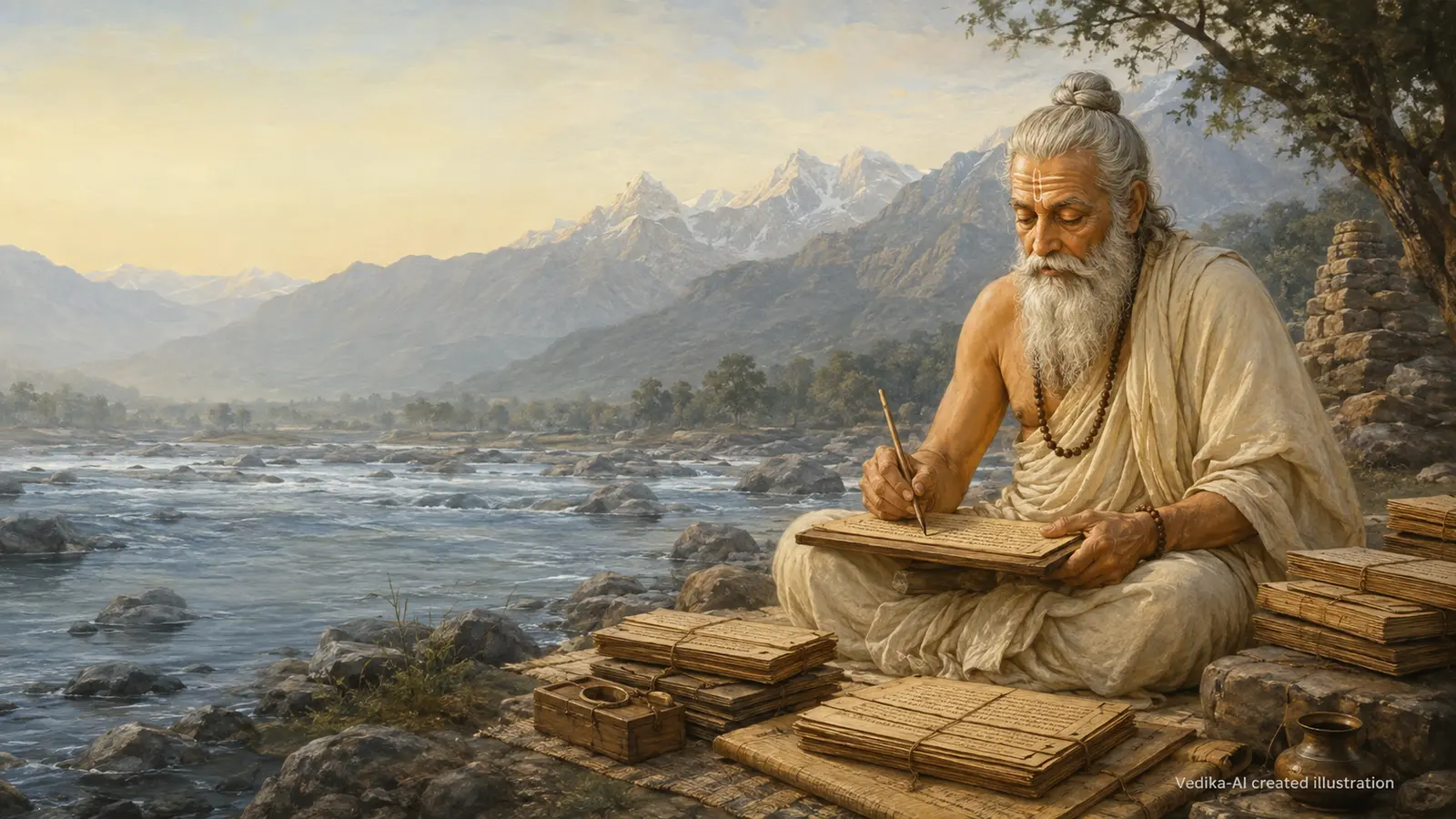
VEDANTA SUTRA AUTHOR
बादरायण
Badarayana
The traditional author of the Brahma Sutra, whose compact synthesis became the shared debating ground of Vedanta.
- Era
- Ancient · date debated
- Known for
- Vedanta sutra author · Self
WHY BADARAYANA MATTERS
A shared text for divergent Vedantas
Badarayana is the name traditionally attached to the Brahma Sutra, also called the Vedanta Sutra. The text organises questions raised by the Upanishads into a terse argumentative sequence and became the common foundation on which very different Vedanta schools built their commentaries.
LIFE & HISTORICAL RECORD
A shared text for divergent Vedantas
The Brahma Sutra does not read like a continuous modern book. Its brief aphorisms often require a commentary even to identify the opponent, question and intended conclusion.
That difficulty became historically creative. Shankara, Ramanuja, Madhva, Vallabha, Nimbarka and others read the same sutra corpus through distinct metaphysical and devotional commitments.
The author behind an uncertain chronology
Badarayana’s individual life is largely unknown. Tradition sometimes identifies him with Veda Vyasa, while scholarship does not treat that identity as historically settled.
What the record leaves open
The text itself likely reflects a period of synthesis and debate rather than a simple transcription of one teaching session. Vedika therefore centres the work and reception, not invented biographical detail.
CORE TEACHINGS
Three threads to carry with you
The sutras ask how apparently varied Upanishadic passages relate, what Brahman is, how the individual self and world depend on ultimate reality, and what knowledge or practice leads toward liberation.
Because the aphorisms are compressed, no single later commentary can be silently treated as “what Badarayana simply said.” The history of Vedanta is partly the history of arguing responsibly over this ambiguity.
Brahma jijnasa
The opening announces inquiry into Brahman as the text’s governing concern.
Common foundation
Rival Vedanta schools establish their positions by commenting on the same sutra corpus.
Practice cue
When certainty comes too quickly, identify which assumptions are doing the interpretive work.
WORKS & PRACTICES
One terse text, centuries of commentary
The Brahma Sutra is Badarayana’s defining attributed work. Its four chapters address reconciliation, non-contradiction, means and the fruit of knowledge, though details depend on commentary. The practical legacy is dialogical. A seeker learns not only conclusions but how traditions expose hidden premises, answer objections and remain accountable to a shared textual record.
Internet Encyclopedia of Philosophy: Hindu Philosophy
Scholarly overview used for Badarayana, the Brahma Sutra and the emergence of divergent Vedanta commentaries.
Vedanta Sutras with Shankara commentary
Public-domain translation used as a primary textual witness while explicitly recognising its Advaita commentary layer.
RELEVANCE TODAY
Why he matters now
Badarayana matters because unity need not mean uniformity. A common canon can sustain profound disagreement while preserving a recognisable field of conversation. For Vedika, his page connects the Upanishads to the acharyas already in the archive and shows that philosophical traditions grow through interpretation, not merely repetition.
SOURCES & FURTHER READING
Follow the record
Internet Encyclopedia of Philosophy: Hindu Philosophy
Scholarly overview used for Badarayana, the Brahma Sutra and the emergence of divergent Vedanta commentaries.
Open scholarly reference ↗Vedanta Sutras with Shankara commentary
Public-domain translation used as a primary textual witness while explicitly recognising its Advaita commentary layer.
Open primary text ↗CONTINUE THE JOURNEY