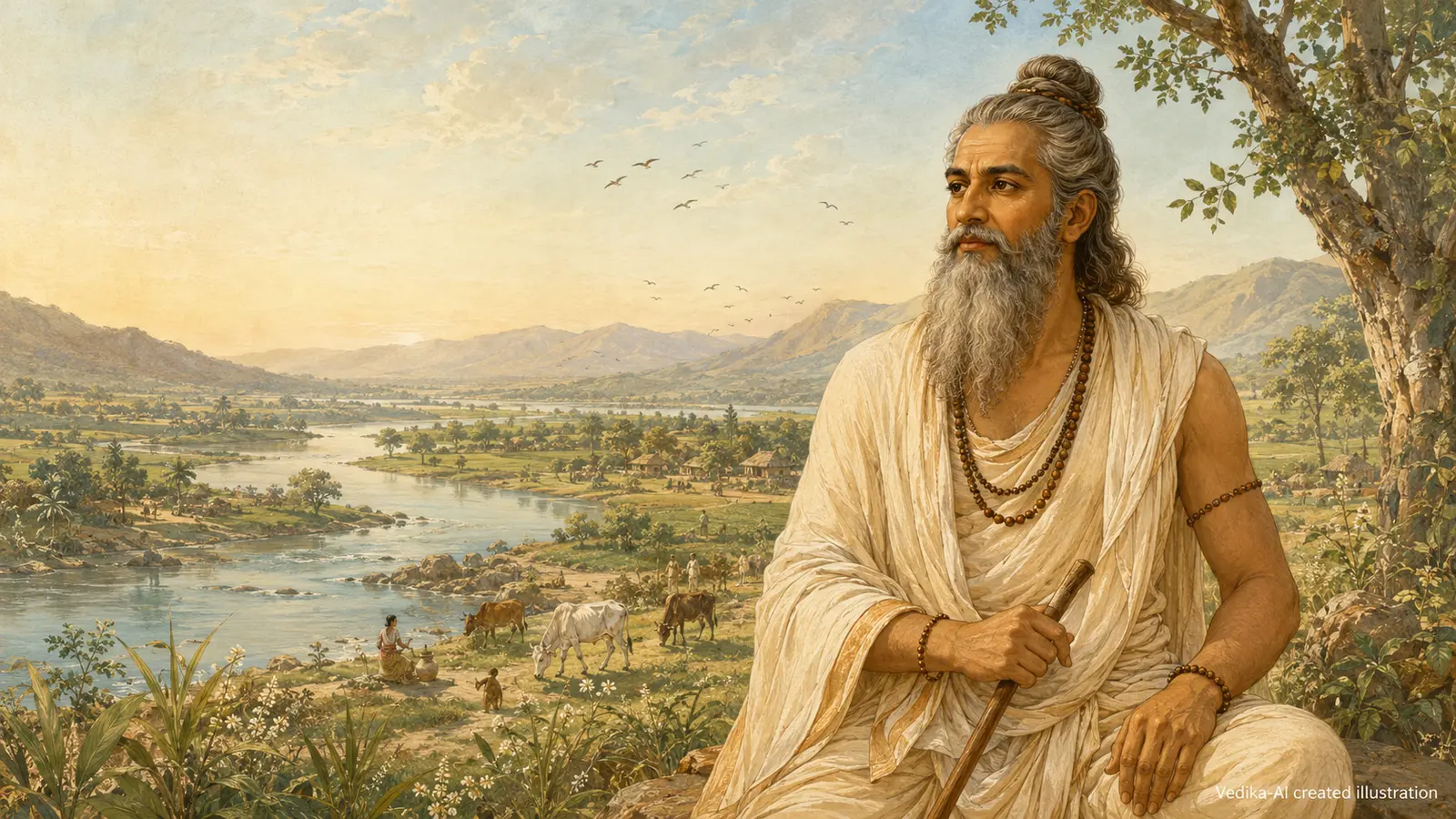
VEDIC SEER & ANCESTRAL SAGE
कश्यप
Kashyapa
An ancient seer-name that grew into a vast ancestral figure connecting Vedic hymn, genealogy and the diversity of life.
- Era
- Vedic antiquity · date unknown
- Known for
- Vedic seer & ancestral sage · Dharma
WHY KASHYAPA MATTERS
An ancestral imagination of living diversity
Kashyapa is among the most expansive names in Indian sacred genealogy. A Kashyapa is associated with Vedic material, while epic and Puranic traditions remember the sage as progenitor through several wives of gods, humans, animals, birds and other beings. The breadth of that memory is symbolically powerful but historically layered.
LIFE & HISTORICAL RECORD
An ancestral imagination of living diversity
Kashyapa’s later genealogies gather many forms of life into one extended sacred household. Rather than offering biological history, they map relationships among divine, human, animal and cosmic communities.
This makes Kashyapa less a recoverable individual than an ancestral principle: life is plural, kinship is wider than human society and conflict often occurs within one interconnected creation.
A name carried through many textual worlds
Vedic texts contain the Kashyapa name and lineage, but do not provide the enormous family biography familiar from later Puranas. Epic and Puranic authors developed different lists of wives, children and episodes.
What the record leaves open
Because the genealogies vary, Vedika does not harmonise them into a false single chart. Their religious function is more important than exact consistency: they place the diversity of beings inside sacred ancestry.
CORE TEACHINGS
Three threads to carry with you
Kashyapa’s strongest teaching is carried by genealogy rather than aphorism. Beings who appear opposed—devas and asuras, serpents and birds—can be remembered as relatives within a larger order.
That vision does not erase conflict, but it challenges absolute othering. Difference exists inside relationship, and power carries responsibility toward the whole field of life.
Ancestral sage
Puranic genealogies use Kashyapa to connect many classes of beings within one sacred family.
Layered identity
The Vedic name and later progenitor traditions should be related carefully, not treated as one documented biography.
Practice cue
Widen one decision today to include the human and non-human lives affected by it.
WORKS & PRACTICES
Genealogy as sacred reflection
Texts attributed to Kashyapa exist in fields including ritual, law and medicine, but the name functioned across long periods and schools. Common authorship should not be assumed. A fruitful practice is to read the genealogies ethically: not “who belongs above whom?” but “what obligations follow when apparent strangers are remembered as kin?”
Mahabharata, Adi Parva genealogy
Primary epic source used for the development of Kashyapa as an ancestral figure within sacred genealogies.
Encyclopaedia Britannica: Kashyapa
Reference overview used to distinguish the Vedic sage-name from later Puranic progenitor traditions.
RELEVANCE TODAY
Why he matters now
Kashyapa matters amid ecological fragmentation and social polarisation. His sacred family is not a modern environmental theory, yet it offers a deep cultural language for interdependence. Vedika presents him as a bridge between Vedic lineage and Puranic imagination—an archive of how India thought with ancestry to understand a many-species world.
SOURCES & FURTHER READING
Follow the record
Mahabharata, Adi Parva genealogy
Primary epic source used for the development of Kashyapa as an ancestral figure within sacred genealogies.
Open primary text ↗Encyclopaedia Britannica: Kashyapa
Reference overview used to distinguish the Vedic sage-name from later Puranic progenitor traditions.
Open scholarly reference ↗CONTINUE THE JOURNEY