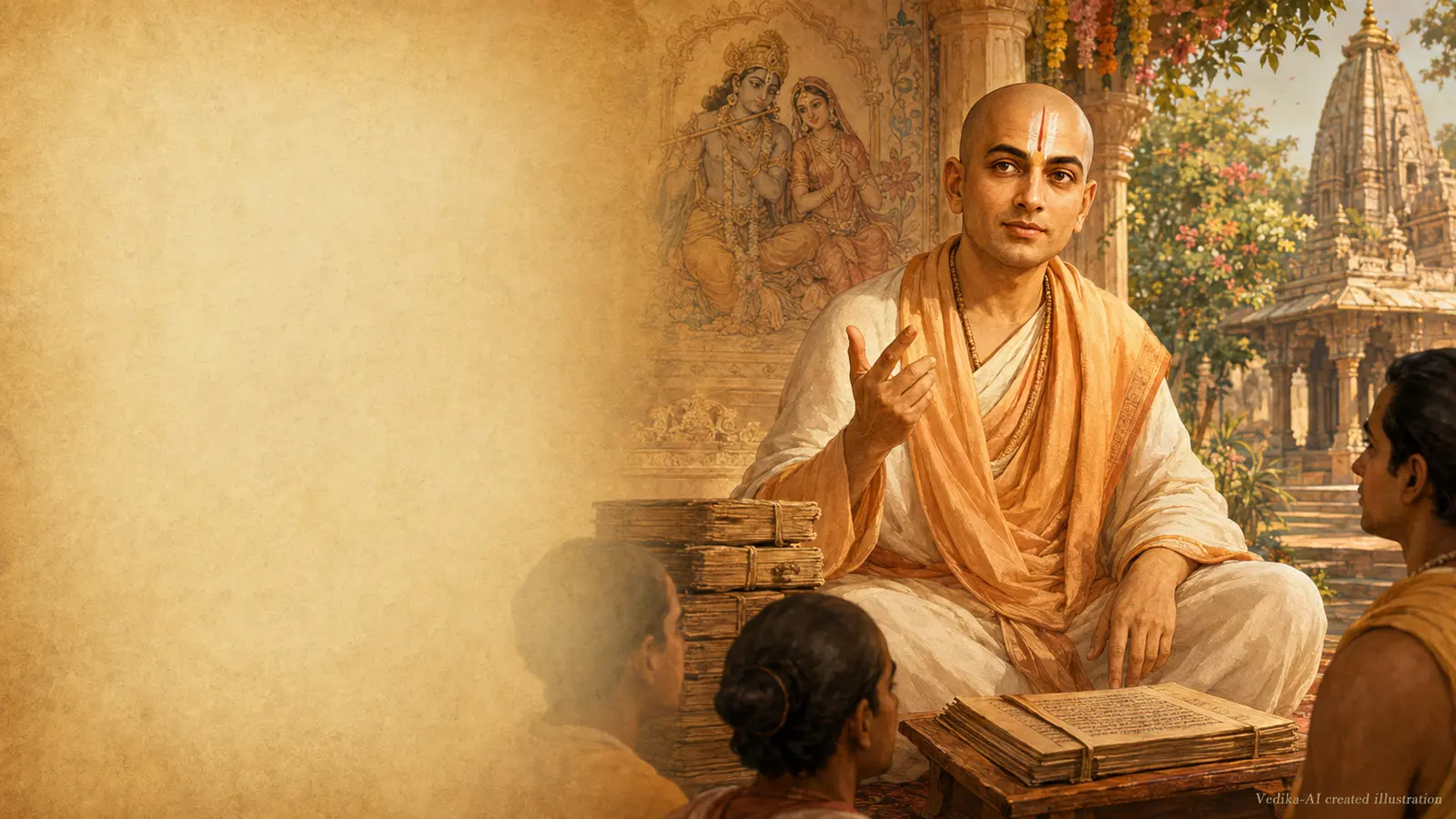
VEDANTA ACHARYA
निम्बार्क
Nimbarka
The Vedanta teacher associated with difference-and-non-difference and a devotional lineage centred on Radha and Krishna.
- Era
- Medieval · date debated
- Known for
- Vedanta acharya · Devotion
WHY NIMBARKA MATTERS
Difference held inside dependence
Nimbarka is the acharya associated with the Vedanta school commonly called Dvaitadvaita, “dualistic non-dualism” or difference-and-non-difference. His historical date is disputed, while the lineage that bears his name developed a rich Radha-Krishna devotional life.
LIFE & HISTORICAL RECORD
Difference held inside dependence
Nimbarka’s Vedanta affirms Brahman, individual selves and the world as real. Souls and matter are distinct from the Divine, yet entirely dependent and inseparable from Brahman as their ground.
The relation is therefore neither absolute identity nor complete separation. Later teachers explain it through images such as sun and rays, where distinction and belonging are both true.
A lineage with contested chronology
Traditional accounts give Nimbarka an ancient sacred pedigree and tell of a decisive episode beneath a neem tree. Modern scholarship generally places the historical teacher in the medieval period, but proposed dates vary considerably.
What the record leaves open
Vedika does not choose a falsely exact birth year. The more secure record lies in texts attributed to Nimbarka, later commentaries and the institutional memory of the Nimbarka Sampradaya.
CORE TEACHINGS
Three threads to carry with you
Nimbarka’s framework protects the reality of devotion. If lover, beloved and relationship were merely provisional illusion, bhakti would lose its enduring theological place.
At the same time, dependence on Brahman means no being possesses a self-sufficient existence. Liberation unfolds through knowledge, surrender and grace rather than isolation from the Divine.
Dvaitadvaita
Difference and non-difference describe the real but dependent relation of souls and world to Brahman.
Radha-Krishna bhakti
The later lineage gives central devotional expression to Radha and Krishna together.
Practice cue
Hold one relationship today as both real in its difference and dependent on a larger shared life.
WORKS & PRACTICES
Vedanta Parijata Saurabha and lineage practice
The Vedanta Parijata Saurabha, a concise Brahma Sutra commentary, is the principal work attributed to Nimbarka. Other short texts are also transmitted under his name, with varying questions of attribution. Lineage practice combines mantra, devotion, temple worship and theological study. The mature Radha-Krishna emphasis should be presented as a living development, not silently projected into every early textual layer.
Encyclopaedia Britannica: Nimbarka
Reference overview used for Nimbarka’s Vedanta, difference-and-non-difference and the chronology problem.
Internet Encyclopedia of Philosophy: Hindu Philosophy
Scholarly overview used to situate Nimbarka among Vedanta commentarial schools and their common Brahma Sutra ground.
RELEVANCE TODAY
Why he matters now
Nimbarka matters because he offers a relational metaphysics: dependence need not erase individuality, and difference need not mean alienation. His page also fills a major Vedanta gap between the best-known schools. India’s philosophical archive is not exhausted by Advaita, Vishishtadvaita and Dvaita alone.
SOURCES & FURTHER READING
Follow the record
Encyclopaedia Britannica: Nimbarka
Reference overview used for Nimbarka’s Vedanta, difference-and-non-difference and the chronology problem.
Open scholarly reference ↗Internet Encyclopedia of Philosophy: Hindu Philosophy
Scholarly overview used to situate Nimbarka among Vedanta commentarial schools and their common Brahma Sutra ground.
Open scholarly reference ↗CONTINUE THE JOURNEY