UPANISHADIC SEEKER & TEACHER
सत्यकाम जाबाल
Satyakama Jabala
The seeker whose uncompromising truthfulness becomes the doorway to education and knowledge of Brahman.
- Era
- Upanishadic period · date unknown
- Known for
- Upanishadic seeker & teacher · Self
WHY SATYAKAMA JABALA MATTERS
Truth before status
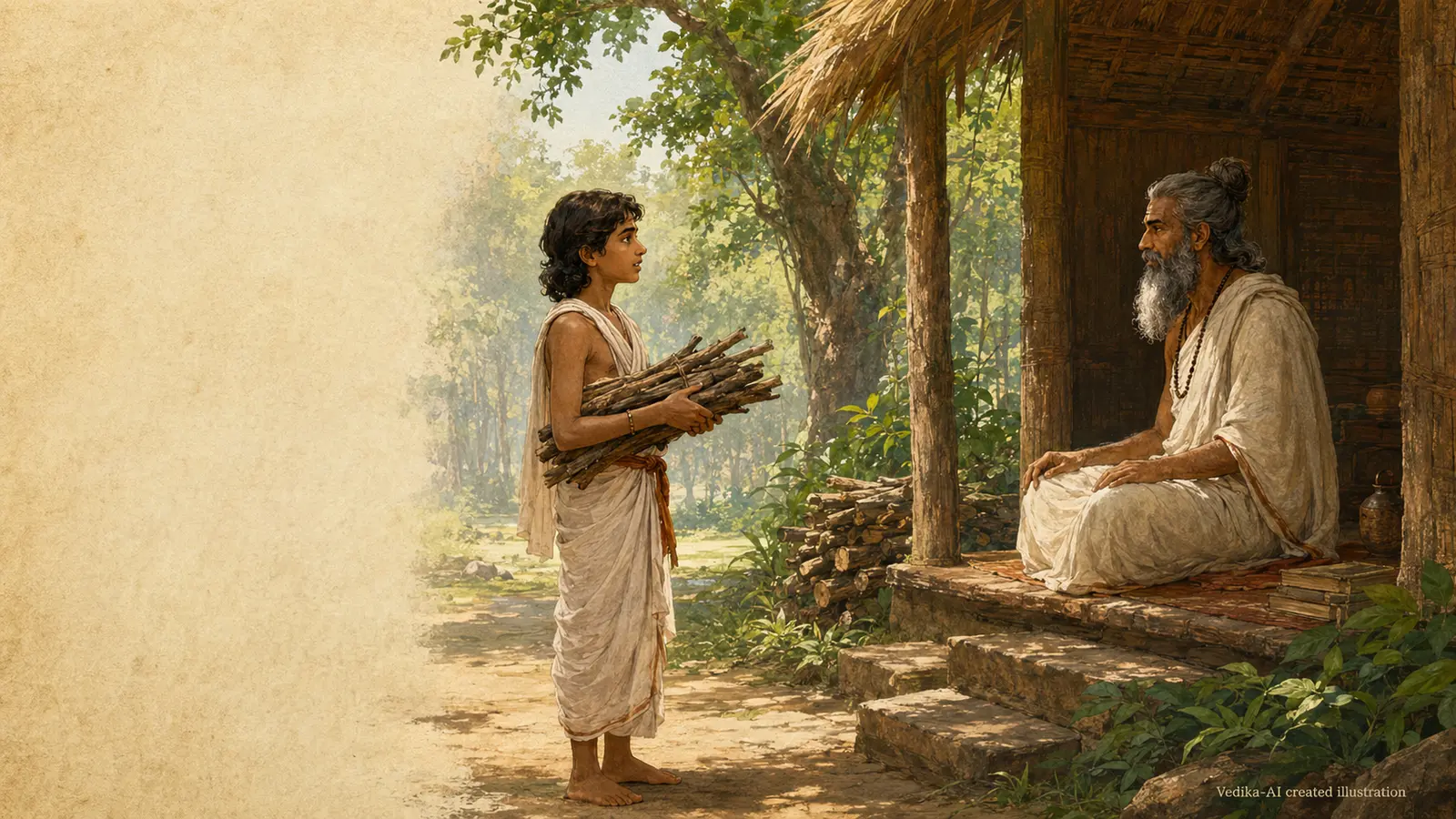
Satyakama Jabala enters the Chandogya Upanishad through an act of truth. Unable to name his paternal lineage, he repeats exactly what his mother Jabala told him. Gautama accepts him as a student because he has not departed from truth, and the narrative then unfolds as an education received from teacher, labour, solitude and the living world.
LIFE & HISTORICAL RECORD
Truth before status
Satyakama’s story begins with vulnerability. He wants to study, yet cannot provide the lineage answer expected of a student. Neither he nor his mother invents one.
Gautama’s response makes truthfulness the decisive qualification. The passage has generated many later debates about social identity, but its immediate ethical force is clear: access to knowledge begins with refusing falsehood.
Learning among cattle, fire and open sky
After initiation, Satyakama is sent away with four hundred weak cattle and resolves not to return until they number a thousand. During the long solitude, a bull, fire, a swan and a water bird become voices through which dimensions of Brahman are taught.
What the record leaves open
When he returns, Gautama completes the teaching. The story does not oppose nature and guru; it portrays ripeness developing through responsibility, endurance, attention and formal instruction together.
CORE TEACHINGS
Three threads to carry with you
Satyakama’s truth is not merely accurate speech. His name itself joins satya, truth, with kama, desire: the longing for truth must govern the way one presents oneself.
The teachings he receives are partial facets, not a quick secret. Space, light, life and direction gradually enlarge his understanding before the teacher integrates it.
Truthfulness
He gains entry to study by stating an uncertain social origin without shame or invention.
Learning through care
Years of tending vulnerable cattle form part of the discipline, not a delay before real teaching.
Practice cue
State one uncomfortable truth plainly, without adding a story to protect your image.
WORKS & PRACTICES
A narrative, not an authored treatise
Satyakama is a character and teacher within the Chandogya Upanishad rather than the named author of an extant book. Later in the Upanishad, he appears as a teacher to Upakosala, showing that received knowledge becomes responsibility for another learner. Practice here means aligning speech, work and readiness. Intellectual brilliance without truthfulness would violate the very doorway through which Satyakama enters the tradition.
Chandogya Upanishad 4.4–4.9
Primary-text translation used for Jabala’s answer, Gautama’s acceptance and Satyakama’s progressive instruction.
Internet Encyclopedia of Philosophy: Upanishads
Scholarly overview used for the literary and philosophical setting of early Upanishadic teaching narratives.
RELEVANCE TODAY
Why he matters now
Satyakama matters wherever credentials, family background or confidence threaten to become substitutes for integrity. The story does not erase historical social realities, but it refuses to make inherited certainty more sacred than truth. For education, it offers a humane model: recognise character, let responsibility ripen the student and complete experience with careful teaching.
SOURCES & FURTHER READING
Follow the record
Chandogya Upanishad 4.4–4.9
Primary-text translation used for Jabala’s answer, Gautama’s acceptance and Satyakama’s progressive instruction.
Open primary text ↗Internet Encyclopedia of Philosophy: Upanishads
Scholarly overview used for the literary and philosophical setting of early Upanishadic teaching narratives.
Open scholarly reference ↗CONTINUE THE JOURNEY