UPANISHADIC TEACHER
उद्दालक आरुणि
Uddalaka Aruni
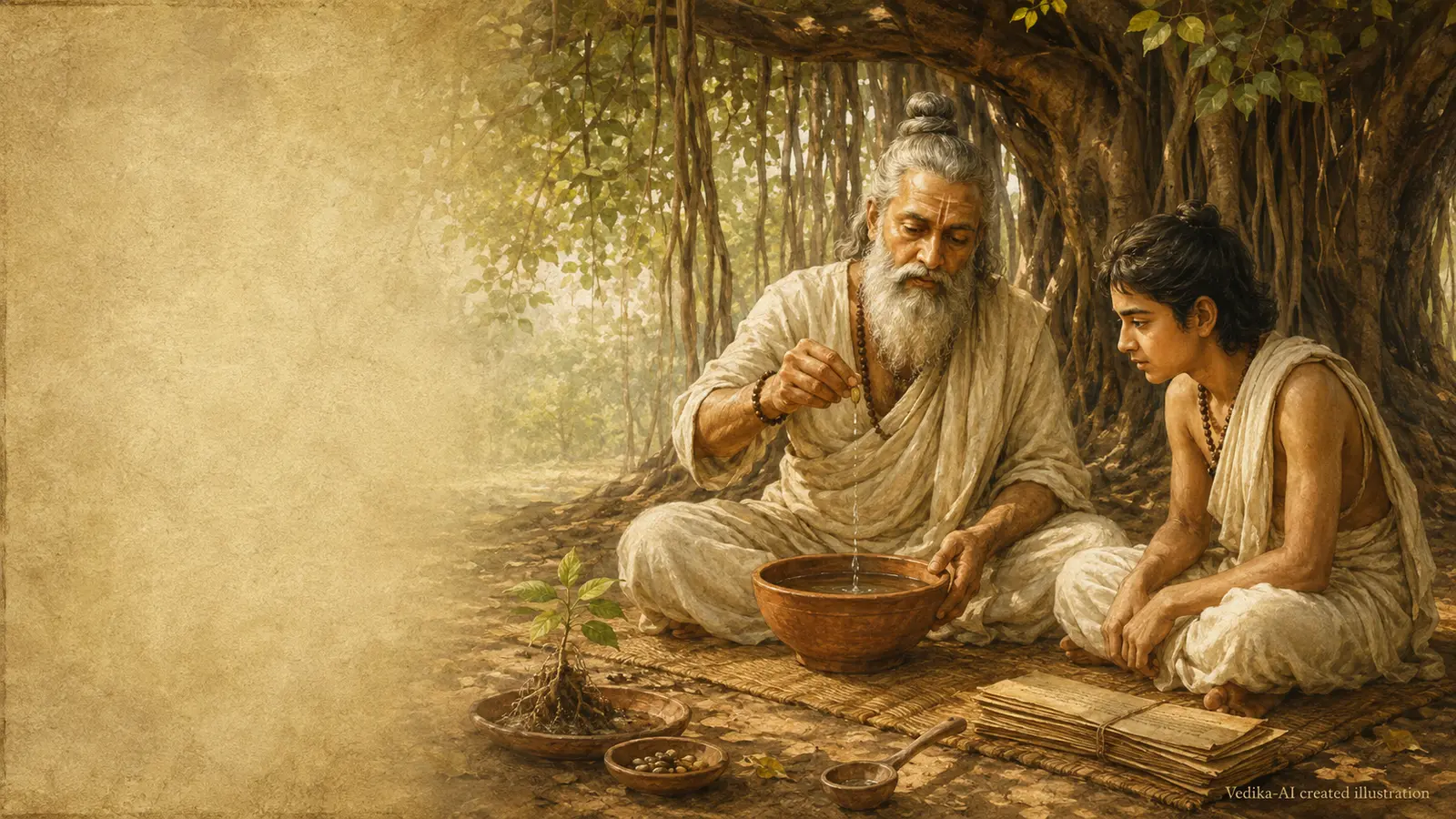
The Upanishadic teacher who used seeds, salt and clay to guide inquiry from visible forms toward underlying reality.
- Era
- c. 8th–7th century BCE
- Known for
- Upanishadic teacher · Self
WHY UDDALAKA ARUNI MATTERS
Teaching through things close at hand
Uddalaka Aruni is one of the earliest named philosophical teachers in the Upanishads. In the Chandogya, his dialogue with Svetaketu moves through ordinary objects—clay, gold, a seed and salt dissolved in water—to ask what remains true beneath changing names and forms.
LIFE & HISTORICAL RECORD
Teaching through things close at hand
Uddalaka does not begin with abstraction. He asks Svetaketu to examine objects and processes until thought becomes capable of seeing unity without denying difference.
The repeated statement tat tvam asi, “that you are,” appears within this pedagogical sequence. Its force comes from the whole inquiry, not from treating one phrase as a detached slogan.
A teacher inside early philosophical networks
Aruni and Uddalaka appear in more than one Vedic and Upanishadic context, and the precise relation among names and stories is not always simple. The Chandogya presents Uddalaka as Svetaketu’s father and teacher; the Brihadaranyaka places him within wider debates and transmissions.
What the record leaves open
These texts show intellectual networks rather than a continuous personal biography. What survives most vividly is his teaching method: question, demonstration, correction and patient repetition.
CORE TEACHINGS
Three threads to carry with you
Clay objects differ in name and use, yet are known through clay; salt disappears in water, yet remains present in every taste; the great banyan arises from a seed whose inner essence cannot be seen. Each example trains attention toward what supports appearance.
The teaching does not make the world worthless. It asks the student to recognise that visible distinction is not the final account of reality or self.
Tat tvam asi
The repeated teaching identifies the student with the subtle reality underlying all beings.
Concrete inquiry
Clay, seed and salt turn metaphysics into experiments the learner can inspect.
Practice cue
Take one familiar object and ask what conditions, materials and relations make its apparent separateness possible.
WORKS & PRACTICES
Dialogues rather than a personal book
No extant treatise can be securely identified as Uddalaka’s authored work. His legacy is embedded in teaching dialogues preserved by Upanishadic redactors. The practical method is unusually modern in spirit: do not demand belief before observation. Let a question mature through examples, then test whether the insight changes how self and world are understood.
Chandogya Upanishad, chapter 6
Primary-text translation used for Uddalaka’s demonstrations, Svetaketu dialogue and repeated tat tvam asi teaching.
Internet Encyclopedia of Philosophy: Upanishads
Scholarly overview used for early Upanishadic method, genre and philosophical setting.
RELEVANCE TODAY
Why he matters now
Uddalaka matters for anyone trying to teach difficult ideas without flattening them. He shows that depth can be approached through precise, ordinary experience. His dialogue also guards against borrowed confidence. Svetaketu returns educated but proud; genuine knowledge begins when information is exposed as incomplete.
SOURCES & FURTHER READING
Follow the record
Chandogya Upanishad, chapter 6
Primary-text translation used for Uddalaka’s demonstrations, Svetaketu dialogue and repeated tat tvam asi teaching.
Open primary text ↗Internet Encyclopedia of Philosophy: Upanishads
Scholarly overview used for early Upanishadic method, genre and philosophical setting.
Open scholarly reference ↗CONTINUE THE JOURNEY