Ayodhyā
Ayodhyā
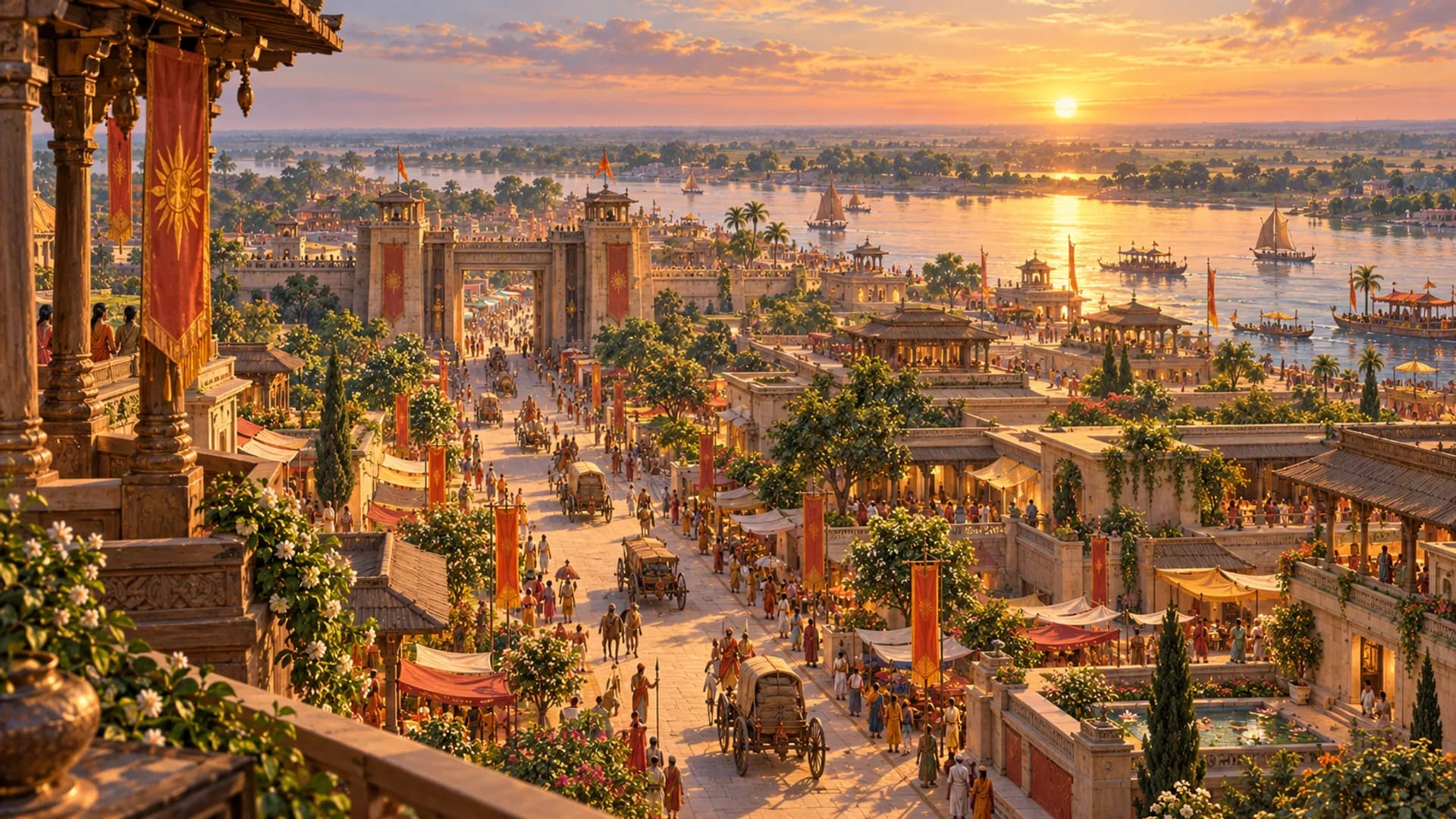
Ayodhyā is the capital of the Ikṣvāku kings of Kosala, on the Sarayū. Vālmīki says Manu built it, and describes a long, orderly city with watered royal highways, gateways, a broad wall and deep moats. Rāma is born here, leaves it for exile with its citizens running after his chariot, and comes back fourteen years later as king.
Bāla Kāṇḍa sarga 5Vālmīki (primary text)In the text
Why it matters
Rāma leaves Ayodhyā as heir, and Vālmīki shows what the city is without him: a joyless place at dawn, then a silent one when Bharata returns from Kekaya. The return in the Yuddha Kāṇḍa closes that absence. Rāma enters the city and is consecrated by Vasiṣṭha.
What Vālmīki describes
Vālmīki says Manu built Ayodhyā, in the country of Kosala on the Sarayū (Bāla Kāṇḍa sarga 5). He gives its size as twelve yojanas long and three wide. The royal highways are sprinkled with water and strewn with flowers. The city has gateways and archways, a broad wall and deep moats that are hard to cross.
In the next sarga he describes the citizens as virtuous, truthful, learned and content, with no thieves and no one without means (Bāla Kāṇḍa sarga 6). This is Vālmīki's idealised portrait of a well-governed capital, not a record of any surviving city. Daśaratha rules with eight ministers, among them Sumantra, and with the priest Vasiṣṭha (Bāla Kāṇḍa sarga 7).
Key moments
- Rāma is born to Kausalyā on the ninth day of Caitra; Bharata, Lakṣmaṇa and Śatrughna are born to Kaikeyī and Sumitrā (Bāla 18).
- The citizens follow Rāma's chariot and camp by the Tamasā; while they sleep, Rāma, Sītā, Lakṣmaṇa and Sumantra drive on before dawn, and Sumantra doubles back to blur the tracks (Ayodhyā 45–46).
- At dawn the citizens follow the wheel tracks until they vanish, then return to a joyless city, like a moonless sky (Ayodhyā 47).
- Bharata returns from Kekaya to a silent city: houses unswept, shrines deserted, people in tears (Ayodhyā Kāṇḍa).
- Bharata meets Rāma at Nandigrāma and returns the kingdom with the sandals; Rāma enters Ayodhyā and is consecrated by Vasiṣṭha (Yuddha 127–128).
Primary text: Śrīmad Vālmīkīya Rāmāyaṇa, Gita Press, Gorakhpur. Later traditions and living-tradition associations are labelled as such. Return to the Rāmāyaṇa World.