Sages
Mithilā
Mithilā is the city of Janaka, king of Videha. Viśvāmitra brings the young Rāma and Lakṣmaṇa here for Janaka's sacrifice and to see Śiva's bow. Janaka has set valour as the price of his daughter Sītā's hand, and no king has been able to lift the bow. Rāma strings it, and it breaks as he draws it. Four weddings follow.
Bāla Kāṇḍa sargas 66–67Vālmīki (primary text)In the text
Why it matters
Mithilā is where Rāma meets Sītā and where two royal houses are joined. Vālmīki says Janaka found Sītā in a furrow, raised her as his daughter, and made the bow the test of her suitor. When it breaks, Janaka sends ministers to Ayodhyā for Daśaratha.
What Vālmīki describes
Vālmīki places the deserted hermitage of Gautama and Ahalyā at the edge of Mithilā (Bāla Kāṇḍa sarga 48). Ahalyā, the text says, was not turned to stone. Gautama cursed her to live unseen in penance, eating only air, until Rāma came. When the princes enter and touch her feet she is released and welcomes them, and Gautama returns (Bāla Kāṇḍa sarga 49).
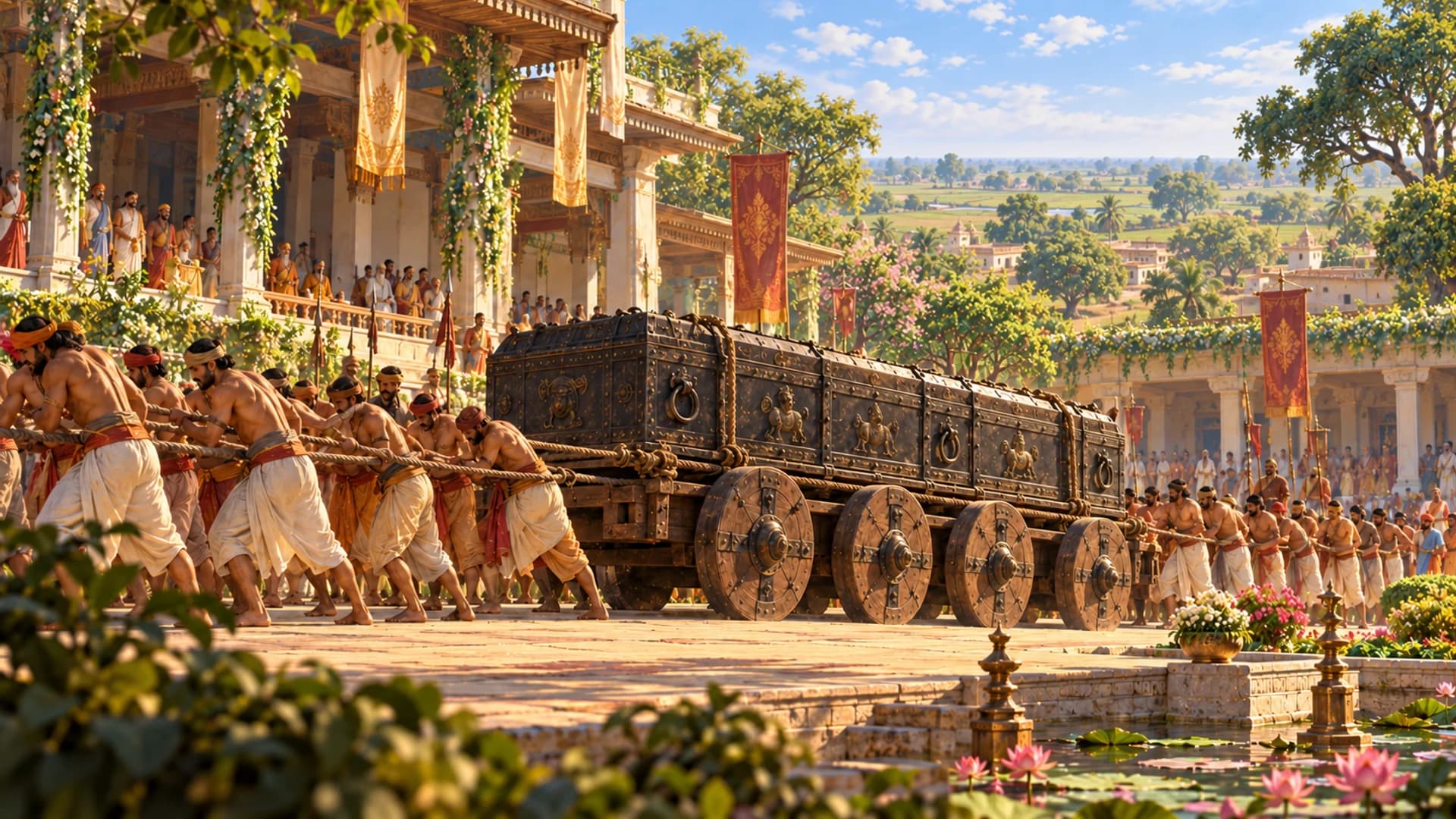
In the city, Janaka welcomes Viśvāmitra with his priest Śatānanda, Ahalyā's son (Bāla Kāṇḍa sargas 50–51). Janaka tells how the bow came to his ancestor Devarāta from the gods, after Śiva used it at Dakṣa's sacrifice, and how he found Sītā while ploughing the sacrificial field (Bāla Kāṇḍa sarga 66). Five thousand tall men haul in the great iron chest that holds the bow (Bāla Kāṇḍa sarga 67).
Key moments
- Viśvāmitra brings the princes to Mithilā for Janaka's sacrifice and to see Śiva's bow (Bāla 31, 50).
- The princes enter Gautama's deserted hermitage, touch Ahalyā's feet, and release her from her curse (Bāla 49).
- At Viśvāmitra's word Rāma opens the chest, takes the bow at its middle and strings it; it breaks as he draws it, with a thunder-like crash, and the crowd falls (Bāla 67).
- Janaka offers Sītā to Rāma and sends ministers to Ayodhyā to bring Daśaratha (Bāla 67).
- Four weddings are held: Rāma and Sītā, Lakṣmaṇa and Ūrmilā, Bharata and Māṇḍavī, Śatrughna and Śrutakīrti (Bāla 73).
Primary text: Śrīmad Vālmīkīya Rāmāyaṇa, Gita Press, Gorakhpur. Later traditions and living-tradition associations are labelled as such. Return to the Rāmāyaṇa World.