Vānaras
Kiṣkindhā
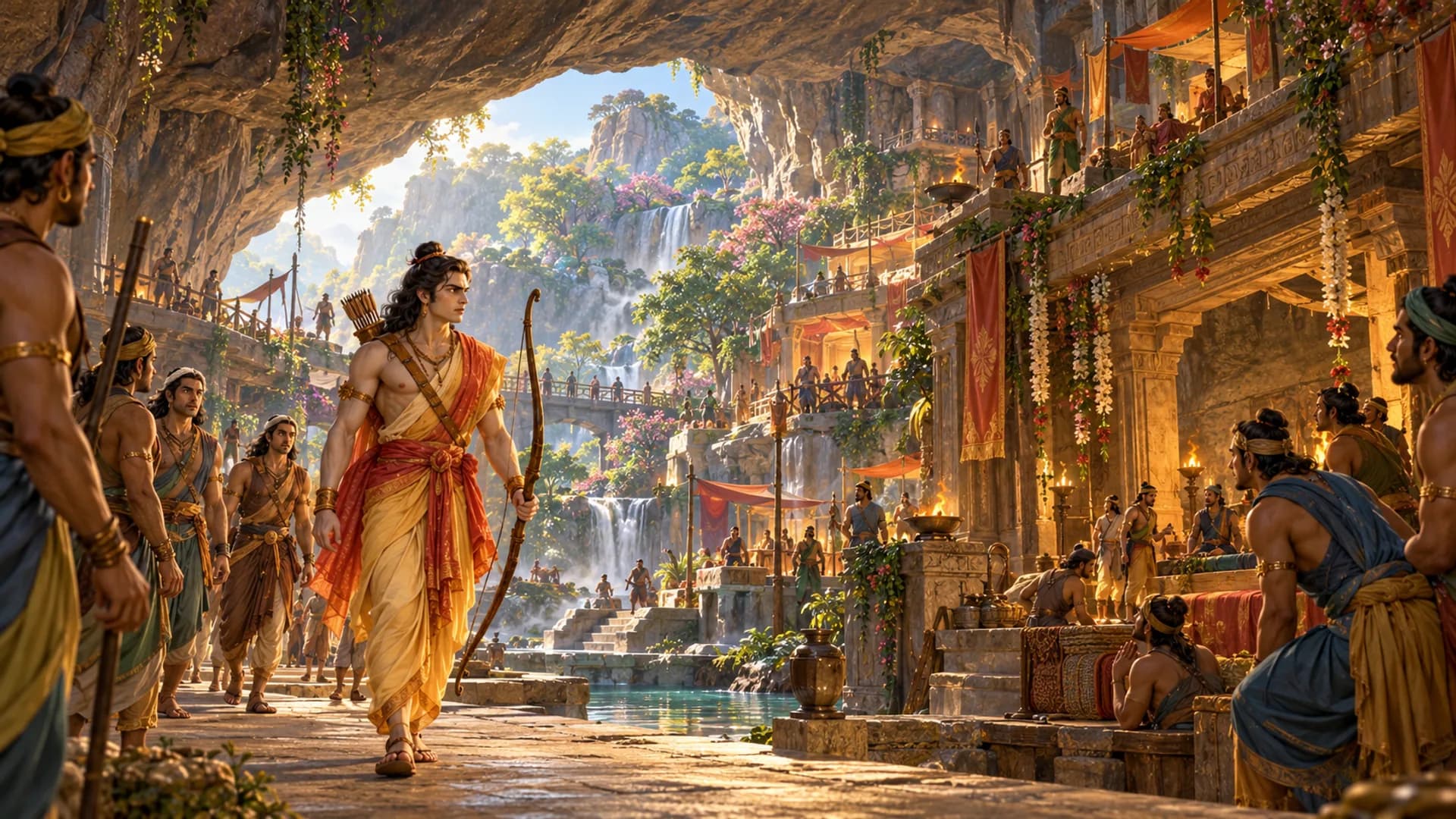
Kiṣkindhā is the vānara capital, a vast cave city adorned with jewels. Vālmīki describes gem-set, multi-storeyed mansions along its streets and orchards that flower and fruit in every season. Rāma comes to this country grieving for Sītā, wins Sugrīva the throne, and waits out the rains nearby. From the city the search for Sītā goes out to the east, south, west and north.
Kiṣkindhā Kāṇḍa sarga 33Vālmīki (primary text)In the text
Why it matters
Rāma has no army of his own. His alliance with Sugrīva, sworn before a fire, turns into a search that reaches every quarter, and only the southern party finds the lead, through Sampāti. The city also holds the alliance's crisis: Sugrīva, absorbed in pleasure, lets Rāma's deadline pass.
What Vālmīki describes
Vālmīki describes Kiṣkindhā as a vast cave adorned with jewels (Kiṣkindhā Kāṇḍa sarga 33). It has flowering orchards, trees that fruit in every season, and multi-storeyed mansions set with gems along the streets. As Lakṣmaṇa enters he passes the mansions of Aṅgada and other chiefs, armed vānaras at the gateways, and seven courtyards leading to the inner chambers.
Lakṣmaṇa has come in anger because Sugrīva let the deadline lapse. He hears music within, and in his anger twangs his bowstring. Sugrīva sends Tārā, who concedes the lapse, asks Lakṣmaṇa to bear Sugrīva's fault, and invites him in. The rebuke is softened and Sugrīva apologises (Kiṣkindhā Kāṇḍa sargas 33–36).
Key moments
- Rāma, grieving at Pampā, comes to Ṛṣyamūka, where Hanumān, sent by Sugrīva, meets him; Rāma and Sugrīva swear friendship before a fire (Kiṣkindhā 1–3, 5).
- Rāma shoots Vāli from concealment; Vāli questions the act, and Rāma answers on dharma (Kiṣkindhā 16–18).
- After Vāli's funeral Sugrīva is consecrated and Aṅgada is made crown prince (Kiṣkindhā 25–26).
- Sugrīva lets the deadline lapse; Hanumān warns him, and Rāma sends Lakṣmaṇa in anger (Kiṣkindhā 29–31).
- Parties are sent east, south, west and north and Rāma gives Hanumān his ring; only the southern party finds the lead, through Sampāti (Kiṣkindhā 37, 40–44, 47, 56–58).
Primary text: Śrīmad Vālmīkīya Rāmāyaṇa, Gita Press, Gorakhpur. Later traditions and living-tradition associations are labelled as such. Return to the Rāmāyaṇa World.